
Mobile Hot Tubs on Trailers: UK Towing and Operating Guide
A mobile hot tub is not simply a small tub placed on a trailer. The road unit, load distribution, towing vehicle, setup surface, water supply, drainage, heater and operating routine must work as one documented system. A tub that is convenient at one venue can be unsafe or impractical at the next.
This guide is for private owners, event operators, rentals, glamping sites and tourism businesses. It explains dry transport, plated weights, towing checks, pitch setup, wood heating, water hygiene, guest handover, insurance and whole-life cost without giving one-size-fits-all legal or operating claims.
Transport rule: move the hot tub empty unless the approved trailer documentation explicitly establishes another safe condition. Water is heavy, moves dynamically and can exceed the permitted mass or destabilise the combination.
Mobile hot tub versus portable hot tub
A portable hot tub may be movable with lifting equipment but is usually installed at one site. A mobile hot tub is integrated with, secured to or specifically transported on a trailer for repeated movement. That difference adds road legality, towing, load, stabilisation and frequent setup duties.
Ask whether the sale includes the complete road trailer or only a tub intended to be mounted by another party. Identify who is responsible for trailer approval, coupling, brakes, lights, tyres, securing and documentation. The final road unit—not the tub in isolation—must be suitable for its intended use.
Current trailer-mounted hot-tub model
The current mobile model appears below. Open the product to review its available configuration, then request the exact trailer, tub, heater and equipment data for the intended towing vehicle and operation.
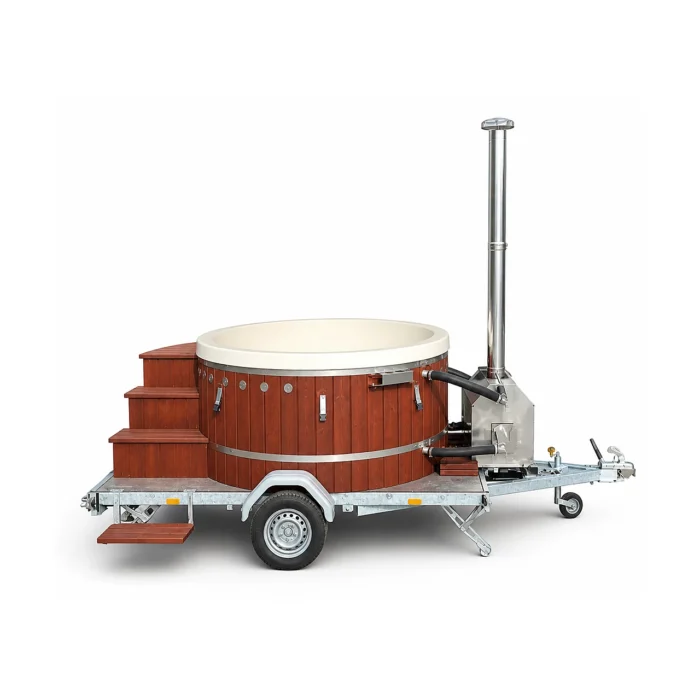
Mobile Wood Fired Hot Tub on Trailer – TimberIN Nordic Mobile™
Mobile Wood Fired Hot Tub on Trailer – TimberIN Nordic Mobile™. Nordic Mobile places a complete wood-fired hot tub on a trailer platform for operators who need the unit to serve more than one location. Four diameters and several heater positions allow the build to be matched to capacity and operating style, but each choice affects completed mass, axle loading and chimney layout. It is a specialist mobile system: final towing, registration…
What makes the complete system genuinely mobile?
| System area | Travel requirement | Site requirement |
|---|---|---|
| Trailer and load | Correct plated mass, distribution, coupling, brakes, tyres, lights and securing | Stable level pitch and approved stabilisation |
| Hot tub | Empty, drained, covered and protected from road movement | Filled to the specified level before heating |
| Stove and chimney | Cold, clean and secured for transport | Assembled with clearances and safe fuel access |
| Water | No uncontrolled residual load or leakage | Known source, fill volume, hygiene and discharge route |
| Electrical equipment | Protected, isolated and secured | Suitable supply, connections and safe cable route |
Towing vehicle, licence and plated weights
Use the actual trailer plate, measured or documented unladen condition, maximum authorised mass and towing-vehicle limits. Include every carried item: cover, chimney, fuel, hoses, steps, tools and optional equipment. Do not estimate legality from the tub’s catalogue weight.
The driver’s entitlement, vehicle and trailer combination must comply with current rules. Use the official GOV.UK towing guidance and its weight and width limits, then obtain competent advice for the specific combination. Business use can add operator, insurance and work-safety duties.
Pre-journey safety checks
Check the coupling, breakaway cable, lights, number plate, tyres, wheel fixings, brakes, load security, mirrors and overall condition before every journey. Confirm the tub is drained and that loose chimney, covers, steps and accessories cannot move.
The official trailer safety checklist explains the general road checks. A written business inspection log should identify the person who completed them, defects and action taken. Never rely on appearance after a unit has been used, heated and exposed to water.
Arrival, pitch and stabilisation
Survey the pitch for bearing capacity, level, overhead hazards, drainage, public access and fire clearance. Position the unit before filling because a full tub cannot simply be moved to correct the layout. Stabilise it with the approved supports; the towing vehicle and jockey wheel are not substitutes for a designed operating setup.
Protect users from wheels, drawbar, steps, hot stove and level changes. Define the entry side and an operator-only fuel area. Recheck level and supports as the water load is added, and prevent the public from altering stabilisers or controls.
Water supply at temporary locations
Confirm the model’s operating volume and the venue’s source, pressure, hose route and fill time. Do not assume every event tap is suitable or accessible. Hoses and connectors should be kept clean and protected from vehicle and pedestrian traffic.
Where water is delivered or stored, assess its suitability and the contamination controls. A transfer pump adds power and maintenance. Record how the complete tub will be filled before accepting a booking at a remote venue.
Drainage and leaving the site
The operator needs an agreed discharge route for the full volume. Water temperature and treatment affect where and when it can be released. Do not empty onto a road, public route, neighbouring land, unstable pitch or sensitive water environment.
Allow time for the stove to cool, then drain the shell, heater, pipework, pump and filter as instructed. Residual water adds weight, can leak during transport and may freeze. Inspect the pitch and unit before folding or securing the equipment for departure.
Wood-fired heating at events and rentals
A wood stove makes the unit independent of a large electrical heater, but it needs dry fuel, safe storage, guarding, chimney assembly, ash handling and a trained operator. Establish the required water level and circulation before lighting and monitor temperature throughout the session.
Keep combustible marquees, tents, furniture, fences and queues away from the stove and flue. Consider wind direction and neighbours. Never move the trailer, drain the water or dismantle hot components until the system has cooled in accordance with its instructions.
Powered jets, filters and lighting
Wood-fired does not mean electricity-free when pumps, filtration, bubbles or lights are selected. List the rated and start-up loads, voltage, controls and operating time. The venue supply, generator or battery system must be suitable for the complete equipment package.
Use appropriate outdoor connections, protection and cable management designed by competent people. Keep leads away from water and public routes. Test and inspect portable or fixed equipment under the operation’s documented electrical-safety regime.
Water hygiene for rentals and paying guests
Commercial bathing load changes water quality quickly. The operator needs a risk-based process for source water, treatment, testing, filtration or water replacement, cleaning, records and action when results fall outside limits. A domestic fill-and-drain habit is not enough evidence for repeated public use.
Define maximum users, session length, turnover time and who authorises reopening after cleaning. Keep chemicals secured and follow product guidance. Obtain competent local advice for the actual operation and do not use marketing claims as a substitute for water-safety controls.
Guest handover and supervision
Explain entry, temperature, maximum occupancy, session limits, emergency contact, cover and prohibited actions. Identify who controls the stove and equipment. Children require continuous supervision, and users with pregnancy, cardiovascular, medication or other health concerns should seek appropriate professional advice.
A waiver is not an operating system. Staff still need training, pre-use checks, incident reporting and a way to isolate the tub. Provide non-slip access, lighting and barriers where an event layout exposes people to the trailer or heater.
Events, glamping and rental planning
An event unit may move frequently and serve many users; a glamping tub may remain at one pitch for a season; a private trailer may travel only occasionally. These uses justify different water, inspection, staffing and transport routines. Describe the real operating pattern when obtaining insurance and professional advice.
Check venue permission, access hours, noise, fire controls, drainage, electrical supply and cancellation arrangements. Price setup and turnaround labour as well as hire or product cost. Keep road records, water logs, maintenance and incident documents together for each unit.
Winter transport and storage
Drain all low points before travel or storage and follow the model’s frost procedure for the stove, valves, pumps, filters, jets and air lines. A covered trailer can still retain water and freeze. Store removable components dry and protect tyres, brakes and electrical connections.
Cold weather also changes traction, pitch bearing, fill time and heat-up. Do not accept a booking merely because the tub can reach the postcode. Confirm that users, staff, water and the complete road combination can operate safely in the forecast conditions.
Complete mobile-hot-tub cost
| Cost area | Include | Why it is easy to miss |
|---|---|---|
| Road unit | Trailer, coupling, brakes, lights, securing and documentation | The tub price may not describe the complete road specification |
| Bathing system | Tub, stove, chimney, cover, steps and chosen equipment | Options alter weight, power and setup |
| Transport | Tow vehicle, fuel, driver, tolls, ferries, storage and inspections | Every booking creates two journeys and setup time |
| Venue | Water, drainage, electricity, barriers and pitch protection | Facilities vary between locations |
| Operation | Staff, fuel, water management, cleaning, records and insurance | Commercial compliance is an ongoing cost |
Mobile-hot-tub checklist
- Confirm the complete trailer specification and plated masses.
- Match the towing vehicle and driver to current rules.
- Travel drained, cold and with every component secured.
- Survey pitch, water, drainage, power and fire clearances.
- Level and stabilise before filling.
- Use a documented water and guest-safety routine.
- Cool, drain and inspect before departure.
- Keep road, maintenance, water and incident records.
Frequently asked questions
Can a hot tub be towed full of water?
Do not do so unless the complete approved road-unit documentation explicitly supports that condition. Water adds major moving load and can exceed mass limits or destabilise the trailer; mobile tubs are normally transported drained.
What towing vehicle does a mobile hot tub need?
It depends on the trailer plate, actual load and vehicle limits. Include all carried equipment and use current official towing guidance and competent advice for the exact combination.
Can a mobile hot tub operate without electricity?
A simple approved wood-heated configuration may, but pumps, filtration, jets, bubbles and lights require power. Confirm every component in the final equipment schedule.
How long does a mobile hot tub take to set up?
There is no fixed time. Pitch levelling, stabilisation, water volume, source pressure, stove setup, starting temperature and water-safety process all affect it. Test and document the actual routine before taking bookings.
Can I rent a mobile hot tub to guests?
Potentially, but commercial use needs appropriate trailer, insurance, water, fire, electrical, staff, user and record controls. Confirm the actual business and local requirements before operation.
Design the operating system before the trailer styling
Share the towing vehicle, intended use, expected venues, water plan and desired equipment. TimberIN can then clarify the tub configuration while you verify road, insurance and local operating requirements for the complete unit.