
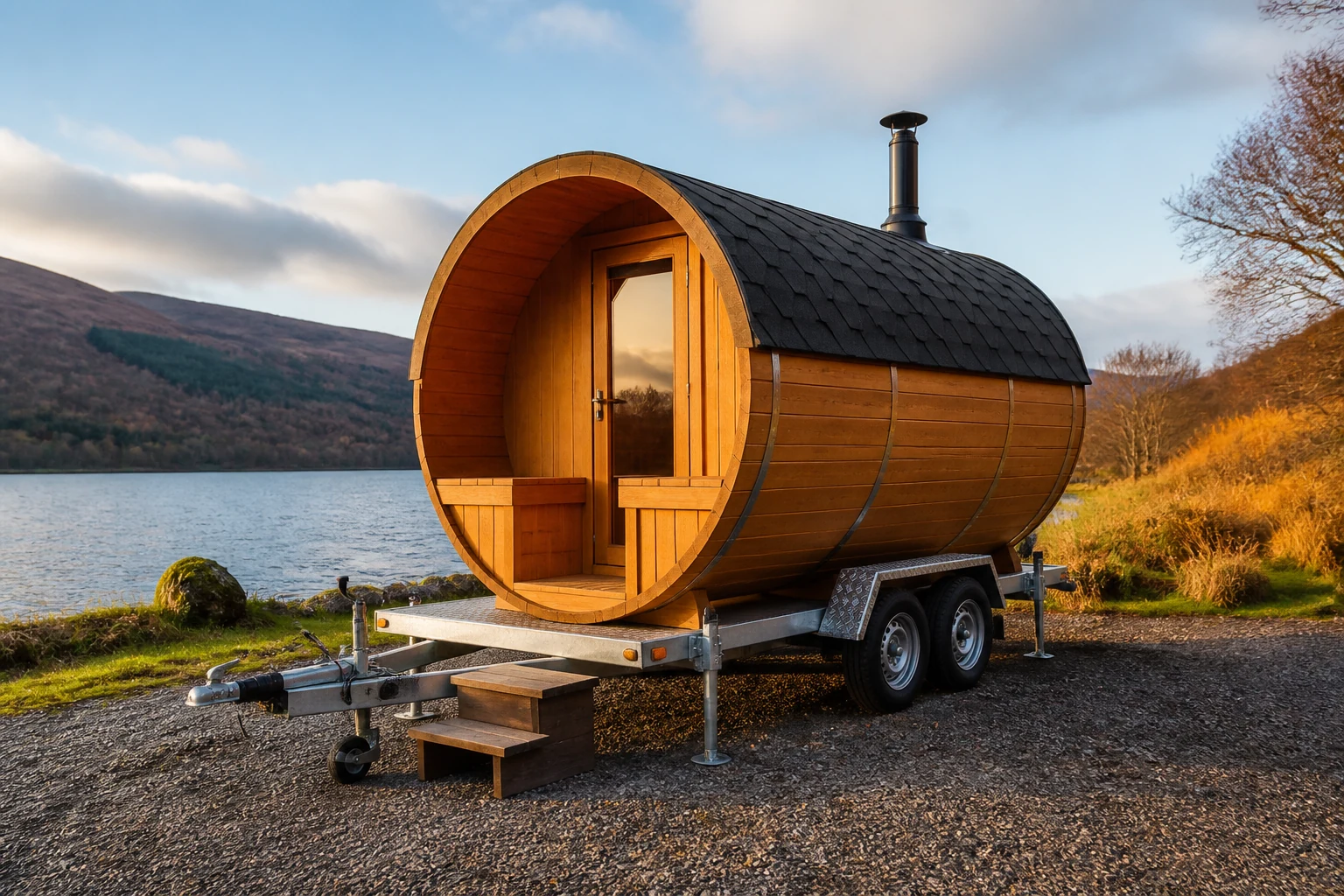
A mobile sauna has two identities. On the road it is a loaded trailer whose weights, coupling, brakes, tyres, lights and load security must be correct. Once parked, it becomes a heat-producing room that needs stable support, safe access, ventilation, heater clearances and an operating plan. Passing one set of checks does not prove the other.

Start with payload, not the number of benches
The useful capacity of a mobile sauna is limited by more than floor area. The trailer chassis has a plated maximum authorised mass (MAM). From that limit, subtract the completed sauna, heater, flue, stones, batteries or electrical equipment and every permanently carried item. What remains is payload for water containers, steps, tools, cleaning supplies and other equipment. Occupants are not carried while towing, but their weight and movement still matter to the stabilised unit on site.
Ask for a written weight schedule and a final measured weight where available. A design that is legal on paper with an empty shell may have very little useful allowance after the stove and stones are fitted. The towing vehicle’s permitted trailer weight and gross train weight must also be respected.
| Road state | On-site sauna state |
|---|---|
| Check MAM, actual laden weight, tow-vehicle limit and licence entitlement | Confirm level, firm ground and deploy stabilisers or supports exactly as specified |
| Secure stove parts, stones, steps, buckets and every loose object | Install safe steps and handholds; define a lit, non-slip route to a cool recovery area |
| Inspect coupling, breakaway cable, brakes, tyres, wheels, lights and number plate | Fit the approved flue or power supply; verify heater guards, clearances and ventilation |
| Remove or secure travel-sensitive flue sections and external items | Check wind and weather; do not operate if the manufacturer’s site limits cannot be met |
Current UK towing checks that belong in the handover
GOV.UK states that the fully loaded vehicle and trailer must stay within the vehicle’s gross train weight. The maximum trailer width for any towing vehicle is 2.55 metres, and length limits depend on the towing vehicle’s MAM. A loaded trailer over 750 kg must have a working brake system, and a breakaway cable or secondary coupling is required. These are general rules; the plated data and current guidance for the actual combination remain decisive.
Before every journey, inspect the coupling, cable, tyres, wheel fixings, lights and load distribution. Sauna stones are dense and must not be allowed to shift. Doors, vents, benches, heater guards, chimney sections and external steps need positive travel restraints rather than relying on friction or an interior latch.
A trailer used only in the UK does not use the same registration regime as every international journey. GOV.UK says trailers over 750 kg generally need registration when towed through or to many European countries, with listed exceptions including Ireland. Check the current country and insurance requirements before crossing a border.
Choose the heater around the places you will actually operate
Wood-burning heater
A wood-burning sauna can operate away from a high-capacity electrical connection and suits remote events. It adds a flue assembly, fuel storage, ash handling and a hot exterior zone. The exact stove manual determines safety distances, protective surfaces, stone loading and flue arrangement. Dry fuel is important: UK guidance for domestic firewood identifies 20% moisture or less as the “Ready to Burn” threshold, but the appliance’s approved fuel remains the first reference.
Electric heater
Electric heat avoids fuel and flue handling on site and offers straightforward control, but the venue must provide the designed supply. A household extension lead is not an installation plan. Cable route, load, isolation, weather protection and RCD arrangements need to be specified and checked by a competent electrician for the heater and event environment.
Ventilation, room layout and drying
Mobile construction does not change the heater’s need for designed ventilation. Follow the heater and sauna-room plan rather than applying “intake low, exhaust high” as a universal rule: Harvia, for example, specifies different arrangements for gravity and mechanical ventilation and for electric versus wood-burning heaters. Do not let the supply air cool an electric heater’s temperature sensor or block the exhaust with luggage.
Bench height, heater guard, door swing and standing space must work together in the moving shell. Every edge should remain safe when the trailer is not perfectly level. After use, remove wet items, clean the benches and floor, then use residual heat and the designed ventilation to dry the room. Inspect underneath removable benches and floor grates instead of cleaning only visible surfaces.
A repeatable setup and shutdown sequence
- Walk the pitch and reject soft, steep, flood-prone or obstructed ground.
- Position, chock and stabilise the trailer according to the chassis and body instructions.
- Fit steps, rails, lighting and a clear recovery area before inviting users.
- Inspect the cold heater, stones, guard, vents and either flue or electrical connection.
- Heat under supervision and record abnormal smoke, odour, control trips or movement.
- Control entry numbers and session length through the operating risk assessment.
- After the last session, allow the heater and flue to cool fully, remove ash safely where applicable, clean and dry the room, then secure every item for travel.
Commercial hire needs a documented operating system
For paid sessions, holiday accommodation or events, product ownership is only part of the duty. Decide who is competent to tow, set up, light or energise the heater, supervise users, test and clean the room, record defects and cancel operation in poor conditions. Public liability, vehicle and trailer cover must reflect the actual use. The venue may also impose licensing, fire, waste-water, access or trading conditions.
Keep a pre-journey checklist, site-setup record, heater log and cleaning/defect record. If the sauna travels to Scotland, Ireland or continental Europe, do not assume the English planning or road summary applies unchanged.
What to request before signing the quotation
- Trailer manufacturer, chassis identification, MAM, measured empty/running weight and payload allowance.
- Overall travel dimensions, nose-weight range and compatible towing equipment.
- Heater model, room-volume calculation, stone quantity, clearances and guard details.
- Travel and site positions for chimney sections, steps and accessories.
- Ventilation plan, drying routine and service access.
- Electrical requirements or approved fuel specification.
- Setup, shutdown, maintenance and fault-response documents.
Explore the current TimberIN mobile sauna range, then compare the written trailer and heater data rather than choosing by the photograph alone.
Hi,
I am currently looking to buy a mobile sauna for approx 6-8 persons with a wood burner. I’m quite attracted to the barrel ones. I am worried about the Brexit situation at the moment and buying from the UK. Can you let me know who problematic this might be.
Maire