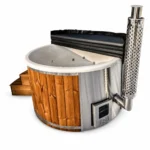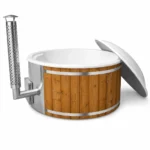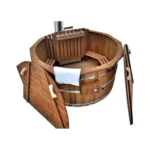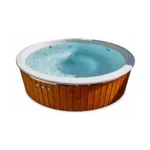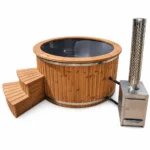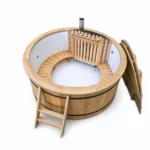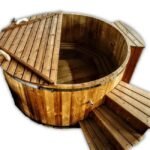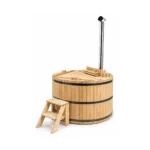

Scandinavian Hot Tubs: Complete UK Guide to Nordic Design, Heating and Year-Round Use
A Scandinavian hot tub is best understood as a design approach rather than a single fixed product type. The category usually combines outdoor-first construction, deep bathing, simple operation, timber or timber-look finishes and heating systems suited to cold-weather use.
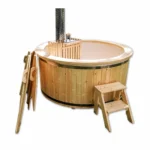
Some Scandinavian-style hot tubs are traditional wooden vessels heated by fire. Others use a smooth polypropylene or fibreglass liner with real-wood cladding, filtration, lights or massage systems. Wood-fired heating remains central to the classic Nordic experience, but electric, pellet and hybrid configurations can also fit the same practical design philosophy.
This guide explains what the Scandinavian label should mean in practice, how Nordic and Baltic manufacturing traditions relate, which materials and heater layouts to compare, and how to plan installation, water care, winter use, delivery and long-term maintenance in the UK.
Choose by construction and use—not by the label alone. A genuine cold-climate hot tub should be judged by its water volume, heater, insulation, drainage, serviceability and winter procedure.
Scandinavian hot tubs at a glance
| Decision | Typical Nordic direction | What to verify |
|---|---|---|
| Construction | Traditional timber vessel or smooth liner with timber exterior. | Which material actually holds the water. |
| Heating | Wood-fired is traditional; electric, pellet and hybrid options may be available. | Power needs, heater output, controls and service access. |
| Climate use | Designed for outdoor use across seasons. | Insulation, cover, pipework and winter shutdown procedure. |
| Appearance | Natural timber, simple forms and restrained detailing. | How the selected finish weathers outdoors. |
| Maintenance | Repairable and accessible components are preferred. | Whether pumps, heaters, bands and fittings remain serviceable. |
| Bathing style | Deep immersion and social seating rather than heavily moulded spa seating. | Internal diameter, bench shape and heater position. |
Current Scandinavian and Nordic-style hot-tub models
The models and prices below are loaded dynamically from WooCommerce. Open each product page to confirm the exact shell, timber, diameter, heater, insulation and available options for the configuration you are considering.
What defines a Scandinavian hot tub?
There is no single official technical standard that makes a hot tub Scandinavian. In buying terms, the phrase usually refers to a combination of outdoor durability, straightforward heating, natural materials, practical repairability and suitability for cold weather.
| Characteristic | Why it matters |
|---|---|
| Outdoor-first design | The product is intended for rain, wind, frost and repeated seasonal use rather than occasional sheltered use. |
| Deep water | Supports full-body immersion and a traditional soaking experience. |
| Simple geometry | Round, oval or square forms maximise usable space without unnecessary moulded features. |
| Wood or timber character | Creates the visual and tactile connection associated with Nordic outdoor bathing. |
| Powerful heater | Cold source water and low air temperatures require enough useful heat output. |
| Repairable components | Heaters, pumps, bands, fittings and covers should be inspectable and replaceable. |
| Clear winter routine | Owners need a defined process for active use, drain-down and frost protection. |
Scandinavian, Nordic, Swedish and Baltic: what do the terms mean?
Scandinavia usually refers geographically to Denmark, Norway and Sweden, while Nordic is a broader regional term. Baltic countries are geographically distinct, but their manufacturing traditions often share cold-climate woodworking, sauna culture and outdoor-bathing design principles.
For buyers, the useful question is not whether a product can claim one regional label. It is whether the design, materials, heater, insulation and quality-control process suit the intended climate and use.
| Term | Useful buyer interpretation | Avoid assuming |
|---|---|---|
| Scandinavian hot tub | A Nordic-style outdoor bathing product focused on simplicity and cold-climate use. | That every model is made in Sweden or is fully wooden. |
| Nordic hot tub | A broad design category influenced by northern European bathing traditions. | That it must be wood-fired or electricity-free. |
| Swedish hot tub | Often used for simple wood-heated outdoor tubs and social soaking. | That the name guarantees a specific construction standard. |
| Baltic-made hot tub | Manufactured in Estonia, Latvia or Lithuania, often using established timber and sauna-production skills. | That Baltic and Scandinavian are the same geographic term. |
Traditional timber tub or modern lined tub?
A traditional wooden hot tub and a liner-based Nordic hot tub can look similar from outside while behaving very differently in use.
| Feature | Traditional all-wood tub | Liner with timber exterior |
|---|---|---|
| Water containment | Timber staves form the vessel. | Polypropylene, fibreglass or another shell holds the water. |
| First filling | Timber may need time to swell and seal after drying. | Shell is normally immediately watertight. |
| Cleaning | Requires timber-compatible products and methods. | Smooth interior is generally easier to wipe and inspect. |
| Dry storage | Long dry periods can temporarily open stave joints. | Exterior timber can dry without affecting shell watertightness. |
| Technical options | Often selected for simplicity. | Usually easier to combine with filtration, lights, jets and digital controls. |
| Traditional feel | Water contacts natural timber. | Natural appearance outside with a smoother interior. |
Neither approach is universally better. Choose based on the experience and maintenance routine you actually want.
Wood-fired heating and Nordic design
Wood-fired heating is central to the classic Scandinavian experience because it allows strong heat input, visible fire and operation with little or no electrical infrastructure. However, the heater must be matched to the water volume and installed with correct circulation and clearances.
| Heater position | Advantages | Trade-offs |
|---|---|---|
| Internal or snorkel heater | Compact external footprint and direct heat transfer. | Uses bathing space and requires a protective guard. |
| Integrated heater | Neat overall appearance with compact dimensions. | Ventilation and maintenance access must remain clear. |
| External heater | Preserves more internal bathing space. | Needs extra ground area, pipework and safe fuel access. |
| Electric heater | Automated temperature control. | Requires suitable electrical capacity and usually heats differently from a wood stove. |
| Hybrid system | Combines wood-fired heat with electric support. | More components, controls and maintenance. |
| Pellet heater | More controlled fuel feed on compatible models. | Often requires electricity for controls or feed systems. |
A wood-fired hot tub can heat without mains electricity when the design uses natural circulation. Filters, jets, bubbles, lights, digital controls and many pellet systems normally require power.
Natural circulation and heater safety
Some wood-fired systems circulate water by thermosiphon: warmer water rises into the tub while cooler water returns to the heater. This works only when the heater and pipework are positioned correctly.
- Maintain the required water level before lighting the fire.
- Keep heater connections and pipe routes free from air locks and restrictions.
- Do not close valves while the fire is active.
- Do not drain the tub until the heater has cooled.
- Never assume natural circulation if the model specifies a pump.
- Mix the water and verify temperature before bathing.
Wood-fired safety rule: fire, water level and circulation must always be treated as one system.
Timber choices: spruce, larch and thermowood
| Timber | Appearance | Practical characteristics | Maintenance expectations |
|---|---|---|---|
| Spruce | Light, traditional Nordic appearance. | Relatively light and widely used in classic tubs and cladding. | Needs protection from persistent dampness and realistic expectations about knots and checking. |
| Larch | Warmer tone and stronger grain. | Denser and naturally resinous compared with many softwoods. | Can grey and develop natural surface checks outdoors. |
| Thermowood | Darker, more uniform heat-treated appearance. | Improved dimensional stability compared with untreated timber. | Still weathers outdoors and may need oiling if colour retention is desired. |
| Timber cladding over liner | Appearance depends on selected timber. | Water-tightness comes from the shell rather than the cladding. | Exterior boards still require airflow and protection from standing water. |
The name of the timber is only part of the quality equation. Machining, drying, storage, assembly, ventilation and maintenance all affect long-term performance.
What natural timber variation should you expect?
| Observation | Often normal | Requires investigation |
|---|---|---|
| Colour variation | Different grain and tone between boards. | Localised darkening caused by persistent trapped moisture. |
| Weathering | Gradual greying outdoors. | Soft, decayed or unstable timber. |
| Surface checks | Small shallow cracks that do not affect structure. | Deep splitting, loose sections or movement at joints. |
| Knots | Sound knots and normal grain features. | Loose knots that create structural or sharp defects. |
| Initial seepage in all-wood tubs | Limited seepage while dry timber swells. | Persistent loss from fittings, pipes or damaged staves. |
Heating time: calculate rather than guess
A fixed heating time cannot be promised for every Scandinavian hot tub. Water volume, starting temperature, target temperature, heater output, fuel, wind, insulation and cover all influence the result.
For comparison, use: litres of water × temperature rise in °C × 0.001163 = theoretical kWh of heat in the water.
Heating 1,200 litres from 10°C to 38°C requires approximately 39.1 kWh in the water before allowing for losses. Heating 1,500 litres over the same temperature rise requires approximately 48.8 kWh. Actual fuel or electricity input will be higher.
| Factor | Effect on heat-up | Practical response |
|---|---|---|
| More water | Longer heating and greater fuel demand. | Choose size for normal occupancy. |
| Cold source water | Larger temperature rise. | Allow more time in winter. |
| Wet firewood | Poorer combustion and less useful heat. | Use dry, untreated wood. |
| No cover | Large heat loss from the water surface. | Use a suitable thermal cover where permitted. |
| Wind exposure | Higher surface and wall losses. | Choose a sheltered but safely ventilated site. |
| Poor circulation | Uneven temperature and possible heater risk. | Follow the heater and pipe layout exactly. |
Insulation for UK and Nordic-style winter use
Cold-climate suitability depends on the whole system, not just thick timber. The water surface, base, pipework and technical compartment can lose substantial heat or freeze.
| Area | What to check | Why it matters |
|---|---|---|
| Walls | Construction, insulation and access to fittings. | Controls heat loss without hiding service points. |
| Base | Insulation compatible with structural support and drainage. | Reduces loss to cold ground. |
| Pipework | Insulation, drainage and accessible joints. | Reduces heat loss and frost risk. |
| Technical space | Dryness, ventilation and service access. | Protects pumps and controls without trapping condensation. |
| Cover | Fit, insulation value and secure closure. | The water surface is a major heat-loss area. |
Winter use and frost protection
Scandinavian-style hot tubs can be used in winter, but they are not automatically frost-proof. Water trapped in heaters, pumps, filters and low pipe sections can freeze and damage components.
- Follow the model-specific winter-use and shutdown instructions.
- Do not light a heater when circulation may be blocked by ice.
- Drain all vulnerable components before long unattended periods.
- Plan for power failure when filtration or frost protection relies on electricity.
- Keep the cover, steps and walking route clear of dangerous ice.
- Do not assume an empty-looking tub has no water in the pipework.
A winter-ready product is one with a clear operating procedure, not one that simply carries a Nordic name.
Water care and filtration
Water management depends on whether the hot tub is traditional timber, a lined model, filtered or frequently emptied. Warm water is not self-cleaning.
| Configuration | Typical water-management approach | Main caution |
|---|---|---|
| Traditional all-wood tub without filtration | Frequent replacement and timber-compatible cleaning. | Do not copy chemical routines from acrylic spas without approval. |
| Liner tub without filtration | Manual cleaning and regular water replacement. | Water quality can deteriorate quickly under heavy use. |
| Liner tub with filtration | Pump, filter and consistent treatment routine. | Requires electricity and regular filter maintenance. |
| Rental or commercial use | Documented testing, cleaning and change procedures. | Domestic routines may be insufficient for high bathing loads. |
- Shower before use.
- Keep the tub covered when not in use.
- Measure rather than dose chemicals by guesswork.
- Never mix chemicals.
- Use products compatible with timber, liners, seals and heaters.
- Replace water when quality cannot be maintained safely.
Scandinavian hot tub versus acrylic spa
| Topic | Scandinavian-style hot tub | Modern acrylic spa |
|---|---|---|
| Primary experience | Deep outdoor soaking, natural materials and simple ritual. | Moulded seating, integrated jets and automated controls. |
| Heating | Wood, electric, pellet or hybrid depending on model. | Usually electric. |
| Electricity dependence | Can be low in simple wood-fired configurations. | Normally continuous for heating, filtration and controls. |
| Jets | Optional on suitable models. | Often central to the product. |
| Maintenance | Depends on timber, liner, heater and optional filtration. | Depends on shell, filters, pumps, electronics and plumbing. |
| Visual character | Natural timber and weathering. | Uniform moulded shell and cabinet. |
| Repair philosophy | Often modular and visibly serviceable. | Can be highly integrated, depending on design. |
The best choice depends on whether you value traditional outdoor bathing or automated spa functions more highly.
Size, seating and actual capacity
Advertised capacity is an approximation. Comfort depends on internal diameter, bench shape, heater position, water depth and user size.
| Normal use | Practical direction | What to measure |
|---|---|---|
| One or two people | Compact round, oval or ofuro-style model. | Legroom, water depth and heater space. |
| Three or four people | Small family model. | Bench circumference and entry position. |
| Five or six people | Medium family tub. | Internal diameter, water volume and shoulder room. |
| Seven or eight people | Large round or square configuration. | Foundation, heater capacity and total operating cost. |
| Holiday rental | Robust model matched to permitted occupancy. | Cleaning, controls, guest safety and technical access. |
Foundation, drainage and garden position
One litre of water weighs approximately one kilogram. A filled hot tub can therefore weigh well over a tonne before adding the tub, heater, cover and users.
| Site element | Requirement | Reason |
|---|---|---|
| Foundation | Level, stable and sized for the full supporting footprint. | Prevents distortion and uneven loading. |
| Drainage | Rain, splash and full emptying water must leave safely. | Protects the base, timber and nearby buildings. |
| Ventilation | Air must move around exterior timber and equipment. | Reduces persistent dampness and condensation. |
| Heater area | Stable, accessible and safely separated from combustibles. | Allows safe firing and maintenance. |
| Service space | Pumps, fittings, bands and drains remain reachable. | Supports inspection and repair. |
| Delivery route | Measured from road to final position. | Avoids access problems after production. |
Freestanding, decked-in or sunken?
| Installation | Benefit | Main caution |
|---|---|---|
| Freestanding | Best access for inspection and maintenance. | Higher step-in height and more visible exterior. |
| Deck surround | Integrated look while the tub remains independently supported. | Do not block bands, cladding ventilation or service panels. |
| Partially sunken | Lower entry and strong visual integration. | Requires drainage, ventilation and removable access. |
| Fully in-ground | Minimal visual impact. | Most complex for moisture control, service and future replacement. |
For recessed projects, use the dedicated sunken and in-ground hot-tub guide before finalising the landscape design.
Sustainability: evaluate the complete system
Natural timber, wood fuel and repairable components can support a lower-waste ownership model, but no hot tub is automatically sustainable. Water use, fuel sourcing, combustion quality, insulation, transport, product lifespan and maintenance all matter.
| Sustainability factor | Better practice |
|---|---|
| Timber | Choose responsibly sourced material and maintain it for long service. |
| Fuel | Use dry, clean and appropriately sourced wood. |
| Water | Match the volume to normal use and manage water safely. |
| Heat loss | Use suitable insulation and a thermal cover. |
| Repairability | Keep components accessible and replace only what is worn. |
| Transport | Plan delivery efficiently and avoid failed access attempts. |
Private gardens, cabins and hospitality
| Use case | Priority |
|---|---|
| Private home | Comfort, appearance, manageable maintenance and safe access. |
| Sauna companion | Layout, wet walkway, heating sequence and privacy. |
| Remote cabin | Water source, wood storage, drainage and frost shutdown. |
| Holiday let | Guest instructions, simple controls and water-management routine. |
| Wellness venue | Higher-duty filtration, serviceability and documented operation. |
A Scandinavian hot tub may improve the appeal of accommodation or a wellness space, but it does not guarantee higher occupancy, rates, revenue or property value.
Delivery and installation in the UK
UK delivery is commonly planned at approximately 6–8 weeks depending on the model, options, production schedule and route. This is an estimate rather than a guaranteed date.
| Stage | What to prepare |
|---|---|
| Before ordering | Confirm model, dimensions, water volume, heater, access and unloading. |
| During production | Complete foundation, drainage and required electrical work. |
| Before transport | Confirm vehicle access and arrange crane, forklift or telehandler if needed. |
| At delivery | Inspect packaging and place the tub safely on the prepared base. |
| Before first use | Connect, fill, inspect, test circulation and follow the heater procedure. |
Comparing total cost
The current product prices are shown dynamically above. Compare complete configurations rather than only the starting price.
| Cost area | What to compare | Common omission |
|---|---|---|
| Tub construction | Traditional wood or liner, diameter, benches and cladding. | Comparing different constructions as if they are identical. |
| Heating | Heater type, output, chimney, controls and connections. | Ignoring flue and installation work. |
| Insulation and cover | Walls, base, pipework and top cover. | Assuming thick wood solves all heat loss. |
| Water system | Drainage, filtration, pump and treatment compatibility. | No plan for repeated water care. |
| Options | Jets, bubbles, lighting and controls. | Forgetting electricity and maintenance needs. |
| Transport and unloading | Delivery point, access and lifting. | Assuming final garden placement is included. |
| Foundation | Groundworks, drainage and deck construction. | Treating the product price as the installed cost. |
Common mistakes
| Mistake | Likely consequence | Better approach |
|---|---|---|
| Buying only because the product is labelled Scandinavian | Important construction and performance details are missed. | Compare the actual shell, heater, insulation and maintenance. |
| Assuming Baltic and Scandinavian are identical geographic terms | The page becomes inaccurate. | Describe Baltic manufacturing as Nordic-influenced, not geographically Scandinavian. |
| Assuming every Nordic tub is fully wooden | The water-contact material is misunderstood. | Confirm whether the model uses timber or a liner. |
| Assuming every wood-fired model needs no electricity | Powered accessories are overlooked. | List every pump, filter, light and controller. |
| Promising fixed heating times | Real performance differs in winter or wind. | Use water-volume calculations and model-specific estimates. |
| No winter drain-down plan | Pipes, pumps or heaters can freeze. | Follow the exact shutdown procedure. |
| Building decking tightly around the tub | Ventilation and service access disappear. | Use removable panels and maintain clearances. |
| Ignoring delivery access | The tub cannot reach the foundation. | Survey gates, turning space and lifting route in advance. |
Scandinavian hot-tub buying checklist
- Confirm whether the model is traditional timber or uses a smooth liner.
- Choose the normal number of users and check actual internal dimensions.
- Compare internal, integrated and external heater positions.
- Confirm whether heating and circulation can operate without electricity.
- List all powered filters, jets, lights, blowers and controls.
- Compare spruce, larch and thermowood based on maintenance and appearance.
- Calculate water volume and theoretical heating demand.
- Compare wall, base, pipe and cover insulation.
- Choose a water-care method compatible with the exact construction.
- Prepare a level foundation for the full wet load.
- Plan drainage for rain, splash water and complete emptying.
- Maintain ventilation and access around timber and equipment.
- Create a winter-use and drain-down procedure.
- Measure the delivery route and confirm unloading responsibility.
- Compare total installed cost rather than only product price.
- Treat the 6–8 week UK delivery period as an estimate.
Frequently asked questions about Scandinavian hot tubs
What is a Scandinavian hot tub?
It is an outdoor hot tub inspired by Nordic bathing traditions, usually focused on simple construction, deep soaking, natural materials and reliable cold-weather use.
Is Scandinavian the same as Nordic?
Scandinavian is a narrower geographic term, while Nordic is broader. In product descriptions, both are often used for a similar cold-climate outdoor-bathing style.
Are Baltic hot tubs Scandinavian?
Baltic countries are not geographically Scandinavian. However, many Baltic-made hot tubs use Nordic-influenced designs, timber skills and cold-climate manufacturing methods.
Are Scandinavian hot tubs always made from solid wood?
No. Some are traditional timber vessels, while others have polypropylene or fibreglass interiors with real-wood exterior cladding.
Are Scandinavian hot tubs always wood-fired?
Wood-fired heating is traditional, but electric, pellet and hybrid configurations are also available on suitable models.
Do Scandinavian hot tubs require electricity?
A simple wood-fired configuration may heat without mains power. Filters, jets, bubbles, lighting, electric heaters and many pellet systems normally require electricity.
Can Scandinavian hot tubs be used in winter?
Yes, when the heater, insulation, cover, pipework and winter procedure are suitable. Cold-climate styling alone does not make a system frost-proof.
How long does a Scandinavian hot tub take to heat?
Heating time depends on water volume, start temperature, heater output, fuel, wind, insulation and cover. A fixed time cannot be guaranteed for every setup.
Which timber is best?
There is no universal best choice. Spruce offers a traditional light appearance, larch is denser and warmer in tone, and thermowood is selected for darker colour and improved stability.
Is a traditional wooden tub harder to maintain?
It has a different routine. Timber movement, compatible water care and dry-storage procedures matter more than with a smooth liner.
Can Scandinavian hot tubs have jets and bubbles?
Yes, on compatible models. These options add pumps, pipework, electricity, noise and maintenance.
What foundation is required?
The foundation must be level, stable, well drained and capable of carrying the complete filled weight. Raised decks may need structural assessment.
Can one be built into decking?
Yes, but the hot tub should remain independently supported, ventilated and accessible. Decking must not permanently cover service points or exterior timber.
Are Scandinavian hot tubs sustainable?
They can support long service life and repairability, but overall impact depends on timber sourcing, fuel, water use, insulation, transport and maintenance.
What is the expected UK delivery time?
UK delivery is commonly planned at approximately 6–8 weeks depending on the model, options, production schedule and route. This is an estimate and not a guaranteed date.
Choose the system behind the Scandinavian appearance
Start with the water-contact construction, normal number of users and preferred heating routine. Then compare timber, insulation, filtration, installation and winter use as one complete configuration.