

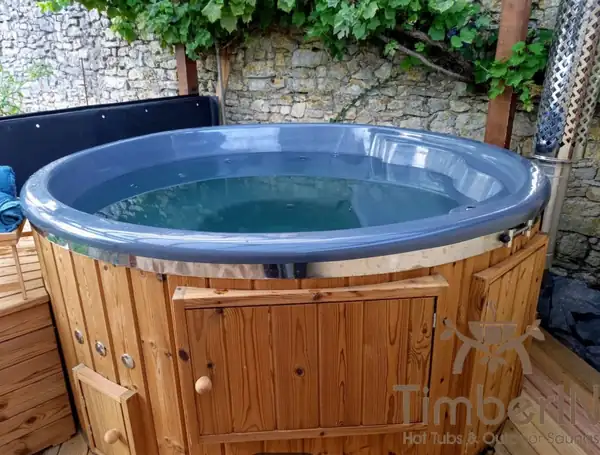
A pellet heater may meter fuel and regulate temperature, but the owner still has to check the hopper, combustion path and water circuit. A useful maintenance routine follows those three routes. App functions and cleaning access differ between burners, so begin with the model plate and the instructions supplied with that installation.
How a pellet hot tub heater works
Dry, appliance-approved pellets are stored in a hopper. A motorised feed moves a measured quantity towards the burn pot, where an igniter starts combustion. A fan and controller manage air and fuel delivery, while a temperature sensor tells the system how the bathing water is responding. Heat passes through the heater’s water jacket or exchanger and into the tub circuit.
That description contains four systems, not one: fuel storage and feed, combustion and flue, water flow, and electrical control. A useful quotation identifies each of them. “App-controlled” on its own says nothing about whether circulation is by a pump or another approved arrangement, which alarms are available, or whether a person must be present for a restart.
| Part of the system | What automation can do | What the owner still verifies |
|---|---|---|
| Pellet feed | Meter fuel according to the control programme | Correct, dry pellets; clean hopper; unobstructed feed route |
| Ignition and flame | Start and modulate combustion when conditions are satisfied | Clean burn pot, sound door seal, clear air path and approved flue |
| Water temperature | Read a sensor and reduce or stop fuel demand near the set point | Real water level, proven circulation, open valves and correctly placed sensor |
| Remote control | Show status, schedules and some alarms, depending on the model | What happens when power, Wi-Fi or the feed fails; local manual recovery |
Identify the burner before changing settings
Keep the burner model, controller version and hot-tub circuit drawing together. Check which tasks the owner may perform and which require service. An app description is not evidence that every burner can ignite remotely, restart after an outage or work safely without a local inspection.
The older general TimberIN manual includes one named burner, but an owner’s present appliance may differ. Obtain its current instructions before using menu sequences, changing feed settings or deciding a cleaning interval. Do not power an auger separately or bypass its controls to force fuel through.
Before starting: follow the fuel and water paths
Inspect the installation in person before enabling an approved start. Confirm the required water level, valve positions and circulation; clear the loading area and check visible flue joints and air openings. A phone display cannot show a closed valve, an empty water jacket or an object left against the heater.
Use dry pellets of the grade and dimensions required by the burner. Damp, swollen fuel and excess fines can interrupt feeding. Keep bags in dry storage, and do not mix logs, waste wood or other fuel into the hopper. Leave fingers and tools out of the feed mechanism, including when the burner appears idle: an automatic start may still be enabled.
Know the normal local stop control and what an alarm means. Record a recurring code and the conditions before it appeared. Repeated resets, altered fan settings and defeated sensors are not remedies for a feed, combustion or water-flow fault.
Heating time and fuel use: use the actual configuration
No responsible article can promise that every pellet-heated tub will be ready in a fixed number of hours. The starting water temperature, water volume, heater output, cover, exposed pipework, wind and desired bathing temperature all change the result. The same heater will take longer with a larger volume or a greater temperature rise. A cover normally reduces loss during heat-up, but the product instructions determine whether and how it may be used around a working flue.
Ask the supplier for test conditions behind any quoted time: model and water volume, starting and final temperatures, outdoor conditions, fuel specification and whether circulation or insulation differed from your order. Use the separate hot-tub heating-time method to compare like with like.
Shutdown, cold cleaning and the maintenance record
Allow the normal controlled shutdown to finish before isolating the appliance for permitted cold cleaning. Switching off its electricity midway through an ordinary shutdown can interrupt functions that the controller needs. For an emergency, follow the appliance’s emergency procedure; do not improvise a sequence from another burner.
Once fully cold and isolated, clean only the burn pot, ash area and accessible hopper surfaces identified as owner-serviceable. Use the approved tools and ash container. Do not use a household vacuum, enlarge combustion holes or wash ash into the burner. Cracked parts, damaged seals, hard unusual deposits or smoke escaping from joints need service advice.
Check fuel storage and keep a short record of operating hours, fuel batch, cleaning date and any alarm. If cleaning is needed much more often, record the change rather than extending the interval. The manual’s service schedule and observed condition govern the work; a monthly calendar rule cannot fit every fuel and installation.
Flue work, internal electrical repairs, auger faults and heat-exchanger repairs belong to a competent technician. Keep the appliance out of use when it leaks, repeatedly fails ignition or loses the circulation required for heating.
Returning to service after an interruption
After a refill, fuel outage or power loss, use the recovery procedure for the actual burner and circulation system. Confirm the physical water path again before heat is enabled. Restoring Wi-Fi is not proof that the installation is ready.
For model availability and configuration, use pellet-fired hot tubs. This article covers the operating checks and maintenance record; the supplied current burner manual defines the exact buttons, intervals and permitted work.



Reader comments
Hi there,
how much pellets does the oven use per one session?
Let’s say, how many pellets do you need to burn to get to the initial 40 degree celsius from a water that is 10 degrees at start?
Thanks!
Hi there,
Normally, we would be looking at 10-15 kg per session. The compartment fits 20 kg.
Thanks
Can you only operate from a phone – or is there an operating pannel on the hottub?
Hello,
there is an operating panel on the hot tub also you can operate from a phone.
Hello,
Where does one get the pellets from?
Can you select to use logs if you are using it manually without the smart system?
Do you deliver to Guernsey.
Hello,
Thank you for interest in our new product.
Pellets usually can be found in any bigger hardware store. In some countries (in the UK this company https://www.woodlets.co.uk/) pellets can be ordered online and delivered right to your front door.
With each order, we will add a bag of pellets as a gift 🙂
Unfortunately, only pellets can be used with our new smart oven heating system.
Delivery to Guernsey is possible. We can arrange delivery to the nearest seaport in France or directly to the island. If you are interested just select your preferred hot tub model on our website and send us an inquiry.
Best wishes