

Two tubs can have similar grey exterior boards and need different care. “Composite” is a broad description, not a cleaning specification. Establish the actual cladding manufacturer, profile and finish before applying a product or ordering a replacement panel. The outer boards are separate from the shell that retains the bathing water.
What the name Neular establishes—and what it does not
Neular describes its material as profiles made from recycled household plastics. That does not make every composite hot-tub board Neular, or establish which Neular profile was supplied on a particular order. Keep the invoice, panel code and care sheet; ask TimberIN to identify an older installation if those are missing.
Nor does a historical article establish present UK stock, colours or compatibility. Confirm any proposed replacement or new order in writing. A decking datasheet can explain that a polymer moves with temperature, but its fixing gaps and load ratings are not a hot-tub cladding installation drawing.
What it does not change
On a lined tub, the specified interior retains the water; the exterior cladding does not. It does not determine the water volume, bench comfort, heater output, insulation or filtration. It also does not remove the need to access pumps, unions and controls behind the exterior.
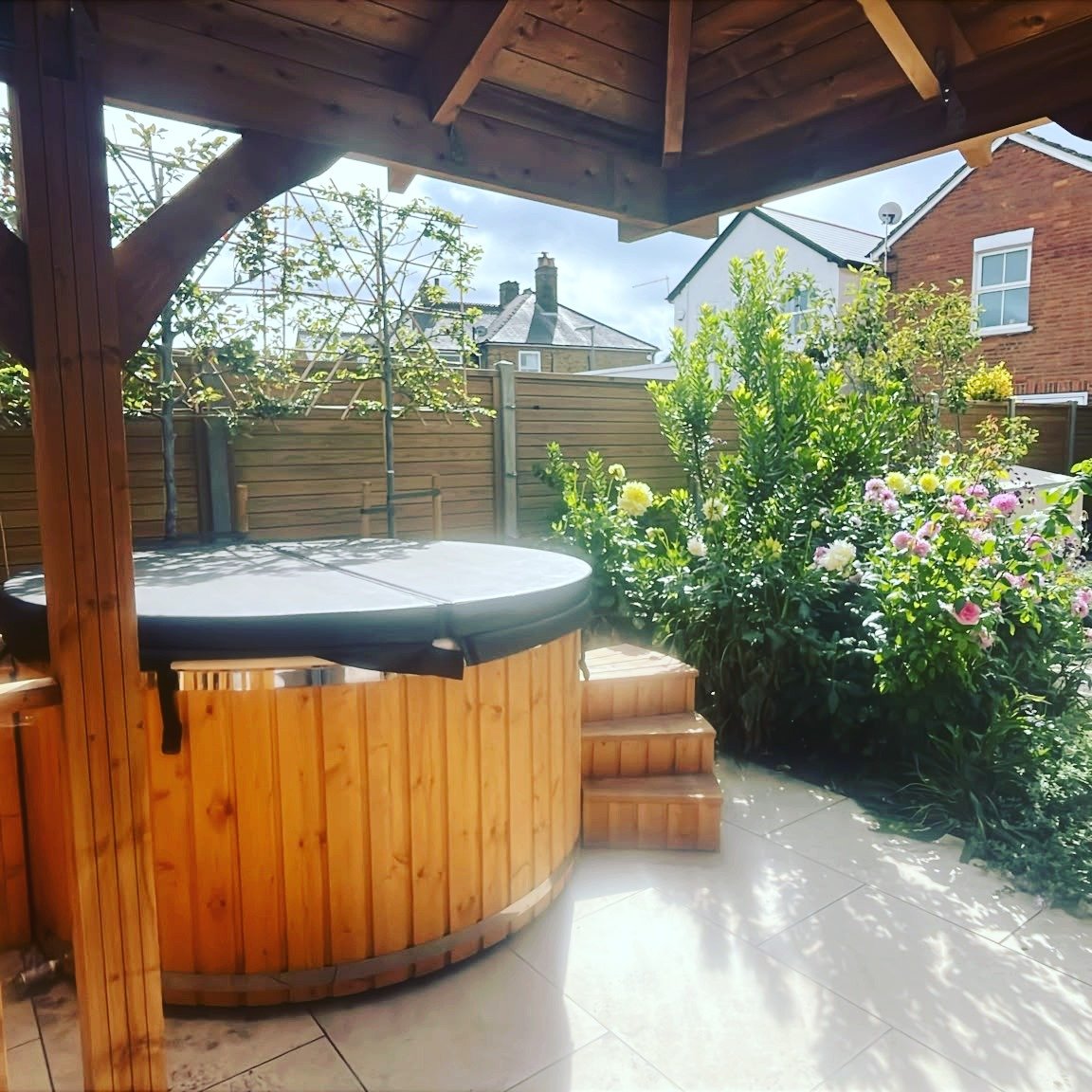
Ask for a drawing showing removable panels. On a built-in installation, the deck access must align with those panels and be large enough for component removal. A visually seamless surround that traps the technical bay is an installation fault, whatever the cladding material.
Clean the identified finish, not a generic composite
Begin with the current care sheet for the identified panel. Remove loose leaves and grit without scratching it; use water and the permitted soft cloth or brush. Add a cleaner only if that product and concentration are approved for the finish. Rinse as directed without spraying electrical equipment or forcing water into the technical bay.
Do not assume that timber oil, solvent, abrasive polish or close-range pressure washing is suitable. A small hidden test cannot prove that a chemically incompatible product is safe long term. If staining persists, send the supplier a photograph, panel code and the name of anything already applied.
Clear debris around the lower edges and keep designed ventilation and service openings accessible. “No routine oiling” does not mean no inspection or cleaning. A bowed panel, loose fixing or heat-distorted area needs diagnosis rather than additional screws driven through it.
Plan for scratches and future replacement
A hard impact can mark a composite panel, and the repair method depends on its composition and finish. Before ordering, ask whether a single section can be replaced, how corners are dismantled and how long matching colour/profile stock is expected to remain available. Store the exact product code and, where practical, a spare offcut.
Colour can appear different between samples, screens and the finished garden. View a physical sample outdoors and accept that replacement material from a later production batch may not be visually identical to weathered panels.
Assess environmental claims with the full product life in mind
Neular is described by its supplier as a recycled polymer composite. Ask for the current technical and environmental information supporting recycled content, durability and end-of-life routes in your market. A material can reduce routine coatings and use recycled feedstock while still depending on long service life, repairability and an available recycling route to deliver its intended benefit.
Do not compare cladding in isolation from the tub’s size and operation. Heating unnecessary water, replacing a poorly fitted cover or discarding an inaccessible component can outweigh a small material difference. Durability and repair are part of sustainability.
The useful record to keep with the tub
Record the panel manufacturer and profile, supplied colour, approved cleaner, access-panel arrangement and replacement route. If any of these are unknown, resolve them before refinishing or dismantling the surround.
Read the shell-care comparison for the water-retaining material and the maintenance guide for the complete tub. Neular’s own material information provides manufacturer context; your order and care sheet establish what is actually fitted.



Reader comments