
Round Hot Tubs: Sizes, Heating and UK Buying Advice
A round hot tub creates a naturally social seating layout: bathers face towards the centre, a continuous bench makes flexible use of the circumference and the shape works with traditional timber construction as well as modern lined shells.
The important decisions sit beneath that familiar outline. Internal diameter, water depth, heater position and bench design determine how many people can sit comfortably. Exterior diameter alone does not tell you how much bathing space or water volume you are buying.
This guide shows how to compare round models, choose an appropriate heating system and prepare the foundation, access, drainage and equipment area for a complete installation.
Start inside the tub: confirm usable seating, water volume and heater space before choosing the exterior finish or optional equipment.
Why buyers choose a round hot tub
The curved wall has no unused corners and supports an informal seating arrangement for couples, families and groups. People can change position more easily than they can in a shell with strongly defined seats, and a smaller party can spread out around the bench.
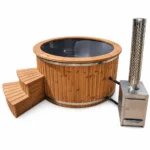
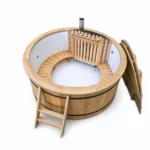
Round construction also suits several heater layouts. An external stove preserves the whole bathing area, an integrated stove keeps the overall footprint compact, and an internal snorkel stove creates a simple system at the expense of some seating space. The right version depends on the site and normal occupancy.
Current round hot-tub models
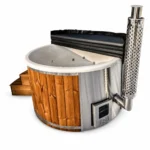
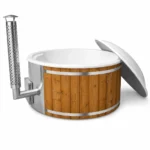
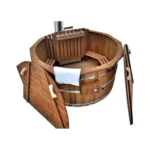
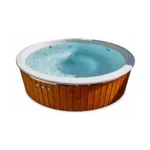
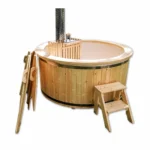
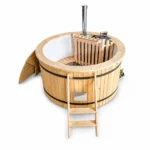
These models and prices are loaded directly from WooCommerce. Open a product page to check its available diameter, interior, heater arrangement and configurable equipment; the category includes different capacity and heating choices.
-
Product on saleSave up to 16% Wood Fired Hot Tub with Jets – TimberIN Nordic Rojal™ (4–8 Person)
From: €6,954From: €6,021 -
Modular coreTimberIN Nordic Core™From: €3,371
-
ThermowoodThermowood Hot Tub – TimberIN Nordic™ Deluxe (Wood-Fired, 4–8 Person)From: €3,280
-
Electric heatingElectric Wooden Hot Tub for Garden Use – TimberIN Nordic Family™ ElectricFrom: €2,975
-
External stoveWood Fired Hot Tub with External Stove – TimberIN Nordic™ External ComfortFrom: €3,382
-
PolypropylenePolypropylene Hot Tub – TimberIN Nordic Flex™ (160–220 cm, Configurable)From: €2,600
-
Traditional timberWood Fired Wooden Jacuzzi – Traditional Timber Hot TubFrom: €2,820
-
Spruce value modelWooden Hot Tub Basic – TimberIN Nordic™ (Affordable Wood Fired Model)From: €2,333
-
Compact for 44 Person Wood Fired Hot Tub – Compact Snorkel Stove DesignFrom: €2,963
-
Product on saleSave up to 17%Affordable Wooden Hot Tub for Your Garden – TimberIN Nordic Value™From: €3,269From: €2,931
Diameter, depth and realistic capacity
Capacity figures are nominal model guidance. The shell thickness, bench depth, steps into the water and heater all reduce the clear internal space. Ask for the internal diameter at the seating level, usable water depth and a drawing of the chosen configuration.
Select for the people who will use the tub most often. A couple may prefer a moderate model with room to stretch, while a family needs a bench and entry arrangement that children can use under constant adult supervision. Buying a much larger tub for rare gatherings means heating and treating more water every normal week.
Outside diameter still matters for the foundation and delivery route. Add the external stove, flue, steps, filter housing and working clearances to the plan; they are not contained inside the simple circle shown on a product dimension.
Round and square hot tubs compared
| Consideration | Round tub | Square or rectangular tub |
|---|---|---|
| Seating | Flexible continuous bench and face-to-face layout | Defined sides and corners may create distinct positions |
| Garden layout | Strong freestanding focal point | Can align neatly with straight terrace lines |
| Cover | Simple circular form; storage space still required | Shape and split design vary by model |
| Best choice | Social seating and traditional appearance | Site alignment or a preferred internal layout |
Shape alone does not determine efficiency or comfort. Compare the exact water volume, insulation, cover and seating plan. See the square hot-tub guide if the installation needs straight edges or a larger defined floor area.
Internal, integrated or external wood stove
An external stove leaves the full round shell available for bathing and offers direct service access, but it increases the installation footprint and adds connecting pipework. An integrated stove sits partly within the tub outline and can create a tidy package, while still taking some internal or perimeter space.
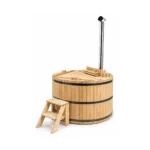
An internal snorkel stove places the heater in the water behind a protective barrier. It can suit a compact, simple build, but buyers must allow for lost seating and hot-surface management. For every arrangement, confirm output, materials, water-level requirements, flue components and clearances in the final quotation.
Wood-fired, electric, pellet or hybrid heating
Wood firing provides a traditional heating routine and may suit a site without a large electrical heating supply. It requires dry logs, active fire management and a safe route around the stove and chimney. Electric heating offers convenient control when the supply and tariff suit the intended use. Pellet burners meter compressed wood fuel but normally need electricity for feeding and controls.
Hybrid systems combine two heat sources, often using wood for heat-up and electricity for support. They add flexibility but also equipment, controls and installation complexity. Do not compare systems using one advertised heat-up time: request an estimate for the chosen water volume and stated starting conditions.
Traditional timber or a smooth liner
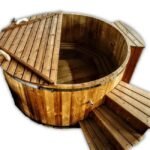
An all-wood interior delivers the traditional bathing feel, with natural boards visible and in contact with the water. Owners must be comfortable with timber movement, wetting and drying behaviour and the specified maintenance routine.
Fibreglass and polypropylene liners offer a smooth surface and can be paired with exterior timber cladding. They simplify some cleaning tasks and provide colour choices, but pumps, fittings and water-care responsibilities remain. Ask how the liner, frame and cladding can be accessed and repaired over the life of the tub.
Water volume, cover and insulation
Small increases in diameter can add a meaningful amount of water. That affects filling, heating, treatment and drainage. Obtain the actual volume for the selected shell and heater, then size the heating and filtration systems from that figure.
A fitted insulated cover reduces heat loss while protecting the water from debris. Wall and floor insulation can support repeated use, particularly in colder weather, but the benefit depends on the operating pattern. Agree how the tub will be protected or fully drained during freezing conditions, including pipes, pumps and filter housings.
If water will remain for several sessions, define the filtration and treatment routine before choosing optional massage equipment. Jets and air bubbles add pipework in which water can remain, so cleaning and winter drainage become more involved. Ask where samples are taken, how the filter is reached and which surfaces or components require periodic removal.
Foundation, drainage and equipment access
Prepare a level, stable base for the filled weight of the tub, water, bathers, stove and accessories. The supporting area should remain drained and accessible rather than trapping moisture around the timber or equipment. Plan where a full drain will go and check any local restrictions on treated water.
Leave working room at the stove, valves, pumps and filter. A circular tub can tempt designers to build a tight deck around the wall, but future servicing requires removable access. Photograph and measure the delivery route, including its narrowest gate, sharpest corner, overhead obstruction and final lifting position.
If the tub will be recessed, provide ventilation and inspection space around the shell rather than treating it as a sealed vessel. Agree who can remove deck panels and how a technician will reach every connection without lifting the complete tub. A good drawing should show access paths as clearly as it shows the visible terrace finish.
Steps, entry and safe circulation
Choose the entry point before placing the heater. Steps need a firm base, a comfortable approach and a handhold where appropriate. Avoid directing bathers across the stove service area or beneath the flue. Wet surfaces around any outdoor tub can be slippery, so provide drainage, lighting and a clear route back to the house.
Children require continuous adult supervision. Establish the correct water level and circulation before lighting a combustion heater, keep guards and covers in place and follow the model-specific manual rather than general internet advice.
What belongs in the final price
| Cost group | Items to confirm |
|---|---|
| Tub configuration | Diameter, interior, cladding, heater, cover and steps |
| Comfort equipment | Filtration, jets, bubbles, lights and controls |
| Installation | Foundation, drainage, electrical work and flue |
| Delivery | Transport, unloading, lifting and access preparation |
| Ownership | Fuel or electricity, water treatment, cleaning and service |
Compare like with like using the hot-tub price guide. Starting prices are useful for orientation, but the signed order should list every selected option and exclusion.
The confirmation should also state the estimated production and delivery window, unloading arrangements, commissioning responsibilities and warranty boundaries. Lead times can change with configuration and transport, so plan construction around a confirmed schedule rather than a generic website estimate. Keep the final specification with photographs of the prepared site for handover and future service.
Round hot-tub buying checklist
- Confirm regular occupancy and the required personal space.
- Record internal diameter, depth, water volume and filled weight.
- Choose the heater and show its position on the site plan.
- Select the interior, cladding, cover and insulation separately.
- List filtration, jets, bubbles, lights and their electrical demand.
- Prepare the base, drainage and freeze-protection method.
- Measure delivery access and preserve service clearances.
- Obtain the complete configuration, warranty and responsibilities in writing.
Frequently asked questions
Are round hot tubs more comfortable than square tubs?
They provide flexible social seating, but comfort depends on the internal dimensions, bench and heater position. Compare layouts rather than choosing from shape alone.
How many people fit in a round hot tub?
Capacity varies with diameter, shell thickness, bench design and heater. Treat the published number as guidance and confirm the clear seating area.
Does a round tub heat evenly?
Shape may support circulation, but heater output, pipework, water movement, insulation and cover use are more important. Use the instructions for the actual system.
Can a round tub have jets and filtration?
Compatible models can include both. Specify the pumps, controls, electrical load, service access and winter drainage at the same time as the tub.
Can a round hot tub be built into a deck?
It can be integrated into a suitable design, but the structure must support the filled load and retain removable access to the tub, heater, valves and equipment.
Plan the complete circle—and everything around it
Share the expected occupancy, access measurements, foundation, utilities and preferred equipment with your enquiry. The resulting quotation can then define one buildable round hot tub with a realistic footprint and ownership plan.