
Japanese Soaking Tubs UK: Ofuro Style, Size and Heating Guide
A Japanese soaking tub is usually chosen for depth, an upright bathing posture and a compact footprint rather than for swimming, powerful jets or a large social layout. In the UK market, however, “Japanese”, “ofuro” and “soaking tub” are often used loosely. A product may be Japanese-inspired without being made in Japan, formed from hinoki cypress or filled with natural hot-spring water.
This guide separates the bathing idea from the product specification. It explains what to measure, how wood-fired and electric heating change the design, which materials suit outdoor use, and how to plan safe access, water care and delivery before choosing a compact tub.
Short answer: buy the depth, seat geometry, access and heating system that suit your users. Treat “ofuro style” as a design description, not proof of origin, timber species or cultural authenticity.
What “Japanese soaking tub” means on a UK product page
In practical retail language, a Japanese-style soaking tub is a deeper bath with a relatively small floor area and a seated, upright position. It may be oval, round or rectangular. It can have a smooth moulded interior or a timber bathing surface, and it may be installed indoors or outdoors if the complete construction and services are designed for that location.
The label does not define one diameter, material or heater. Ask for external and internal dimensions, water depth, bench height, step-over height, usable legroom, operating water volume and heater intrusion. Those figures tell you more than the style name.
Ofuro, onsen and sento are not interchangeable product terms
Japanese bathing culture includes private baths, public bathhouses and natural hot springs, but these are not three names for the same manufactured tub. An onsen uses naturally heated spring water; a sento is a public bathhouse. “Ofuro” is commonly associated with the bath and bathing routine, but it is not a UK engineering standard for a shell sold online.
The official Japan National Tourism Organization bathing guide describes washing thoroughly before entering the shared bath and using the water for calm soaking rather than swimming or washing. A private UK garden tub is a different setting, yet the wash-before-soaking principle can reduce the dirt and organic load introduced into the water.
Deep soaking tub versus conventional hot tub
| Decision | Japanese-style soaking tub | Conventional social hot tub |
|---|---|---|
| Posture | More upright, with depth prioritised | More reclined or bench-based seating |
| Footprint | Can be compact for one or two regular users | Usually grows with social capacity |
| Experience | Quiet immersion and still water | Conversation, jets or shared seating may dominate |
| Entry | Higher step-over may need steps and a handhold | Entry height varies; larger surrounds may offer staged access |
| Water system | Fill-and-drain or filtered retained water, depending on design | Often filtered and retained, especially with spa equipment |
| Best evidence | Internal section drawing and seated dimensions | Seat plan, usable capacity and equipment schedule |
A deep shell is not automatically more comfortable. Shorter users need secure footing and a safe seated water level; taller users need knee room. Anyone with reduced mobility may find a high wall difficult to cross. Test the entry sequence on paper and specify stable steps, non-slip surfaces and a suitable handhold where needed.
Compact and deep-soaking hot-tub models
The current compact category appears below. Open each product to confirm its actual body, stove arrangement, sizes, included equipment and options; not every compact model is a literal reproduction of a Japanese domestic bath.
-
2-person model
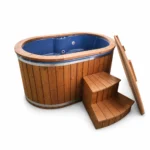
 2 Person Wood Fired Hot Tub – TimberIN Nordic DuoFrom: €2,481
 -
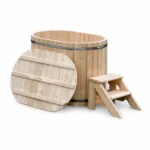
2-person wood tubTimberIN Nordic Duo™ WoodFrom: €1,959
-
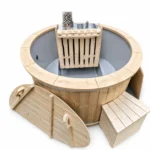
TimberIN Nordic Compact™ SnorkelFrom: €2,683
Choose one or two regular users before choosing a shape
Start with the people who will use the tub most often. A compact oval can give two users separate positions, while a small round tub can support a more social posture. A narrow rectangular form may fit a courtyard but can restrict shoulders or knees. Nominal person counts are model guidance, not a comfort guarantee.
Request a dimensioned interior drawing and compare it with body size, preferred water level and stove guard. The broader two-person hot-tub guide explains capacity and access in more detail.
Wood-fired soaking tubs
A wood stove can heat a compact outdoor tub without a large electric water-heater load, but the fire becomes part of the operating routine. External stoves preserve bathing space but add footprint and connecting pipes. Integrated heaters create a compact outline. Internal or snorkel heaters occupy water space and require the specified guard and water level.
Plan the stove door, chimney, ash route, dry-fuel store and clearances around the selected model. Never light a dry or inadequately filled system, obstruct circulation or drain the tub while the heater is hot. For a quieter category-wide comparison, use the wood-fired soaking-tub guide.
Electric heating and hybrid support
Electric heating can suit regular use and repeatable control, but the exact connected load matters. The heater, pump, filtration, lights, jets and controls must be assessed together. A compact shell does not mean that a normal plug or an existing outdoor socket is suitable.
Give a competent electrician the selected equipment schedule before approving the order. Agree cable routing, isolation, protection, testing and certification. If wood and electric support are combined, specify how the two systems are controlled and maintained. See the electric wooden hot-tub guide.
Heating time depends on water and weather
There is no reliable universal heat-up time for a Japanese-style tub. Operating water volume, starting temperature, useful heater output, insulation, cover, wind, fuel quality and circulation all matter. A smaller volume may heat faster than a family tub, but a weak heater or exposed site can reverse that advantage.
Ask for an estimate for the exact model under stated conditions. Measure water temperature with suitable equipment, mix or circulate as instructed and supervise the heat source. A fixed marketing figure without water volume and starting conditions is not a useful planning promise.
Timber, Thermowood and smooth liners
A traditional timber interior gives direct contact with wood but brings material-specific swelling, drying and cleaning behaviour. Species names should be verified rather than inferred from colour. Thermally modified wood is often used as exterior cladding or in approved constructions; it is not the same thing as Japanese hinoki simply because both are timber.
A fibreglass, acrylic or polypropylene interior provides a smooth water-contact surface and can reduce some of the maintenance associated with a fully wooden vessel. Exterior timber can retain the visual character. Ask which component each material describes, how it should be cleaned and which treatment products are approved.
Still water, bubbles or hydromassage?
Quiet soaking is the clearest link to the bathing idea, so jets should be chosen because users want them, not because a hot tub is expected to have them. Hydromassage jets create directed water movement; air systems create bubbles. Both add pumps, pipework, controls, noise, electrical load and cleaning duties.
If massage is the main priority, compare purpose-built hot tubs with jets. If stillness and compactness are the priority, remove unnecessary systems and keep the written configuration simple.
Water care: fill-and-drain or retained water?
Some private soaking routines use fresh water for a session and drain afterward. Other outdoor tubs retain filtered and treated water. The correct method depends on the approved product design, water source, bathing load and local discharge arrangements; it cannot be decided from the Japanese-style label.
Establish testing, treatment, filtration, cleaning and change intervals before use. Commercial and holiday-let operation needs a formal risk-based system, records and competent responsibility. The HSE spa-pool guidance explains the recognised infection risk in spa-pool systems and the duties relevant to business use.
Foundation, filled weight and drainage
A small footprint concentrates load. Obtain the empty weight, operating water volume and support drawing, then add users, stove, steps and accessories. A competent designer should specify the base for the actual ground and installation; visual levelness alone does not confirm capacity.
Plan complete drain-down and routine splash water. Keep discharge away from the foundation, buildings, neighbouring land and unsuitable drains. Treatment products can affect where water may be released, so follow the product instructions and local requirements.
Access and delivery for a deep compact tub
Compact does not always mean easy to move. A deep rigid shell may be taller than a gate or awkward to turn along a side passage. Record the packed width, height, length and weight; then measure gates after hinges, corners, eaves, steps, slopes and overhead cables. Photograph the complete route from road to prepared base.
Ask who unloads, who moves the tub to its final position and whether lifting equipment is required. Do not assume kerbside delivery includes craning, assembly, utility connection or commissioning.
Build a complete specification and budget
| Cost area | What to specify | Question to resolve |
|---|---|---|
| Tub body | External and internal dimensions, material, seating and water volume | Does the real posture suit the regular users? |
| Heating | Wood, electric or hybrid system, controls and chimney | Which duties and utilities does it add? |
| Water system | Fill-and-drain or retained water, filtration and treatment | What is the written care routine? |
| Access | Freight, unloading, route, lifting and final positioning | Can the packed product reach the base? |
| Site work | Foundation, drainage, electrical and fire-safe installation | Which competent trade owns each task? |
| Ownership | Fuel or electricity, cleaning, water care and servicing | Does the routine match expected use? |
Compare quotations only after these lines match. A low starting price can exclude necessary equipment or local work; a premium package can include features you do not need. Keep the confirmed configuration, drawings, delivery duties and warranty terms together.
Japanese-style soaking-tub checklist
- Confirm whether “Japanese” describes style, origin, material or a specific model feature.
- Request internal depth, seat height, legroom and step-over dimensions.
- Choose the normal users before choosing nominal capacity.
- Define wood, electric or hybrid heating and every powered accessory.
- Select still water, bubbles or jets deliberately.
- Write the water-care and drain-down method for the actual use.
- Design the foundation and drainage from final operating data.
- Audit the delivery route using packed dimensions and photographs.
- Record included equipment, exclusions and local-trade responsibilities.
Frequently asked questions
Is an ofuro the same as a hot tub?
Not automatically. In UK retail, ofuro often describes a deep compact soaking form, while hot tub can cover many social, heated and jetted systems. Compare dimensions, seating, heating and water care instead of relying on the name.
Are these tubs made in Japan?
Japanese-style does not prove Japanese manufacture. Check the stated country of manufacture, material specification and product documents. TimberIN products are manufactured in Europe unless an individual listing states otherwise.
Can a Japanese-style soaking tub be wood fired?
Yes, a compact deep tub can use an approved external, integrated or internal wood heater. The stove changes space, clearances, chimney, water-level and operating requirements, so use the arrangement specified for that model.
Is a deep soaking tub suitable for two people?
It can be, but person labels do not guarantee comfort. Request internal dimensions, seat geometry, water depth and heater intrusion, then compare them with both users and the entry method.
Do I need filtration?
That depends on whether the approved system is filled and drained for each session or retains water. Retained water normally needs a defined filtration, treatment, testing and cleaning routine; business use requires formal risk control.
Choose the tub from the inside out
Share the regular users, preferred posture, available footprint, access measurements, water plan and heater preference. TimberIN can then identify compatible compact models and provide a written configuration without treating a style label as a specification.