
What is a cold plunge tub?
A cold plunge tub is a purpose-built vessel for brief immersion in cold water, usually sitting or standing upright with the water at chest or shoulder height. Unlike an improvised ice bath in a domestic bath or a water butt, a dedicated cold plunge tub has insulated walls, a lid and – on both models here – its own cooling unit with circulation and filtration. That means the same water can be cooled, kept clean and reused rather than refilled and iced before every session.
The terms overlap. “Ice bath” usually describes the cold-water routine, “cold plunge” the short immersion itself and “cold plunge tub” the equipment. Many owners place one beside an outdoor sauna or hot tub to alternate warm and cold; if you are planning both, see outdoor sauna and cold plunge combinations and sauna and hot-tub combinations.
Choose a complete water system
A cold-plunge purchase includes more than the vessel. Temperature control, circulation, filtration, drainage, access and the way the water will be managed all affect whether the installation works in ordinary use. Begin with the available site and the person responsible for operating it, then compare the equipment supplied with each model.
The current range has two dedicated cold-plunge systems. Nordic Ice combines a polypropylene interior with WPC cladding; the Thermowood model uses a brushed AISI 316 stainless-steel interior. Both list circulation or filtration and temperature-control equipment. Neither should be mistaken for a bare tub that only becomes usable after an unspecified chiller is added.
The catalogue above contains those two cold-plunge products. A hot tub without a heater is not automatically an equivalent chilled system, and placing a vessel beside a sauna does not establish a suitable immersion routine. Compare the complete specification rather than buying from a recovery slogan or an attractive photograph.
The two current models, side by side
Use this comparison to identify the next questions for your quotation. Published dimensions are planning references; they do not replace a drawing of the ordered system with its equipment, connections and access spaces.
| Specification | TimberIN Nordic Ice | Thermowood stainless-steel plunge |
|---|---|---|
| Water-side material | Polypropylene interior | Brushed AISI 316 stainless steel |
| Exterior | WPC; black, brown or grey choices listed | Thermowood |
| Published dimensions | 93 cm inside diameter, 113 cm outside diameter, 100 cm height | 90 cm stated diameter and 90 cm height; confirm inside and outside measurements separately |
| Water volume | Approximately 500 litres in the technical sheet | No confirmed working volume published on the current page |
| Temperature equipment | Chiller with Wi-Fi control listed in the package | Poolex SpaWer O’SPA heating/cooling unit with Wi-Fi |
| Other included equipment | Filtration, stairs, insulated walls and lightweight insulated lid | Circulation/filtration, drain, wooden steps and matching equipment box |
The Nordic Ice technical sheet identifies one bather and provides the diameter, sill and stair references. The stainless-steel model is also described for individual use. Neither description establishes a suitable seated waterline for every body size.
Cold plunge tub sizes: one person, upright
Both current models are designed for one person sitting or standing upright, rather than lying back as in a bath. That keeps the water volume, the footprint and the cooling load modest compared with a shared tub.
- Nordic Ice: approximately 93 cm inside and 113 cm outside diameter, 100 cm high and about 500 litres. The supplied steps add roughly 90 cm on the access side.
- Thermowood stainless-steel cold plunge: published as Ø90 × H90 cm. Its water volume is not yet published, so ask for it with the filled weight.
For the footprint, add the tub, the steps, the cooling unit and enough clear space to service the equipment and step out safely. If you are tall or have limited mobility, check the seated water depth and the entry height before ordering – see planning the way in and out.
Cold plunge tub chiller range: advertised versus confirmed
Nordic Ice’s current product page advertises a 3–32°C range. Its linked sheet illustrates an HC-300A chiller but does not state that temperature range. Ask which chiller and controller will actually be supplied, the supported water-temperature range and the ambient conditions under which it applies. Do not treat the lower advertised number as a guaranteed result in every garden.
The Thermowood package currently names Poolex SpaWer O’SPA. The manufacturer’s O’SPA technical table gives an 8–28°C cooling range and a separate 10–40°C heating range. Its promotional FAQ mentions a lower cooling figure, so the exact supplied version and manual must resolve the difference. The O’SPA Flow is a different named product and should not be assumed to be included.
These are equipment specifications, not suggested immersion temperatures. The water setting suitable for an individual cannot be decided from a sales table. Before ordering, ask for the precise model reference, control modes, installation conditions and the evidence supporting any performance requirement that matters to your project.
Cold plunge tub temperature and session time
There is no single correct cold plunge temperature. As a general reference point, many home users set a cold plunge tub somewhere around 10–15°C, and people new to cold water usually start at the warmer end. Single-figure settings tend to be chosen only by experienced users. The RNLI notes that cold water shock can affect anyone in water below 15°C, so even the milder end of that range deserves respect.
Sessions are short. Newcomers commonly start with well under a minute and build up gradually; many regular users keep immersions to a few minutes. Colder or longer is not automatically better. Get out straight away if you are shivering hard, feel numb, dizzy or unwell, or cannot control your breathing.
Common-sense habits for every session
- Lower yourself in slowly and keep your head above the water.
- Have another adult nearby, and never leave children unsupervised around the tub.
- Do not plunge after drinking alcohol.
- Keep a towel and dry, warm clothes within reach and warm up gradually afterwards.
- If you have a heart condition, high blood pressure, are pregnant or have any other health concern, speak to your GP before starting.
These are general reference points, not personal or medical advice. Set the controller to a temperature you are comfortable with and remember that the supplied equipment’s range is a technical limit, not a recommended setting.
Cold plunge tub chiller or ice: two different routines
Adding ice to a suitable vessel lowers the water temperature as it melts, but the result changes with the starting water, quantity of ice, surroundings and time. It involves purchasing or producing ice, carrying it to the bath and allowing for the additional water. There is no universal number of bags that will deliver the same result for every tub.
An active chiller removes heat through a controlled water circuit. It can reduce the daily handling involved in an ice-assisted routine, but it adds electrical supply, maintenance, airflow and running costs. Both models shown here include temperature-control equipment, so confirm how their complete circuits are intended to operate before adding ice or changing the supplied arrangement.
A working chiller also needs time to reach its set point. Request an estimate using the actual starting water temperature, site conditions, volume and cover. Do not compare systems solely by the lowest display setting or assume that a colder limit means faster cooling under all conditions.
| Question | Cold plunge tub with chiller | Tub cooled with ice |
|---|---|---|
| Temperature | Set on the controller and held within the equipment’s capabilities | Depends on ice quantity, starting water and weather; rises as the ice melts |
| Effort per session | Low once running; routine water checks | Buying or freezing ice and carrying it to the tub each time |
| Services | Electrical supply, airflow around the unit and occasional servicing | Freezer space or ice purchases, plus extra water to drain |
| Water | Circulated and filtered, so it can be kept between sessions | Usually replaced more often |
| Best suited to | Regular, frequent use | Occasional use |
Design the equipment space as carefully as the bath position
Mark the vessel, steps, pumps, filter and cooling unit on the site plan. Leave the access required to open equipment covers, remove service parts and inspect connections. A wooden box can organise equipment, but enclosing a heat-rejecting unit without its specified airflow can undermine the installation. Confirm exactly what the box is designed to contain.
Consider nearby windows, bedrooms and seating when discussing equipment sound. Ask for noise information for the supplied unit at a stated distance and operating condition, rather than relying on the word “quiet”. Avoid positioning an air outlet where it will make the approach uncomfortable or where debris is likely to collect.
Outdoor suitability must cover the complete electrical and water system, not only weather-resistant cladding. Indoors, account for waterproofing, drainage, condensation, ventilation and the equipment’s heat discharge. A product described for indoor or outdoor use still needs a site designed for the selected location and the requirements of its supplied components.
Plan an uncomplicated way in and out
The depth and width that work for one person may be awkward for another. Nordic Ice lists an integrated seat, but its public drawing does not provide a complete seat-height and working-waterline specification. The stainless-steel model’s 90 cm height is an external product dimension, not a promise about immersion depth or the movement needed to enter.
Ask for the internal layout, entry point, step dimensions and any approved support points. Nordic Ice’s sheet shows stairs with 31 cm and 61 cm height references and a 90 cm length. Check those against the supplied stair and final rim height, especially if the bath will stand on a raised base.
The surrounding surface should remain stable and suitable for wet feet, with enough clear space to turn, step away and dry off. Do not route hoses or cables across that path. If balance, strength or mobility is a concern, resolve the access arrangement before buying rather than expecting a loose stair to solve it afterwards.
Cold water still needs an active hygiene routine
Cooling does not make water sterile. A filter captures particles, while a suitable water-management routine addresses the condition of the water and the system carrying it. The supplied instructions should explain testing, compatible treatment, filter cleaning, water replacement and the action to take when results are outside the specified limits.
Agree who checks the water and how those checks are recorded. Include the vessel, circulation circuit, filter housing, hoses and any hard-to-reach surfaces. Clear-looking water and an app showing the expected temperature are not evidence that the complete system is ready for use. If the water or equipment condition is uncertain, resolve that before bathing.
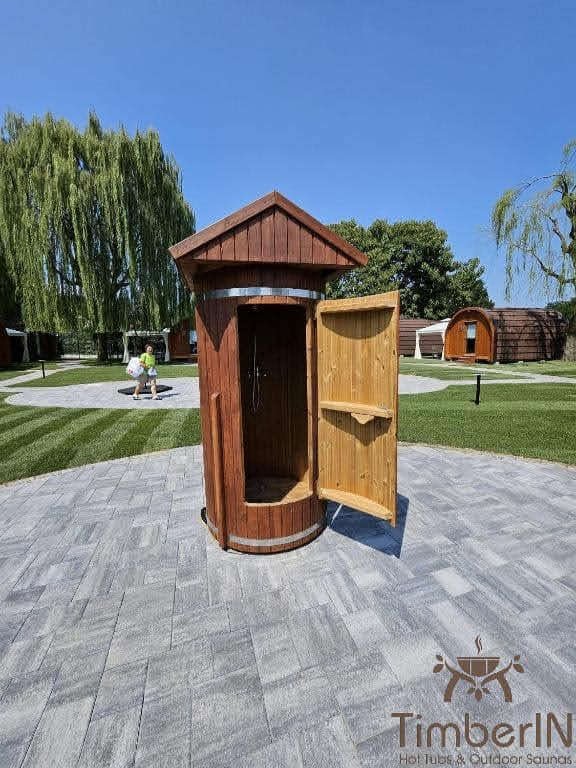
A pre-bathing rinse can reduce material carried into the tub. A separately supplied outdoor shower may help with that routine, but its own water supply and drainage need planning. It does not replace the plunge’s treatment system or cleaning procedure.
Metal or polypropylene? Choosing a cold plunge tub material
Interest in metal cold plunge tubs has grown quickly, and the choice of interior shapes how the tub looks, feels and is cleaned. The two current models take different routes:
- Stainless steel (metal): the Thermowood model uses a brushed AISI 316 stainless-steel tub – a seamless, hard-wearing surface that is easy to reach and wipe down.
- Polypropylene: Nordic Ice has a moulded polypropylene shell with insulated walls, offered in five interior colours (white, black, blue, light grey and dark grey).
- Exterior: Thermowood cladding on the stainless-steel model; WPC (wood-plastic composite) in black, brown or grey on Nordic Ice.
Neither material is “best” for everyone. Choose the look and surface you prefer, then check the cleaning routine and approved products below.
Match cleaning products to the interior
Nordic Ice’s polypropylene shell and the stainless-steel plunge require care appropriate to their materials and equipment. Ask for approved cleaners and treatment products, including concentration limits, contact times and rinsing instructions where applicable. Avoid assuming that a stronger chemical or abrasive pad is a better way to clean a difficult mark.
AISI 316 stainless steel is not a promise of immunity to every chemical or water condition. Preserve the brushed surface using the specified method and keep the drainage fittings and connections accessible for inspection. On the polypropylene model, check how the seat, joins and fittings should be cleaned without damaging seals or surfaces.
The exterior also needs attention. WPC cladding changes the finishing routine compared with Thermowood, but neither choice removes the need to keep vents clear, inspect the base and clean dirt from accessible surfaces. Choose the appearance you prefer, then make sure its routine maintenance is practical in the planned position.
Check supply, filled load and drainage before delivery
Nordic Ice’s approximate 500 litres adds about 500 kg of water before the vessel, bather and equipment. That is enough to make support design important even though the bath occupies a small area. The stainless model’s working volume is not confirmed on its current page, so obtain it rather than estimating the operating load from a simple cylinder calculation.
Have the base assessed for the complete system and its support points. Raised decking, balcony positions and locations beside foundations require particular care. Keep the water-discharge route from washing out the support, pooling around timber or flowing onto neighbouring property.
List every powered component before arranging the electrical supply. The cooling unit, circulation pump and controls must work as the manufacturer specifies, with the correct protection and isolation for the location. Agree connection responsibilities with the installer. Neither a Wi-Fi feature nor a compact appliance size establishes that the system can be connected safely to any convenient socket.
Use covers and controls to support operation
Nordic Ice lists insulated walls and a lightweight insulated lid in its current package. The Thermowood model’s inclusion list does not clearly identify an insulated tub cover, so confirm that item explicitly. Ask about fit, removal, storage and securing arrangements rather than assuming a cover seen in a photograph will arrive with the order.
Covering the bath between uses can help limit debris and unwanted heat exchange, but it does not establish water hygiene or make unsupervised access acceptable. Check whether any claimed access-prevention function is documented for that specific cover. Leave a clear place to put the lid while entering and exiting.
Both systems list Wi-Fi control. Confirm which functions the app actually operates and how the equipment behaves after a power or network interruption. Remote scheduling can support preparation; it cannot inspect the water, detect every obstruction or supervise a person in the bath. The owner still needs local checks and the supplied operating instructions.
Treat cold immersion as a separate personal decision
Cold immersion is not suitable for everyone. The RNLI explains that cold water can rapidly affect breathing and movement and place strain on the heart. Owning purpose-built equipment does not remove those effects. Seek advice from an appropriate healthcare professional before starting if you are unsure whether cold immersion is suitable for you.
Do not use the bath alone. Arrange a clear exit, someone able to help and a way to call for assistance. The RNLI’s cold-water guidance emphasises companionship and accessible entry and exit; its open-water advice is useful risk context, not a treatment protocol for this equipment.
The temperature and time figures on this page are general reference points, not a personal programme or a prescribed hot-to-cold sequence, and this guide does not promise recovery, immunity, weight loss or other medical outcomes. A sauna nearby is a separate purchase and operating decision. Compare outdoor saunas or electric outdoor saunas by their own specifications, rather than treating a pairing as a universal programme.
For shared use, define who is responsible
A gym, accommodation business or shared facility needs more than the domestic owner’s shopping list. Agree the intended user group, supervision arrangements, water-management duties, cleaning between users, inspection records and response to equipment faults. Establish when the bath must be taken out of use and who can authorise its return.
HSE’s pool-management guidance explains the role of a site-specific risk assessment and competent operation. A specialist should determine the requirements relevant to the particular facility. The words “professional” or “commercial” on a product page are not an approval of your proposed installation.
Build in time for maintenance, water changes and unexpected downtime. Include winter shutdown or frost-management arrangements for all water-holding components. Confirm the permitted ambient conditions and any drain-down process in the supplied documents; an insulated bath does not automatically protect its external pump and pipework.
Cold plunge tub FAQ
What is a cold plunge tub?
A purpose-built, insulated tub for short cold-water immersion, usually for one person sitting upright. The models here include cooling equipment and filtration, so the water can be chilled and kept between sessions instead of being refilled with ice each time.
What temperature should a cold plunge tub be?
There is no single right setting. As a general guide, many home users choose around 10–15°C, and beginners usually start at the warmer end. Cold water shock can occur below 15°C, so start gently and seek medical advice first if you have any health concerns.
How long should you stay in a cold plunge tub?
Keep it short. Newcomers often start with well under a minute and build up gradually; many regular users stay in for a few minutes at most. Get out at once if you feel numb, dizzy, unwell or cannot control your breathing.
Do I need a chiller for a cold plunge tub?
Not to take a cold bath, but a chiller removes the need to buy and carry ice, holds a set temperature and works with filtration so the water can be kept. Both current models include temperature-control equipment.
Is a stainless-steel (metal) cold plunge tub better than polypropylene?
They suit different preferences. Brushed AISI 316 stainless steel gives a seamless metal interior; polypropylene is a moulded shell available in several colours with insulated walls. Compare the look, cleaning routine and complete package rather than the material alone.
How much does a cold plunge tub cost?
Current prices are shown on each model in the catalogue above. Delivery is charged by UK zone; also budget for the base, electrical connection and any groundwork.
Do these models include cooling equipment?
Yes. Nordic Ice lists a chiller, while the Thermowood stainless-steel model lists a Poolex SpaWer O’SPA heating/cooling unit. Confirm the exact supplied model, supported operating range and required services in the quotation.
Is the lowest temperature the best buying target?
No. Compare the documented equipment range, water management, access and site requirements. A low set point is neither a guarantee of performance in every condition nor a recommendation for a person’s immersion temperature.
Can a normal hot tub simply become the same system?
Not without an approved specification for the complete conversion. A cold-plunge system needs compatible temperature control, circulation, filtration and access. The wood-fired hot-tub range remains a separate comparison for warm bathing.
Request the complete operating specification
Send the site location, intended private or shared use, access needs and available services. Ask for the vessel drawing, working volume, exact cooling unit, control limits, filtration, cover, maintenance requirements and delivery responsibilities in one written quotation.