
Hybrid Outdoor Saunas: Wood and Electric Planning Guide
“Hybrid outdoor sauna” can describe several different projects: a sauna model offered with either wood-fired or electric heating, one site with more than one sauna system, or a broader wellness area where the sauna and hot tub use different energy sources. It does not automatically mean that two heaters can be installed in one room.
This guide clarifies those meanings, compares wood and electric operation, and explains compatibility, utilities, controls, site work and quotation questions before a flexible-heating project is ordered.
Hybrid rule: every heater, room and control arrangement must be explicitly approved as one configuration. Do not add a second heat source to an existing sauna because the space appears large enough.
What “hybrid sauna” can mean
| Hybrid use of the term | What it actually describes | What to verify |
|---|---|---|
| Choice at order | The same sauna family can be configured with wood or electric heat | Which option is selected and included in the quotation |
| Dual-heater room | One hot room is engineered for two separate heat sources | Explicit manufacturer approval, layout, controls and clearances |
| Hybrid wellness project | Sauna, hot tub, shower or plunge use different systems | Separate utilities, drainage, controls and responsibilities |
| Site resilience | More than one facility or energy source supports flexible operation | What remains usable during an outage or fuel interruption |
Use precise language in the order. “Wood or electric” is not the same as “wood and electric”, and a combined sauna-and-hot-tub project is not necessarily a dual-heated sauna.
Outdoor sauna models for heating comparison
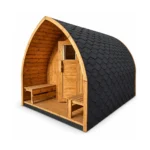
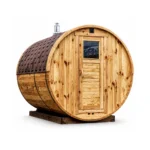
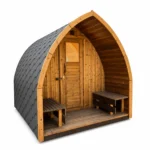
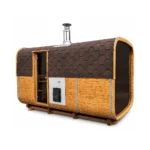
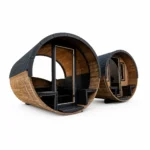
The current outdoor-sauna catalogue appears below. Open a model to review its available heater choices, then request a written configuration that identifies the selected room and heating package.
-
Custom pod
 TimberIN Nordic Pod™ CustomFrom: £4,327
 -
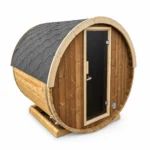
Classic barrelTimberIN Nordic Barrel™ ClassicFrom: £4,106
-
Product on saleSave up to 19%TimberIN Nordic Pod™ PorchFrom: £5,957From: £5,006 -
Square barrelTimberIN Nordic Square Barrel™From: £6,056
-
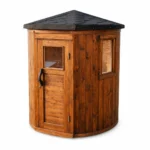
Space-savingTimberIN Nordic Vertical™From: £4,127
-
2-person electricTimberIN Nordic Terrace™ 160 ElectricFrom: £5,192
-
Panoramic glazingTimberIN Nordic Hobbiton™ GlassFrom: £7,348
-
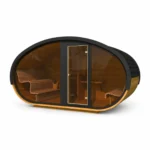
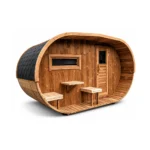
Terrace modelTimberIN Nordic Oval™ TerraceFrom: £7,590
-
Panorama for 4TimberIN Nordic Barrel Panorama™£8,085
Wood-fired and electric heating compared
| Decision factor | Wood-fired | Electric |
|---|---|---|
| Daily routine | Fuel preparation, lighting, monitoring and ash | Controls, preheat and shutdown |
| Site infrastructure | Fuel store, combustion air, shielding and chimney | Supply capacity, cable route and protective equipment |
| User access | Trained person responsible for the fire | Permissions for panel, timer or remote control |
| Maintenance | Stove, stones, ash and chimney | Heater, stones, sensors and electrical system |
| Best fit | Fire-led sessions and suitable lower-power sites | Repeatable home or managed operation |
Read the dedicated guides to wood-fired outdoor saunas and electric outdoor saunas before choosing between them.
Can one sauna room use both heater types?
Only where the sauna manufacturer and both heater specifications support the exact dual arrangement. Two heaters change floor space, clearances, guarding, ventilation, sensors, controls and the heat load. One system may also obstruct safe access to the other.
Ask for a factory drawing that shows both heaters, bench and door positions, air inlets and outlets, chimney, electrical connection and operating restrictions. If no approved drawing and written specification exist, treat the project as a choice between heaters rather than a dual-heater room.
When flexible heating is genuinely useful
Flexibility is valuable when sites operate in different ways. A retreat may want wood-fired sessions for hosted events and electric heat in another sauna for repeat bookings. A home project may choose between heater packages before production based on the available supply and smoke-control position.
It is less useful when extra equipment is added only as insurance against poor planning. Two systems cost more, occupy space and require separate maintenance. Resolve supply, fuel, staffing and local constraints first; the simplest suitable system is often easier to own.
Who should—and should not—consider hybrid planning?
A site with distinct hosted and self-service sessions, more than one wellness unit or genuinely variable utilities may benefit from comparing energy sources at project level. Hybrid planning can also be useful before ordering when the owner has not yet confirmed whether the electrical supply or smoke-control position favours one heater.
A small private sauna with one reliable utility usually does not need two installed heat sources. Buyers seeking the lowest upfront cost, simplest operation or minimal maintenance should compare one correctly sized heater first. Flexibility has value only when the expected operating modes are written down and used often enough to justify the added equipment.
Room volume, glazing and compatibility
Each heater must be sized for the effective room volume and construction. Glass and less-insulated surfaces affect the calculation. If two heaters are approved, the design should state whether they may operate separately, alternately or under any interlock; never assume simultaneous operation.
The bench and door plan must preserve safe movement and clearances. A room that fits one heater comfortably may become cramped when a stove, electric unit, guards and controls are combined.
Utilities, controls and failure modes
An electric system needs the exact load assessed against the supply and cable route. A wood system needs an approved chimney, combustion air and fuel plan. Hybrid wellness areas can add pumps, hot-tub heaters, lighting and water systems, so create one schedule of all connected loads and services.
Document what happens during a power cut, control fault, chimney problem or fuel shortage. A wood stove may continue without mains electricity, but that does not make every light, pump or related facility off-grid. Safe shutdown and isolation belong in the handover.
Sauna and hot-tub combination projects
A combined wellness area may use an electric sauna and wood-fired hot tub, a wood-fired sauna and electric spa, or other approved arrangements. Treat each as a separate technical system with its own heater, controls, water or ventilation needs and maintenance schedule.
Plan the user journey between heat and bathing, but do not combine drainage, electrical and fire assumptions. The sauna base and hot-tub foundation, water discharge, electrical zones, chimney routes and service access all need to work together on the site plan.
Smoke control, electricity and local requirements
Wood burning can be affected by smoke-control rules and neighbours, while electrical work must follow the requirements for the relevant UK nation and property. Check the postcode, appliance and fuel using the UK Smoke Control Areas service, and give the exact electric heater data to the installer.
Planning and building requirements also depend on dimensions, position and use. A “hybrid” label does not create an exemption. Ask the local authority and competent advisers about the actual combined project.
Foundation, delivery and installation sequence
Prepare the stable, level base from the final model drawing, including support for any adjacent hot tub or services. Fix heater positions, chimney and cable routes before the foundation and orientation are final, because external loading or control access can change the layout.
Survey the delivery route and assign unloading, lifting, assembly, electrical work, stove and chimney work and commissioning. Where several contractors are involved, identify who coordinates interfaces and who confirms that the completed system matches the approved configuration.
Operation, maintenance and records
More systems require more disciplined ownership. Keep separate instructions and service schedules for each heater, chimney, electrical control and any water equipment. Staff at a managed site should know which system is active, who can operate it and how to isolate faults.
Record commissioning, inspections, repairs and replacement parts. Do not allow an unused second heater to become an unmaintained obstacle inside the room. If operating practice changes, review the training and risk controls before offering the new mode to guests.
Hybrid sauna quotation checklist
- Define whether “hybrid” means a choice, a dual-heater room or a multi-system site.
- Name every heater, controller, stove, chimney and stone package.
- Obtain a drawing showing benches, doors, clearances and ventilation.
- Confirm permitted operating combinations and any interlocks.
- Schedule all electrical loads, fuel, air, water and drainage requirements.
- Assign foundation, delivery, installation and commissioning responsibilities.
- Document safe shutdown, maintenance and user permissions for every system.
- Compare the complete project cost with one simpler heating choice.
Frequently asked questions
What is a hybrid outdoor sauna?
The term can mean a sauna offered with alternative heater choices, an approved dual-heater room, or a wellness site using different energy sources. The quotation should define which applies.
Can I add an electric heater to a wood-fired sauna?
Only if the sauna and both heater manufacturers approve the exact arrangement. Room layout, clearances, ventilation, controls and electrical work all need redesign and documentation.
Can both sauna heaters run at the same time?
Do not assume so. The approved design and controls must state permitted operating modes. If the documents do not allow simultaneous operation, it must not be used that way.
Is a hybrid sauna better for off-grid use?
Not automatically. A wood stove can heat without mains power, but electric heaters, lights, pumps and controls still need an adequate supply. Review the complete site load.
Is hybrid heating cheaper to run?
It depends on fuel and electricity prices, usage and system efficiency. Extra equipment also adds purchase and maintenance cost, so compare whole-life cost with one suitable heater.
Define the hybrid system before pricing it
Share the intended operation, sauna model, room volume, site utilities, postcode and any hot-tub or plunge components. The first task is to establish a compatible configuration—not to add every available heater.