
Scandinavian Hot Tubs: Nordic Design for UK Gardens
A Scandinavian-style hot tub is best understood as a design approach rather than a protected product class. Buyers usually mean a simple outdoor vessel, natural-looking timber, practical seating and a direct heating system suited to year-round bathing. Those qualities can be achieved with traditional coopered timber or a modern lined construction, and with wood, electric, pellet or approved hybrid heating.
This guide separates Nordic appearance from the engineering decisions that determine comfort and ownership: internal space, water volume, heater position, insulation, cover, water care, frost protection, foundation and delivery. TimberIN is a European manufacturer; “Scandinavian” or “Nordic-style” on this page describes the design tradition and does not claim that every model was manufactured in Scandinavia.
Nordic-design rule: judge the simple appearance and the hidden system separately. A clean round silhouette is useful only when the seating, heater, water care and winter plan fit the site.
Current round and Nordic-style hot-tub models
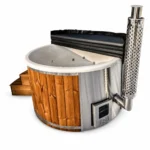
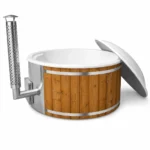
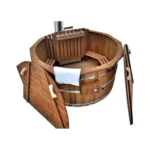
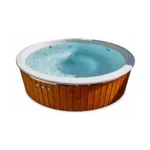
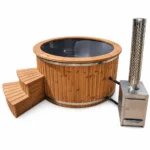
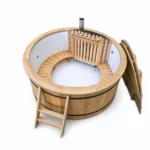
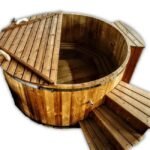
The live round selection below reflects the form most often associated with Nordic outdoor bathing. Open a product to check the actual vessel construction, size, heater, cladding, equipment and options. A round shape or Nordic model name does not by itself establish country of manufacture or one standard specification.
-
Product on saleSave up to 16% Wood Fired Hot Tub with Jets – TimberIN Nordic Rojal™ (4–8 Person)
From: £6,785From: £5,874 -
Modular coreTimberIN Nordic Core™From: £3,289
-
ThermowoodThermowood Hot Tub – TimberIN Nordic™ Deluxe (Wood-Fired, 4–8 Person)From: £3,200
-
Electric heatingElectric Wooden Hot Tub for Garden Use – TimberIN Nordic Family™ ElectricFrom: £2,903
-
External stoveWood Fired Hot Tub with External Stove – TimberIN Nordic™ External ComfortFrom: £3,300
-
PolypropylenePolypropylene Hot Tub – TimberIN Nordic Flex™ (160–220 cm, Configurable)From: £2,537
-
Traditional timberWood Fired Wooden Jacuzzi – Traditional Timber Hot TubFrom: £2,751
-
Spruce value modelWooden Hot Tub Basic – TimberIN Nordic™ (Affordable Wood Fired Model)From: £2,276
-
Compact for 44 Person Wood Fired Hot Tub – Compact Snorkel Stove DesignFrom: £2,891
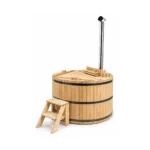
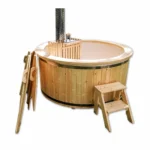
What makes a hot tub feel Scandinavian?
The familiar visual language uses a restrained form, visible timber, uncluttered detailing and a strong relationship with the garden or sauna. In practical terms, that can mean circular social seating, an uncomplicated soaking experience, an external or integrated wood stove and materials intended to weather outdoors.
None of those features is mandatory. A square lined tub with electric control may support the same calm outdoor routine. Start with how people sit, heat and maintain the tub, then choose the finish. Design is credible when it simplifies use rather than hiding equipment that still needs access.
Traditional wooden vessel or modern lined tub?
A traditional coopered tub retains water through fitted timber staves, hoops and moisture-dependent joints. Owners must accept timber movement and follow instructions for filling, drying, cleaning and storage. A lined tub uses a moulded shell or liner for water retention and adds timber cladding for appearance. It normally allows a wider range of colours and spa equipment.
Ask which material touches the water, which is structural and which is decorative. The same thermowood exterior can surround different liners or vessel sizes. The wooden hot-tub guide explains this construction difference.
Round seating supports conversation—but verify usable space
A circular bench lets users face one another and can distribute legroom around a shared centre. Its external diameter does not reveal the internal diameter, bench depth, footwell, waterline or stove intrusion. An internal heater can occupy part of the circle; an external heater preserves seating but adds site footprint.
Sketch the regular users on a dimensioned plan. Nominal person counts describe close capacity, not equal comfort for every body. Compare the round hot-tub guide with the square guide if the terrace or seating posture favours defined sides.
Wood-fired heating is traditional, not compulsory
Wood firing fits the ritual of preparing an outdoor bath and can heat without a large electric water-heater load. It requires dry suitable fuel, stove and chimney access, ash handling, supervision and temperature management. External, integrated and internal heaters change seating and circulation differently.
Electric control may suit frequent scheduled use, while a compatible pellet burner or approved hybrid package can serve another routine. Do not choose on cultural image alone. Compare the selected water volume, useful heat, utilities and maintenance on the wood-fired, electric and pellet guides.
Spruce, larch and thermally modified timber play different roles
Available exterior choices can differ in grain, colour, cost and maintenance. Spruce offers a traditional pale appearance; larch has its own colour and weathering character; thermally modified timber is valued for altered moisture behaviour and dimensional stability. Exact grade, treatment and component remain more useful than a broad wood name.
ThermoWood® is a registered quality mark, not a generic term for every heat-coloured board. The International ThermoWood Association explains its process and classes. Ask what is actually used on the selected model and whether it forms cladding, trim, bench or vessel.
Insulation and cover decide much of the cold-weather performance
A Nordic label does not guarantee one insulation level. Compare wall and floor build-up, pipe protection and the fitted cover. Water volume and temperature rise create the basic heat demand; wind, exposed surface, shell, pipes and cover determine losses. A smaller well-covered tub can fit a regular household better than a large tub chosen for occasional guests.
Ask for heat-up evidence under stated volume, starting temperature, weather, fuel and cover conditions. Fixed “winter heat-up” promises are weak when those inputs are missing.
Year-round bathing needs a complete frost procedure
Decide whether water remains in the system or is drained between uses. The visible vessel is only one water-holding part: heater jackets, pipes, valves, pumps, filter housings, jets and air lines can retain water and crack when frozen. Follow model-specific low points and never light or energise an uncertain frozen circuit to improvise a thaw.
Water care must match the construction and operating pattern
Fill-and-drain soaking differs from retaining shared warm water. Retained water normally needs suitable filtration, treatment, testing and cleaning. A solid-timber interior may have different chemical limits from a liner, heater and spa pipework. Choose a compatible routine before selecting accessories.
Holiday-let and other business use requires a formal risk-based water-management system. A rustic appearance does not reduce hygiene responsibilities or make clear water proof of safety.
Pairing a hot tub with an outdoor sauna
A sauna-and-tub garden can create a coherent bathing sequence, but each system needs safe access, drainage, utilities and supervision. Keep stove doors, chimneys, steps and wet paths from competing for the same circulation space. Outdoor cooling and contrast bathing should remain voluntary and appropriate for the user’s health.
Plan the combined site with the sauna and hot-tub combo guide rather than positioning two products independently and joining the routes later.
Foundation, drainage and delivery are part of the design
Obtain empty weight, operating water volume and support requirements, then add bathers, heater, steps and equipment. The base must be level and stable for the complete load. Plan full drain-down and splash water so they do not erode support or enter unsuitable drainage.
Measure gates, turns, slopes, walls, eaves and cables with packed dimensions. Confirm freight, unloading, lifting and final placement separately. Leave stove, drain, filter and pump access after landscaping. A clean minimalist installation should not make service impossible.
Compare the system behind the appearance
| Design choice | Visible effect | Hidden question |
|---|---|---|
| Round form | Social circular seating | What are the internal diameter, footwell and heater intrusion? |
| Timber exterior | Natural Nordic appearance | Is it cladding or vessel, and what maintenance applies? |
| Wood stove | Traditional fire-led ritual | Where are the door, chimney, guard, circulation and ash route? |
| Minimal equipment | Uncluttered soaking experience | How will water be treated, tested, filtered or replaced? |
| Decked setting | Integrated garden composition | Can the base carry the load and every service point be reached? |
| All-season claim | Winter lifestyle promise | What is the exact insulation, cover and freeze procedure? |
Country of design, manufacture and delivery should be stated separately
Nordic-style design does not prove that a product is made in Sweden, Finland, Norway or Denmark. Ask where the tub is manufactured, where components originate when relevant, and who supplies warranty and service. TimberIN manufactures in Europe and supplies UK projects; this page uses Scandinavian and Nordic to describe design intent, not to rewrite origin.
Compare complete project cost
Price the selected size, vessel, cladding, stove or electric system, chimney, cover, steps, insulation, filtration, spa options and delivery. Add lifting, foundation, drainage, electrical work, landscaping, fuel or tariff, water care and maintenance. Use the price guide to align written quotations.
Scandinavian hot-tub buying checklist
| Decision | Record in writing | Do not assume |
|---|---|---|
| Origin and style | Manufacturer, model and documented design description | Nordic appearance equals Scandinavian manufacture |
| Construction | Water-retaining vessel, cladding and structural support | All visible wood touches the water |
| Capacity | Internal dimensions, seat plan and water volume | Person labels mean equal adult comfort |
| Heating | Source, heater position, output evidence and utilities | Wood firing is the only authentic option |
| Winter | Insulation, cover and every drain or protected component | Nordic branding guarantees frost resistance |
| Site | Load, base, drainage, access, lifting and service clearances | A simple silhouette means simple installation |
Frequently asked questions
What is a Scandinavian hot tub?
It is a design description rather than one technical standard. Buyers usually mean a simple outdoor soaking vessel with natural materials and practical heating. Verify construction, origin and configuration separately.
Are Scandinavian hot tubs always wood fired?
No. Wood firing is traditional, but electric, pellet and approved hybrid systems can support a Nordic-style tub. Choose the heat source for the routine, utilities and site.
Are Nordic hot tubs made in Scandinavia?
Not necessarily. Nordic can describe form or marketing. Ask for the actual manufacturer and country of manufacture. TimberIN is a European manufacturer and does not use this page to claim Scandinavian production.
Can a Scandinavian-style hot tub stay outside in winter?
Yes when the selected construction, cover and freeze-protection or drain-down procedure suit the conditions. Branding does not replace model-specific winter instructions.
Is a round hot tub better than a square one?
Neither is universally better. Round tubs support circular social seating; square tubs can align with terraces and defined seating. Compare internal dimensions, posture, heater position and site footprint.
Choose the Nordic system, not only the silhouette
Share the users, heating routine, preferred vessel, exterior, site, access and winter plan. TimberIN can then identify current models and document the actual manufacture, materials and configuration.