
Wooden Hot Tubs: Timber, Heating and a Practical UK Guide
A wooden hot tub may be a traditional vessel in which the timber itself holds the water, or a smooth lined tub finished with real-wood cladding. From the garden they can look closely related; once filled, their cleaning, drying and maintenance routines are quite different.
The first decision is therefore what should be in contact with the water. An all-wood tub offers the most traditional experience and relies on accurately made staves swelling to seal. A lined model keeps the natural exterior but provides a smoother interior that is generally easier to inspect and combine with filtration, lights or massage systems.
After that choice, compare timber species, heater position, usable internal diameter and insulation as one system. The model also has to suit the foundation, delivery route and amount of routine care you genuinely want to undertake through a British winter.
Best starting point: decide between water-contact timber and a smooth liner before choosing the wood finish or accessories. That single choice has the greatest effect on filling, cleaning, dry storage and long-term ownership.
Safety note: never light a wood-fired heater until the required water level and circulation are established. Hot water can cause dizziness or dehydration; supervise children, avoid alcohol and seek medical advice if pregnancy, a cardiovascular condition, medication or another health concern may affect safe use.
Current wooden hot-tub models
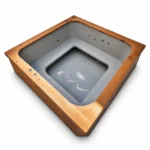
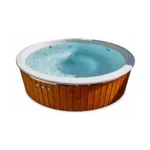
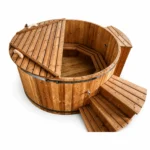
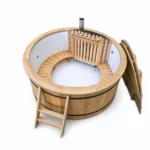
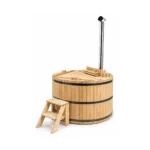
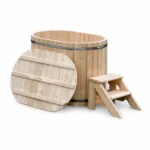
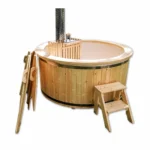
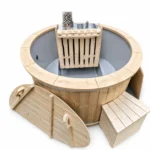
The current models and prices appear below. Open the relevant product page to confirm the diameter, timber, heater, seating arrangement and available options for the configuration you are considering.
Choose the water-contact construction first
| Decision | Traditional all-wood tub | Wood-clad tub with smooth liner |
|---|---|---|
| Water contact | Water is held directly by the timber staves. | Water is held by polypropylene, fibreglass or another formed shell. |
| Appearance | Most traditional inside and out. | Natural exterior with a smoother, more contemporary interior. |
| First fills | Timber may need time to swell and seal naturally. | Shell is normally watertight without timber swelling. |
| Cleaning | Requires timber-compatible cleaning and water care. | Smooth surface is generally easier to wipe and inspect. |
| Dry storage | Prolonged drying can open joints until the timber swells again. | Exterior timber may dry without affecting shell watertightness. |
| Options | Often chosen for simplicity and traditional bathing. | Usually easier to combine with filtration, lights, bubbles and jets. |
What exactly is a wooden hot tub?
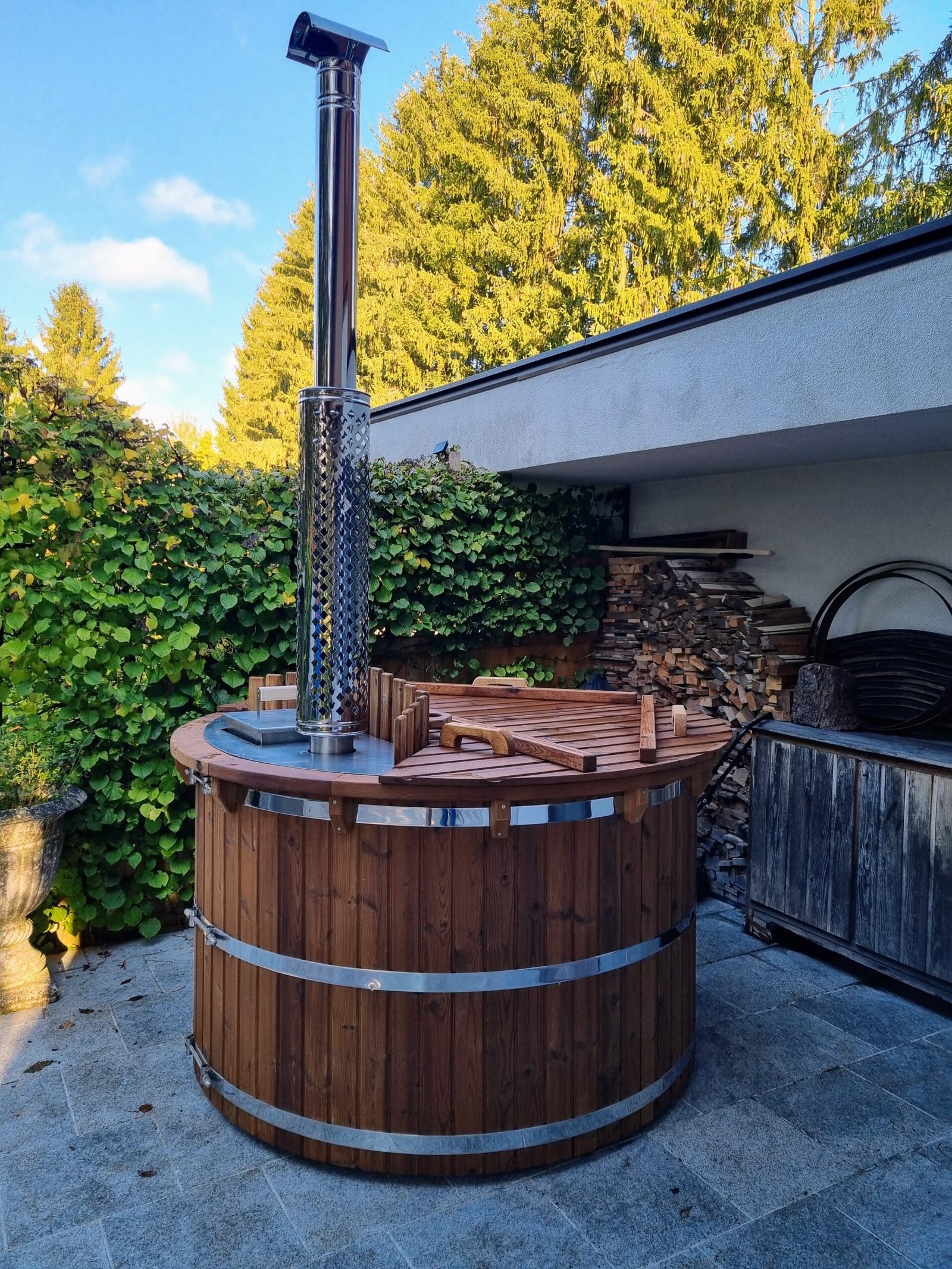
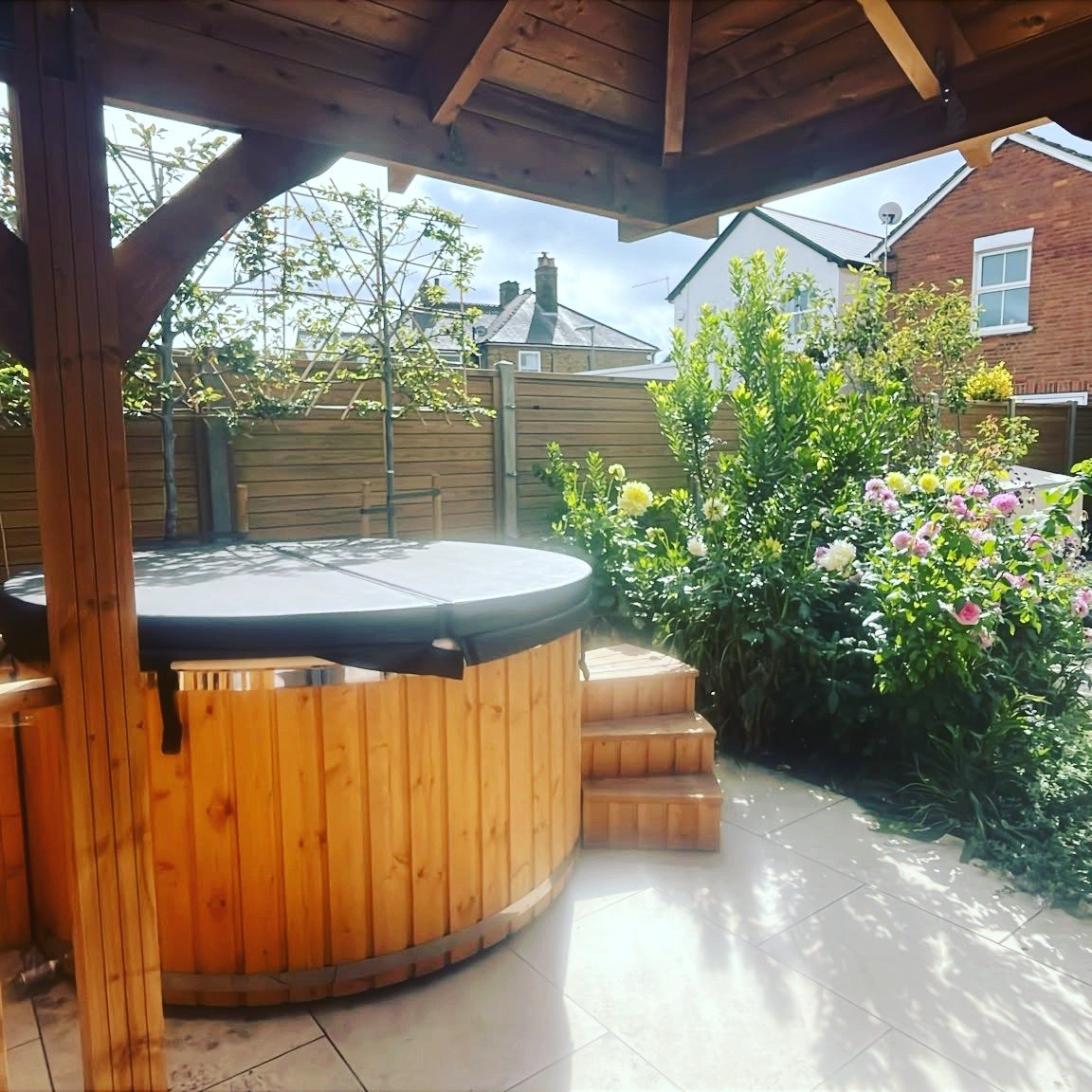
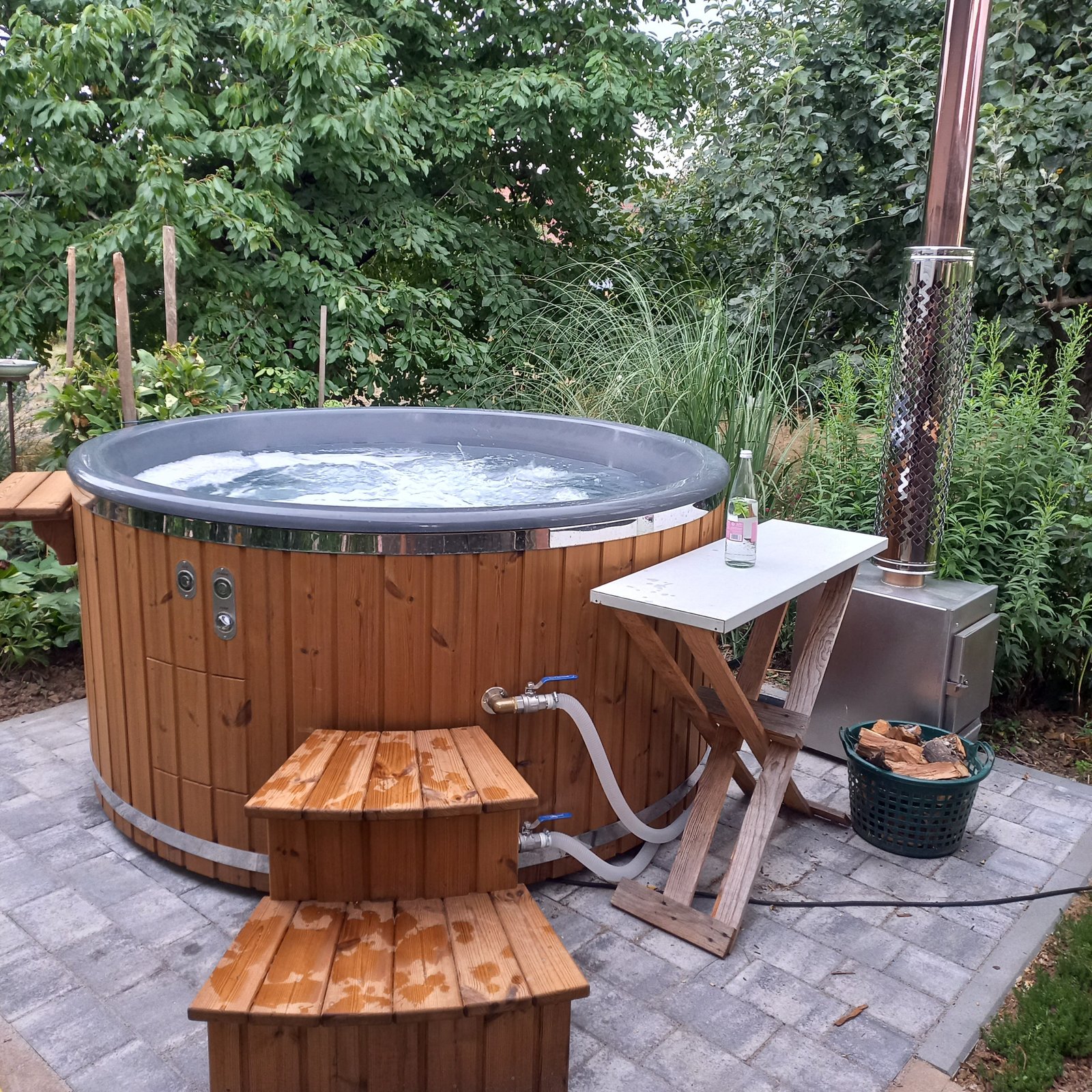
The phrase can describe the structural bath itself or the exterior finish. In a traditional wooden tub, vertical timber staves are held together by metal bands and the timber forms the watertight vessel after it absorbs moisture and expands. In a liner model, the water is held by a separate shell while the timber forms the visible outer cladding and part of the supporting structure.
- Water-contact timber — Why it matters: Determines how the tub reacts to drying, refilling, cleaning products and long periods without water.
- Exterior cladding — Why it matters: Affects appearance and weathering but may not determine how the water is contained.
- Bands and fixings — Why it matters: Traditional tubs depend on correct compression and regular visual inspection.
- Internal benches — Why it matters: Influence comfort, usable diameter and cleaning access.
- Heater connection — Why it matters: Must suit the chosen construction and remain accessible for maintenance.
- Drainage design — Why it matters: Controls whether water can be emptied completely before frost or servicing.
Traditional wooden tub or smooth internal shell?
Neither construction is universally better. A traditional wooden tub appeals to buyers who want direct contact with timber and accept that natural material movement is part of ownership. A lined hot tub suits buyers who want a wooden appearance with easier cleaning, more predictable dry storage and a wider range of technical options.
- The authentic bathing material is the main attraction. — Choose a wood-clad liner tub when…: You prioritise a smooth, easy-to-clean interior.
- You understand swelling, shrinkage and seasonal timber movement. — Choose a wood-clad liner tub when…: You expect periods when the tub may stand empty.
- You prefer simpler equipment and fewer concealed systems. — Choose a wood-clad liner tub when…: You want filtration, jets, lights or automated heating.
- You can use timber-compatible water-care methods. — Choose a wood-clad liner tub when…: You want broader compatibility with standard spa-management systems.
- You accept minor natural variation in grain, knots and checking. — Choose a wood-clad liner tub when…: You prefer a more uniform internal finish.
A smooth liner does not make the hot tub maintenance-free. Pumps, filters, heaters, covers, pipework and exterior timber still need inspection and care.
How wood becomes watertight
Traditional wooden tubs rely on precision-made staves and the natural swelling of timber. When first filled—or refilled after a long dry period—small amounts of seepage can occur while the timber absorbs water and expands. This should be distinguished from a damaged component, loose fitting or installation fault.
- Follow the manufacturer’s filling procedure rather than tightening bands aggressively at the first sign of seepage.
- Keep the tub evenly supported and level so the staves are not distorted.
- Do not allow a wood-fired heater to operate before the required water level and circulation are established.
- Inspect fittings, drain points and heater connections separately from stave joints.
- Expect the behaviour after prolonged dry storage to differ from a tub kept in regular use.
Natural swelling can seal minor stave joints, but it should never be used to explain a leaking fitting, cracked pipe, damaged heater connection or structurally unsupported tub.
Timber types compared
Timber species and treatment influence appearance, dimensional movement, surface hardness and maintenance expectations. The quality of machining, drying, storage and construction is as important as the timber name.
| Timber | Typical appearance | Practical characteristics | Ownership considerations |
|---|---|---|---|
| Spruce | Light colour with a traditional Nordic appearance. | Relatively light and widely used in classic wooden tubs. | Benefits from careful exterior protection and realistic expectations about knots and surface checking. |
| Larch | Warmer tone and stronger visible grain. | Denser and naturally resinous compared with many softwoods. | Can weather and develop surface checks; exterior treatment depends on the desired colour. |
| Thermowood | Darker, more uniform heat-treated appearance. | Improved dimensional stability compared with untreated timber. | Still weathers outdoors and can grey unless maintained; heat treatment does not remove all care requirements. |
| Oak | Dense grain and distinctive traditional character. | Heavy and comparatively hard. | Can increase weight and cost; tannins and material behaviour require appropriate construction and water management. |
| Timber cladding over liner | Appearance depends on selected exterior timber. | Water-tightness comes from the liner rather than the cladding. | Exterior boards need ventilation and protection from standing water. |
There is no single “best” timber for every buyer. Spruce may suit a traditional value-focused project, larch may appeal for its colour and density, and thermowood may be selected for a darker finish and improved stability.
Natural timber variation: what is normal?
Real wood is not visually uniform. Grain, knots, colour variation, resin pockets and small surface checks can be natural characteristics rather than defects. Exterior boards can change colour with sunlight and weather. The important distinction is between normal surface movement and damage that affects structure, watertightness or safe operation.
- Colour change — Often normal: Gradual greying or tonal variation outdoors; Needs investigation: Local darkening caused by persistent trapped moisture or decay.
- Surface checking — Often normal: Small shallow cracks that do not affect structure; Needs investigation: Deep splits, movement at joints or sharp unstable sections.
- Knots — Often normal: Sound knots and natural grain variation; Needs investigation: Loose sections that create damage or structural weakness.
- Initial seepage — Often normal: Limited seepage while a traditional tub swells after drying; Needs investigation: Persistent loss from fittings, pipework or damaged staves.
- Band appearance — Often normal: Normal weathering of suitable metal components; Needs investigation: Loose bands, severe corrosion or visible distortion.
Heating options for wooden hot tubs
Wooden construction does not determine the heating method. The same general category can be combined with a wood-fired stove, electric heater, pellet system or hybrid arrangement when the model supports it.
| Heating system | Best suited to | Key considerations |
|---|---|---|
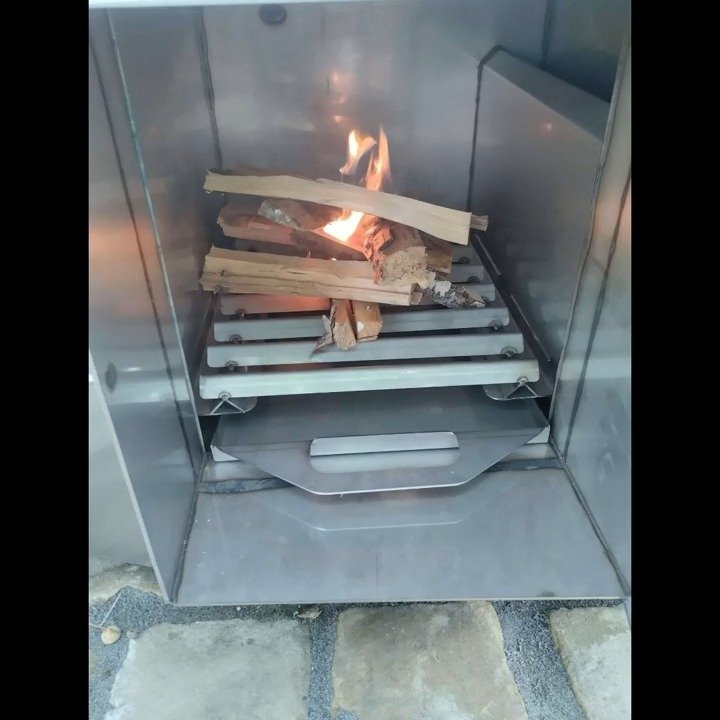
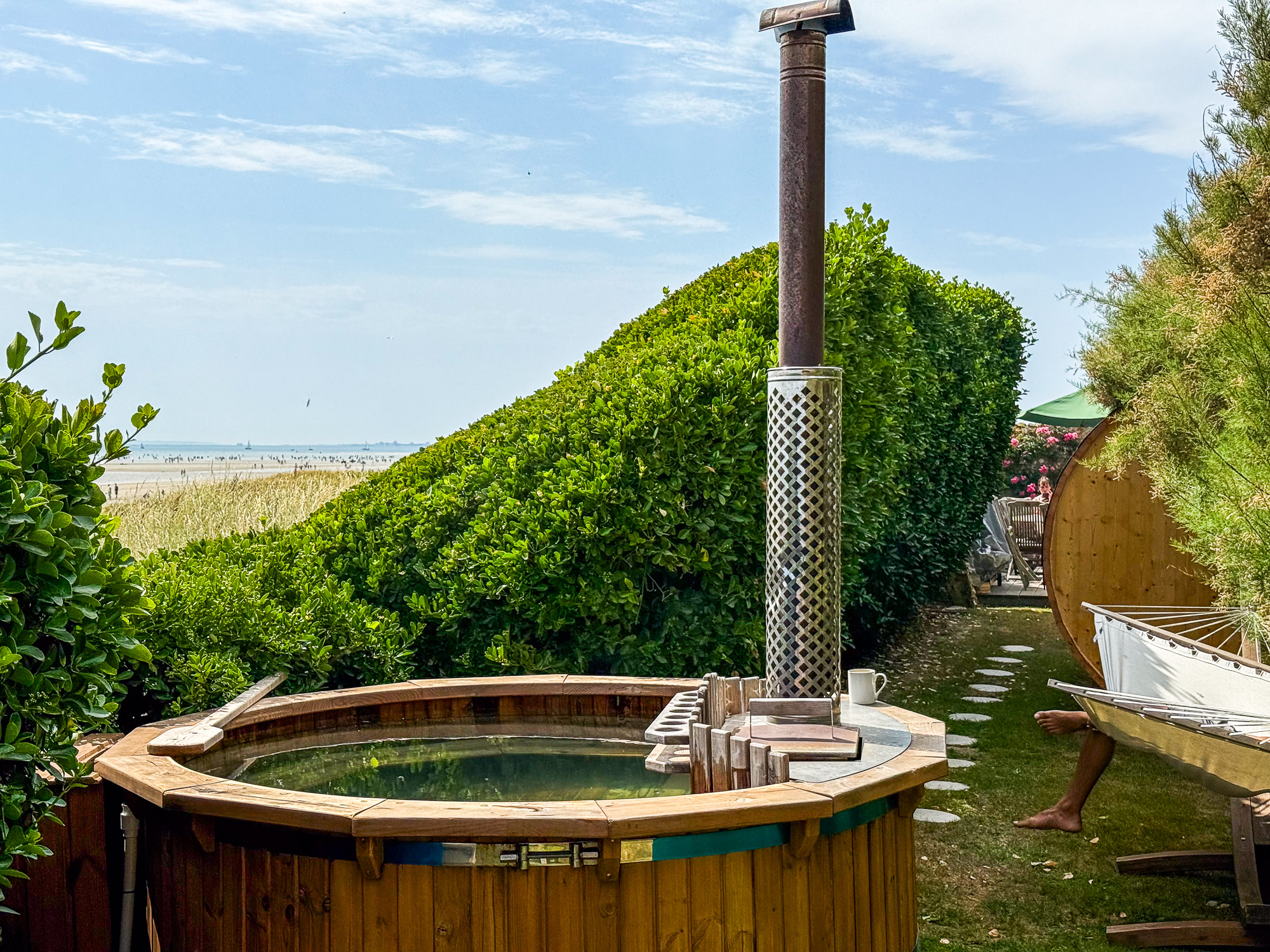
| Wood-fired | Traditional sessions, active involvement and locations without a high-power electric heater. | Dry fuel, chimney route, supervision, circulation and safe clearances. |
| Electric | Regular use and automatic temperature control. | Electrical capacity, insulation, heating rate and ongoing energy use. |
| Pellet | Users wanting more controlled fuel feeding than logs. | Electric supply, pellet storage, electronics and cleaning. |
| Hybrid | Wood-fired heat-up with electric temperature support. | More components, controls and service access. |
| Heat-pump assisted | Efficient temperature maintenance in suitable conditions. | Compatibility, airflow, condensate, sound and outdoor temperature. |
A simple wood-fired tub may heat without mains electricity, but filtration, lighting, jets, blowers, digital controls and frost-protection systems normally require power.
For a closer look at the daily routine and installation differences, compare the dedicated guides to wood-fired hot tubs and electric wooden hot tubs.
Internal, integrated or external wood-fired heater?
- Internal heater — Advantage: Compact external footprint and direct heat transfer; Trade-off: Uses bathing space and requires a protective guard.
- Integrated heater — Advantage: Neat overall form with much of the heater incorporated into the body; Trade-off: Service access and ventilation must remain clear.
- External heater — Advantage: Keeps more space available inside the tub; Trade-off: Needs additional ground space, pipework and a safe working area.
The heater must only be used with the correct water level and free circulation. Never close valves or drain the tub while a wood fire is active. Allow the heater to cool and follow the model-specific operating instructions.
How long does a wooden hot tub take to heat?
Heating time depends on water volume, start temperature, target temperature, heater output, cover, wind, insulation and fuel quality. The construction material alone does not provide a reliable heating-time prediction.
For comparison, the theoretical heat required is: litres of water × temperature rise in °C × 0.001163 = kWh of heat in the water.
Heating 1,200 litres from 10°C to 38°C requires approximately 39.1 kWh in the water before allowing for losses. The actual fuel or electrical input will be higher because heat escapes through the water surface, walls, pipework, heater and surrounding air.
- Larger water volume — Effect: More heat and time required; Practical response: Choose size for normal use rather than rare maximum occupancy.
- Cold fill water — Effect: Larger temperature rise; Practical response: Plan longer heating during winter.
- No thermal cover — Effect: High loss from the water surface; Practical response: Use a properly fitting cover when the system permits.
- Wet firewood — Effect: Lower useful heat and poorer combustion; Practical response: Use dry, untreated wood.
- Wind exposure — Effect: Higher heat loss; Practical response: Choose a sheltered but safely ventilated position.
- Good total insulation — Effect: Reduces losses during heating and temperature holding; Practical response: Assess walls, base, pipework and cover together.
Insulation: wood alone is not the complete answer
Timber has useful thermal properties, but overall heat retention depends on the whole build. Gaps, uninsulated pipework, the water surface and an unsuitable cover can outweigh the benefit of the wall material.
- Walls — Why it matters: Heat moves through the side structure; What to check: Construction thickness, liner arrangement and access to fittings.
- Base — Why it matters: Heat can be lost to cold ground or concrete; What to check: Base insulation that does not trap water or block support.
- Pipework — Why it matters: External pipes can lose heat and freeze; What to check: Insulation, drainage and accessible joints.
- Technical compartment — Why it matters: Equipment needs protection without overheating; What to check: Ventilation, dryness and service access.
- Cover — Why it matters: The water surface is a major heat-loss area; What to check: Fit, insulation value, water resistance and safe storage.
Water care for wooden hot tubs
Water care must be compatible with the timber, metal bands, heater and any filtration equipment. A method suitable for an acrylic spa should not automatically be copied into a traditional all-wood tub.
- Use the water-care method approved for the chosen model and timber construction.
- Measure water conditions rather than dosing by guesswork.
- Avoid concentrated chemicals directly contacting timber or metal components.
- Do not mix chemicals.
- Shower before bathing to reduce contamination.
- Replace water when it cannot be maintained safely.
- Clean with timber-compatible products and non-damaging tools.
Where water is kept for repeated use, filtration and a consistent treatment routine become more important. A simple traditional tub used without filtration usually requires more frequent water replacement.
Water care in a liner hot tub
A smooth shell usually permits a wider range of filtration and water-treatment arrangements, but compatibility still depends on the exact liner, heater and seals. The exterior timber should remain ventilated and protected from persistent splash or ground moisture.
- Interior cleaning — Traditional all-wood tub: Use timber-compatible methods and avoid damaging fibres; Liner with timber exterior: Smooth surface is easier to wipe but still needs approved products.
- Water-treatment choice — Traditional all-wood tub: More dependent on timber and metal compatibility; Liner with timber exterior: Often broader, subject to liner and equipment approval.
- Dry storage — Traditional all-wood tub: May create temporary seepage when refilled; Liner with timber exterior: Does not normally affect shell watertightness.
- Exterior care — Traditional all-wood tub: Integral to the vessel itself; Liner with timber exterior: Primarily protects cladding and appearance.
- Filtration — Traditional all-wood tub: Possible on compatible designs but requires careful planning; Liner with timber exterior: Commonly easier to integrate.
Foundation, drainage and garden position
A wooden hot tub must stand on a level, stable and well-drained base. One litre of water weighs approximately one kilogram, so the water alone can weigh more than a tonne. Add the tub, heater, cover, equipment and bathers.
| Site element | Requirement | Reason |
|---|---|---|
| Base | Flat, stable and sized for the complete supporting footprint. | Prevents distortion and uneven loading. |
| Drainage | Rain, splash and emptying water must leave the area. | Protects timber, equipment and nearby buildings. |
| Ventilation | Air must circulate around exterior timber and technical spaces. | Reduces persistent moisture and helps surfaces dry. |
| Heater area | Stable, accessible and safely separated from combustible materials. | Supports safe firing and maintenance. |
| Access route | Measured from road to final position. | Avoids delivery problems after production. |
| Service space | Pumps, drains, bands and fittings must remain reachable. | Allows inspection and repair. |
A raised deck, balcony, roof terrace or existing timber platform should be checked for the full wet load and moisture exposure before installation.
Freestanding, decked-in or sunken installation
- Freestanding — Benefit: Best access for inspection, drying and maintenance; Main caution: Higher entry and more visible exterior.
- Deck surround — Benefit: Integrated appearance while the hot tub remains independently supported; Main caution: Decking must not block bands, cladding ventilation or service panels.
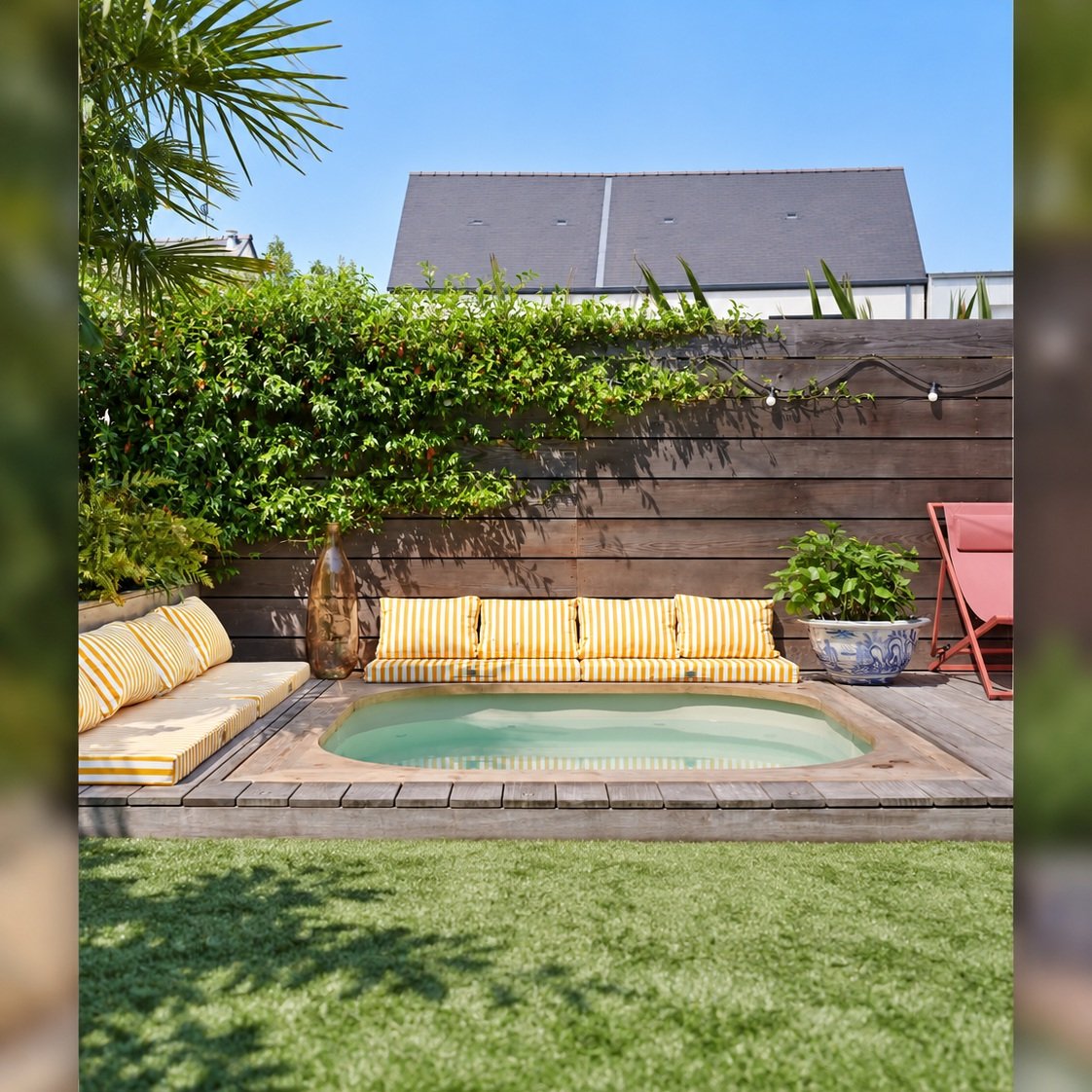
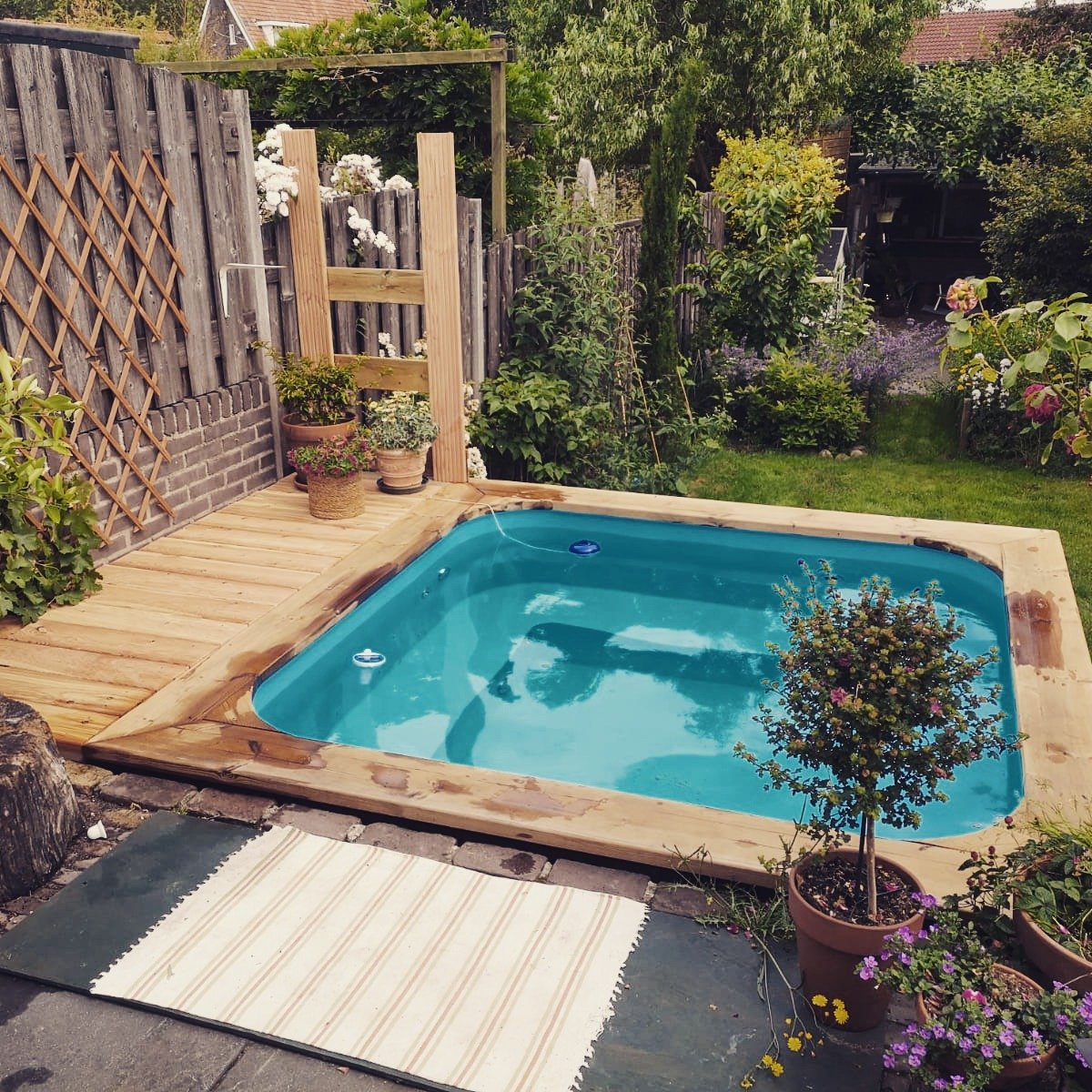
- Partially sunken — Benefit: Lower step-in height and strong visual integration; Main caution: Requires drainage, ventilation and removable access.
- Fully in-ground — Benefit: Minimal visual impact; Main caution: Most complex for moisture control, future removal and maintenance.
For recessed projects, read the dedicated sunken and in-ground hot-tub guide before finalising the landscaping.
Year-round and winter use
Wooden hot tubs can be used in cold weather when the heater, pipework, cover and operating routine are suitable. Winter bathing does not remove the risk of frozen water in pumps, filters, external heaters or low pipe sections.
- Follow the model-specific winter-use and shutdown procedure.
- Do not light a wood-fired heater if circulation may be blocked by ice.
- Drain all vulnerable components before prolonged shutdown.
- Keep access routes free from ice.
- Plan for power failure if pumps or frost-protection systems depend on electricity.
- Do not assume an empty-looking tub has no water remaining in pipework.
Exterior timber maintenance
Untreated exterior wood normally changes colour outdoors. Oil or another approved finish may slow colour change, but it does not make maintenance unnecessary. The correct schedule depends on timber, exposure, product and the desired appearance.
- Keep natural weathered grey — Typical action: Clean gently and allow controlled weathering; Important caution: Still inspect for trapped moisture and biological growth.
- Retain richer colour — Typical action: Apply a compatible exterior treatment as required; Important caution: Do not coat damp timber or block ventilation gaps.
- Protect end grain and edges — Typical action: Inspect high-exposure areas more frequently; Important caution: Use only products approved for the construction.
- Maintain bands and fixings — Typical action: Check tension, corrosion and movement visually; Important caution: Do not overtighten without manufacturer guidance.
- Protect base area — Typical action: Keep soil, leaves and standing water away; Important caution: Exterior timber should not remain continuously wet.
How long does a wooden hot tub last?
There is no honest universal lifespan. Service life depends on timber quality, machining, support, drainage, ventilation, water care, use pattern, climate and maintenance. Replaceable heaters, pumps, covers and fittings may have different service lives from the main tub.
A better purchasing question is: which parts can be inspected, repaired and replaced without dismantling the entire installation? Repairability and access often matter more than a broad lifespan claim.
Wooden hot tub versus acrylic or fibreglass spa
- Primary appeal — Wooden hot tub: Natural material, traditional form and outdoor character; Acrylic or fibreglass spa: Formed seating, integrated technology and uniform finish.
- Heating — Wooden hot tub: Wood, electric, pellet or hybrid depending on model; Acrylic or fibreglass spa: Usually electric, sometimes with alternative systems.
- Jets — Wooden hot tub: Optional on suitable configurations; Acrylic or fibreglass spa: Often central to the design.
- Interior feel — Wooden hot tub: Timber in a traditional tub or smooth liner in a clad model; Acrylic or fibreglass spa: Smooth moulded shell.
- Dry storage — Wooden hot tub: Important consideration for all-wood tubs; Acrylic or fibreglass spa: Normally simpler for the shell.
- Maintenance style — Wooden hot tub: Timber, bands, water care and heater inspection; Acrylic or fibreglass spa: Shell, filters, pumps, electronics and plumbing.
- Visual ageing — Wooden hot tub: Natural variation and weathering; Acrylic or fibreglass spa: More uniform surface, with its own ageing and repair issues.
The right choice depends on whether you value natural material and traditional bathing more than shaped seating and highly integrated spa technology.
Size and capacity
Capacity descriptions are approximate. Comfort depends on internal diameter, bench shape, heater position, water depth and user size. A hot tub labelled for six people may be most comfortable for four adults who want more personal space.
- One or two people — Useful direction: Compact round or oval tub; What to measure: Internal legroom and water depth.
- Three or four people — Useful direction: Small family model; What to measure: Bench circumference and heater position.
- Five or six people — Useful direction: Medium family tub; What to measure: Internal diameter, actual water volume and entry.
- Larger groups — Useful direction: Large round or square configuration; What to measure: Foundation, heating power, filtration and total running demands.
- Holiday rental — Useful direction: Robust model matched to permitted occupancy; What to measure: Cleaning, controls, service access and guest instructions.
Delivery, production and installation in the UK
Ask for the packaged dimensions, empty weight and recommended lifting points before confirming access. A route that looks generous for the finished tub may still be unsuitable once packaging, handling equipment and turning space are included.
Production of a hot tub typically takes around 3 to 4 weeks. This remains an approximate estimate and must be confirmed for the chosen configuration; transport scheduling and the delivery route are additional.
- Before ordering — What to prepare: Confirm model, dimensions, heater, access route, base and unloading method.
- During production — What to prepare: Complete the foundation, drainage and electrical preparation.
- Before transport — What to prepare: Confirm vehicle access and organise crane, forklift or telehandler if required.
- On arrival — What to prepare: Inspect packaging and place the hot tub safely on the prepared base.
- Before first use — What to prepare: Connect, fill, inspect, test circulation and follow the first-fill procedure.
Delivery scope and unloading arrangements should be confirmed in writing. Kerbside transport should not be assumed to include lifting over fences or final positioning in the garden.
Compare the complete installed cost
The current model prices appear above. Compare complete configurations rather than headline figures that may omit essential equipment or site work.
| Cost area | What to compare | Common mistake |
|---|---|---|
| Tub construction | Traditional all-wood or liner, timber type, diameter and benches. | Comparing different constructions as though they are equivalent. |
| Heating | Heater type, output, chimney, controls and connections. | Looking only at wood-fired versus electric as labels. |
| Insulation and cover | Walls, base, pipework and thermal cover. | Ignoring heat loss from the water surface. |
| Water system | Drainage, filter, pump and treatment compatibility. | Assuming every model includes permanent filtration. |
| Options | Jets, bubbles, lighting and controls. | Ignoring electricity and maintenance requirements. |
| Transport and unloading | Delivery point, vehicle access and lifting. | Assuming final placement is included. |
| Groundworks | Base, drainage, deck and electrical preparation. | Comparing product price instead of installed cost. |
Common mistakes when buying a wooden hot tub
- Assuming every wooden hot tub is all wood inside — Why it causes problems: The water-contact construction may differ completely; Better approach: Confirm whether the model is traditional timber or has a liner.
- Choosing timber only by colour — Why it causes problems: Construction and maintenance needs are overlooked; Better approach: Compare stability, exposure, care and intended use.
- Believing wood alone guarantees low running cost — Why it causes problems: Water volume, cover and heater determine much of the energy use; Better approach: Assess the whole thermal system.
- Leaving a traditional tub dry without a refill plan — Why it causes problems: Joints may open temporarily as timber shrinks; Better approach: Follow the model-specific dry-storage procedure.
- Using unsuitable spa chemicals — Why it causes problems: Timber, bands or heater can be damaged; Better approach: Use approved water-care methods.
- Installing on an uneven base — Why it causes problems: The tub can distort or load joints unevenly; Better approach: Prepare a level, stable foundation.
- Building decking tightly around the tub — Why it causes problems: Ventilation and repair access are lost; Better approach: Use removable panels and maintain clearances.
- Ignoring unloading — Why it causes problems: The hot tub reaches the property but not the final position; Better approach: Measure the route and organise lifting in advance.
Wooden hot-tub buying checklist
- Confirm whether water contacts timber or a separate liner.
- Choose timber type based on appearance, movement and maintenance—not colour alone.
- Select the normal number of users and measure actual internal space.
- Choose wood-fired, electric, pellet or hybrid heating.
- Confirm heater output for the water volume and intended climate.
- Compare wall, base, pipe and cover insulation.
- Decide whether filtration, jets, bubbles or lighting are genuinely needed.
- Confirm compatible water-care methods.
- Prepare a level foundation for the full wet load.
- Plan drainage for rain, splash water and complete emptying.
- Keep exterior timber ventilated and away from standing water.
- Maintain access to bands, heater, pumps, drains and fittings.
- Measure the delivery route from road to foundation.
- Confirm who arranges unloading and final placement.
- Plan frost protection and long periods of non-use.
- Compare the total installed project cost.
- Treat the usual 3–4 week production period as approximate and confirm the transport schedule separately.
Further comparisons
Buyers comparing manufacturer-built wooden hot tubs with other suppliers may also find the guides to Salty Barrel hot tubs and Kirami wood-fired hot tubs useful.
Frequently asked questions about wooden hot tubs
What is the difference between a wooden hot tub and a wood-clad hot tub?
In a traditional wooden hot tub, the timber itself contains the water. In a wood-clad model, a separate smooth shell contains the water while real timber forms the exterior appearance.
Do traditional wooden hot tubs leak when first filled?
A tub that has dried may show limited seepage while the staves absorb water and swell. Persistent loss from fittings, pipework or damaged timber requires investigation.
Which timber is best for a wooden hot tub?
There is no single best option. Spruce offers a traditional light appearance, larch is denser and warmer in tone, and thermowood is selected for darker colour and improved dimensional stability.
Do wooden hot tubs only use wood-fired heating?
No. Compatible wooden hot tubs can use wood-fired, electric, pellet or hybrid heating. The word wooden describes the construction or finish, not the heat source.
Is a wooden hot tub difficult to maintain?
Maintenance is different rather than automatically difficult. Traditional tubs require timber-compatible water care and attention to drying, while liner models require shell, equipment and exterior-timber maintenance.
Can I use normal spa chemicals in a wooden hot tub?
Do not assume so. Water treatment must be compatible with the timber, heater, metal bands and any filtration components. Follow the instructions for the exact model.
How often should the water be changed?
It depends on filtration, treatment, bathing load and measured water quality. A tub without filtration normally requires more frequent replacement than a managed system.
Can a wooden hot tub be left empty?
A liner model can usually stand empty without affecting shell watertightness, although the exterior still needs care. A traditional wooden tub may dry and shrink, so follow its storage and refill procedure.
Can wooden hot tubs be used in winter?
Yes, when the heater, insulation, cover and frost procedure are suitable. Pipework, pumps and external heaters must not be allowed to freeze.
How long does a wooden hot tub take to heat?
Heating time depends on water volume, start temperature, heater output, cover, wind, insulation and fuel. The timber type alone does not determine the time.
Can a wooden hot tub have jets and bubbles?
Yes, on compatible configurations. These options add pumps, pipework, electricity, noise and maintenance, so compare the full system.
What foundation does a wooden hot tub need?
The base must be level, stable, well drained and capable of carrying the complete filled weight. Raised decks and terraces may require structural assessment.
Can a wooden hot tub be built into decking?
Yes, but the hot tub should remain independently supported, ventilated and accessible. Decking must not permanently cover service points, bands or exterior timber.
How long will a wooden hot tub last?
There is no universal lifespan. Timber quality, support, drainage, ventilation, water care, climate and maintenance all affect service life.
How long does UK delivery take?
A hot tub is normally produced in about 3 to 4 weeks. Transport time depends on the route and scheduling, so confirm both the production estimate and delivery plan before ordering.
Choose the construction before the accessories
Start by deciding whether you want a traditional all-wood bathing vessel or a smooth liner with real-wood exterior cladding. Then compare timber, size, heater, insulation, filtration and installation as a complete configuration.
Wooden hot tubs and material-led commercial intent
This page supports a specific search intent, while the strongest central category remains wood fired hot tub.
Helpful related pages include garden hot tubs, traditional Scandinavian hot tubs, cedar hot tub alternatives, wooden barrel hot tubs, electric hot tubs and outdoor hot tubs for sale.
Featured wooden hot tub models
- thermowood hot tub is a relevant model to compare for this search intent.
- affordable wooden hot tub is a relevant model to compare for this search intent.
- TimberIN Nordic Core wood burning hot tub is a relevant model to compare for this search intent.
Explore the full range of wood fired hot tubs, including traditional wood burning models, outdoor spa-style options, garden hot tubs, outdoor baths, best-buy comparisons and UK delivery pages.