

Wood Fired Hot Tubs Netherlands: Delivery, Smoke and Site Guide
A wood-fired hot tub can work in a Dutch city garden, rural property, holiday home or wellness business when its size, stove, access route and local setting are considered together. The main water heat comes from burning wood, but pumps, filtration, lights, jets and electric backup still require electricity when they are part of the selected configuration.
This guide turns that choice into a practical Netherlands project: selecting the vessel and heater, arranging EU delivery, getting a large tub through restricted access, checking local environmental rules, limiting smoke impact, designing the base and drainage, and planning safe year-round use. TimberIN supplies from its European manufacturing base; this page does not imply Dutch stock, a Netherlands showroom or an included local installation service.
Dutch-site rule: select the tub for normal occupancy, then prove that the packed product can reach a suitable foundation and that the proposed stove can be operated without unacceptable smoke or neighbour impact.
Current wood-fired hot-tub models for the Netherlands
The live selection below shows current website prices and starting configurations. Open a product to confirm diameter, seating, heater position, vessel and cladding materials, included equipment and optional systems. Delivery, lifting, foundation work, connections and commissioning must be priced for the actual Dutch address.
-
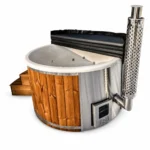
Product on saleSave up to 16% Wood Fired Hot Tub with Jets – TimberIN Nordic Rojal™ (4–8 Person)
From: £6,785From: £5,874 -
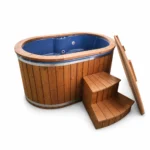
2-person model2 Person Wood Fired Hot Tub – TimberIN Nordic DuoFrom: £2,420
-
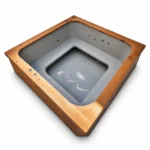
Square modelSquare Wood Fired Hot Tub – TimberIN Nordic Square™ (160–220 cm)From: £2,862
-
8-person modelLarge 8 Person Wood Fired Hot Tub – TimberIN Nordic Elite™ SquareFrom: £4,290
-
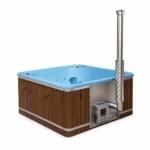
Acrylic luxuryTimberIN Nordic Square™ Acrylic Hot Tub – External or Integrated Wood Stove (Luxury Marble Edition)From: £6,787
What a wood-fired hot tub changes
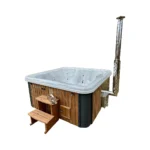
Wood heating makes fire management part of the experience. It can avoid the large continuous electrical demand of a high-output water heater and suits owners who can store clean, dry fuel. It also requires supervision: the operator lights the stove, confirms circulation, manages ash and hot surfaces, watches water temperature and allows the heater to cool safely before draining.
Do not treat “wood fired” as “no electricity”. A basic approved natural-circulation arrangement may heat without a pump, but filtration, lights, massage systems and electric temperature support change the utility plan. The main wood-fired guide compares the complete heating circuit.
Internal, integrated or external stove?
An external stove preserves bathing space and gives clearer service access, but increases the total footprint and adds hot pipework beside the tub. An integrated stove keeps the outline compact while still using part of the surround. An internal or submersible heater reduces the external equipment area but occupies bathing space and needs a correctly fitted guard.
Compare more than the sales image. Record the full installed envelope, chimney location, access to the firebox, clearance from boundaries and seating, and how every part drains for frost protection. In a narrow urban garden, a smaller external footprint is valuable only if the stove remains safe to reach and service.
Delivery in the Netherlands starts at the street
Provide the postcode, property type and photographs before confirming freight. Dutch access can be deceptively difficult: row houses may have no side passage, historic centres can restrict heavy vehicles, canal-side streets may limit crane positions and new developments may have soft verges or parking controls. A carrier reaching the postcode does not mean the tub can reach its base.
Measure packed dimensions against gates, alleys, turns, walls, eaves, trees and overhead cables. Confirm the unloading point and who supplies a crane, telehandler, lifting frame, labour, traffic measures and insurance. For a lift over a house or into an enclosed courtyard, obtain a site-specific lifting plan from a competent local provider before the delivery date.
| Dutch site type | Check before ordering | Likely local input |
|---|---|---|
| Terraced or city garden | Side passage, house lift, parking, road restrictions and neighbour access | Crane survey and municipal parking or traffic arrangements |
| Canal-side or historic setting | Quay loading, underground services, vehicle limits and protected context | Carrier, crane provider and municipality |
| Rural property | Lane width, bridge limits, turning, soft ground and unloading area | Final-mile and ground-protection plan |
| Coastal or exposed site | Wind, salt exposure, cover security and chimney setting | Site-specific material and flue assessment |
| Holiday park or business | Operating rules, guest access, water management and service route | Risk, permit and maintenance planning |
EU supply, VAT and written delivery terms
A movement from one EU member state to another is not automatically the same as a complete delivered quotation. Ask which legal entity sells the tub, where the goods dispatch from, whether the shown amount includes the VAT due for the sale, and whether freight, insurance, unloading or payment charges are additional.
The order should identify the currency, delivery address, handover point, risk for transport damage, inspection procedure and responsibility for lifting. Business purchasers should obtain advice on their own VAT position rather than applying consumer assumptions. Written terms prevent a low headline price from hiding the expensive part of a restricted-access project.
Compact gardens need realistic capacity planning
Choose the tub for normal weekly use, not the largest gathering that might happen once. More water increases heat demand, foundation load, fill time and treatment volume. Check the internal diameter, bench shape, legroom, entry point and stove intrusion; a nominal person count cannot guarantee comfort for every group.
Leave practical space around the vessel for the cover, steps, chimney, controls, drain, filter and maintenance. A tub that just fits between two boundaries may be impossible to service. The two-person guide and family guide help match capacity to use.
Heat-up estimates need test conditions
Water volume and temperature rise determine the basic energy demand. Useful stove output, starting water temperature, fuel moisture, airflow, circulation, wind and cover quality then affect real heat-up. Ask which tub, water volume and weather conditions produced any advertised time; there is no single trustworthy Netherlands figure.
Use suitable dry fuel allowed by the stove instructions. Keep the insulated cover fitted when permitted during heating, maintain clearances and mix or circulate water as specified before measuring away from the hot outlet. Never light a water-jacketed heater unless it is correctly filled, connected and circulating.
Dutch wood-smoke rules are local as well as national
The Netherlands’ official environmental information service explains that municipalities can include wood-burning rules in their omgevingsplan, including rules for outdoor fires and appliances. National duties to prevent or limit harmful effects still matter where no specific local rule exists. Burning waste is prohibited; use only clean, untreated and unpainted fuel suitable for the heater.
Check the municipality’s current rules before choosing a stove position. The official IPLO wood-burning rules page explains the framework. Also use the Stookwijzer and do not fire when local advice, poor dispersion or neighbour impact makes it unsuitable. A product being available for sale does not guarantee that every firing pattern is acceptable at every address.
Planning and permits depend on the whole project
A portable-looking tub, built foundation, raised deck, shelter, flue, privacy wall and commercial accommodation proposal can trigger different questions. Since 2024, the Environment and Planning Act combines rules affecting the physical environment. Requirements can come from the municipality, province, water authority and national government.
Use the official Omgevingsloket permit check for the actual location and complete scheme. Its result may require a permit, notification, further information or contact with the municipality or water authority. Do not rely on a seller’s general statement that a hot tub is always permit-free.
Foundation design matters on soft or wet ground
Obtain the empty weight, intended water volume and support points, then add bathers, stove, steps and equipment. Peat, clay, made ground, high groundwater and settlement can make a visually level patio unsuitable for a concentrated permanent load. A competent local contractor should assess the actual soil, foundation and drainage strategy.
Keep the equipment zone accessible and prevent surface water from collecting around timber cladding or electrical components. If a deck is proposed, its structure must be designed for the filled operating load rather than an empty product photograph.
Plan filling, treatment and drain-down together
Confirm the water source and test its starting characteristics before selecting treatment. Follow the product and component instructions for filtration, disinfectant, pH, cleaning and material compatibility. Timber vessels and synthetic liners can require different commissioning and care routines.
Decide where a complete drain-down will go before filling. It must not undermine the base, flood neighbouring property, enter surface water or overload an unsuitable sewer or soakaway. Treatment chemistry and local water-authority rules may affect disposal, so use the Omgevingsloket result or contact the municipality or waterschap when the route is uncertain.
Electrical accessories need a proper outdoor supply
List every powered component in the final order: circulation and filtration pumps, jets, lights, controls and any electric heater. Obtain the voltage, phase, connected load, protection and isolation requirements before ground works. Cable routes and service access should be designed with the foundation, not added across the garden afterwards.
Have a competent Dutch electrical installer assess the installation and applicable requirements for a wet outdoor environment. Do not treat a domestic extension lead or a convenient garden socket as a permanent design merely because the stove itself burns wood.
Wind, salt air and winter operation
Coastal wind can affect cover handling, smoke direction and bathing comfort; salt exposure can accelerate corrosion. Use approved flue parts and clearances, secure the cover by its designed method and inspect heater connections, fasteners and chimney components. A screen or shelter must not compromise combustion air, flue performance or service access.
Freezing can damage water left in the heater jacket, pipes, valves, pump, filter, jets or air lines. Follow the selected model’s written winter procedure and identify every low point. If the tub remains full, define how circulation and protection continue during faults, absence or power cuts. Never light a frozen or uncertain circuit to thaw it.
Holiday accommodation and wellness businesses
Commercial use changes responsibility. Decide whether guests may operate the stove or whether trained staff prepare the tub. Write procedures for filling, treatment, testing, cleaning, temperature control, records, fault isolation and emergency response. Confirm that the product, warranty and insurer permit the intended usage and duty cycle.
Dutch business guidance treats Legionella control as a specific responsibility in relevant accommodation and bathing settings. Start with the official Business.gov.nl accommodation guidance, then obtain competent Dutch advice for the actual facility. A domestic care routine should not be copied into a guest business without assessment.
Compare the complete project cost
Start with the configured tub and stove, then add VAT treatment, freight, unloading, crane or house lift, foundation, drainage, electrical work, chimney setting and commissioning. Include the cover, steps, filtration, water-treatment and test supplies, dry-fuel storage, replacement filters and scheduled maintenance. Use the price comparison guide to put competing quotations on the same basis.
Netherlands site and quotation checklist
| Decision | Record before ordering | Who confirms it |
|---|---|---|
| Model | Normal users, internal size, water volume, stove and equipment | Supplier and buyer |
| Delivery | Packed dimensions, street access, handover, crane and final route | Carrier and lifting provider |
| Rules | Omgevingsloket result, municipal smoke rules and neighbour setting | Buyer and relevant authority |
| Foundation | Operating load, soil, support, level and equipment access | Competent local contractor |
| Water | Source, treatment, testing and lawful drain route | Owner; municipality or waterschap if needed |
| Electricity | Connected load, cable route, protection and isolation | Competent Dutch electrical installer |
| Operation | Fuel, heating, cover, cleaning, frost plan and responsible person | Owner or business operator |
Frequently asked questions
Can TimberIN deliver a wood-fired hot tub in the Netherlands?
Routes can be quoted after the postcode, packed product, street access, unloading point and final lift are known. Terraced, historic-centre and canal-side sites often need a local crane or access survey.
Is a wood-fired hot tub allowed in a Dutch garden?
The answer depends on the complete project and location. Use the Omgevingsloket permit check and review municipal wood-burning rules; a deck, shelter, flue, protected setting or business use can change what is required.
Can I use the stove whenever I want?
No blanket promise is appropriate. Municipal rules, the general duty to limit harmful effects, local air conditions and neighbour impact matter. Check the Stookwijzer and do not fire when conditions or local advice make it unsuitable.
Does a wood-fired hot tub need electricity?
The stove can provide the main water heat, but filtration, pumps, lights, jets, controls and electric backup need power when selected. Confirm the complete connected load before site work.
Is a wood-fired tub suitable for Dutch holiday accommodation?
It can be, but the operator needs a risk-based fire and water-management system, competent responsibility, records, maintenance and emergency procedures. Check the product, warranty, insurance and Dutch business requirements.
Quote the Dutch access route with the tub
Send the postcode, garden and street photographs, measured access, intended occupancy, preferred stove, required equipment and planned base. TimberIN can then identify compatible configurations and state the product and delivery assumptions for the written quotation.