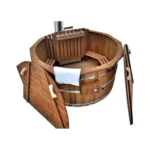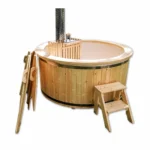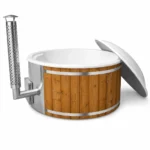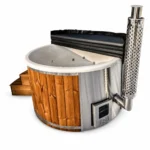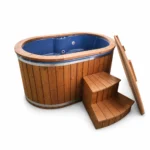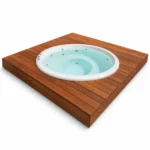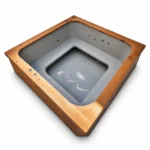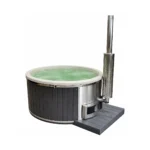

4 Person Hot Tubs: Complete UK Guide to Size, Heating and Installation
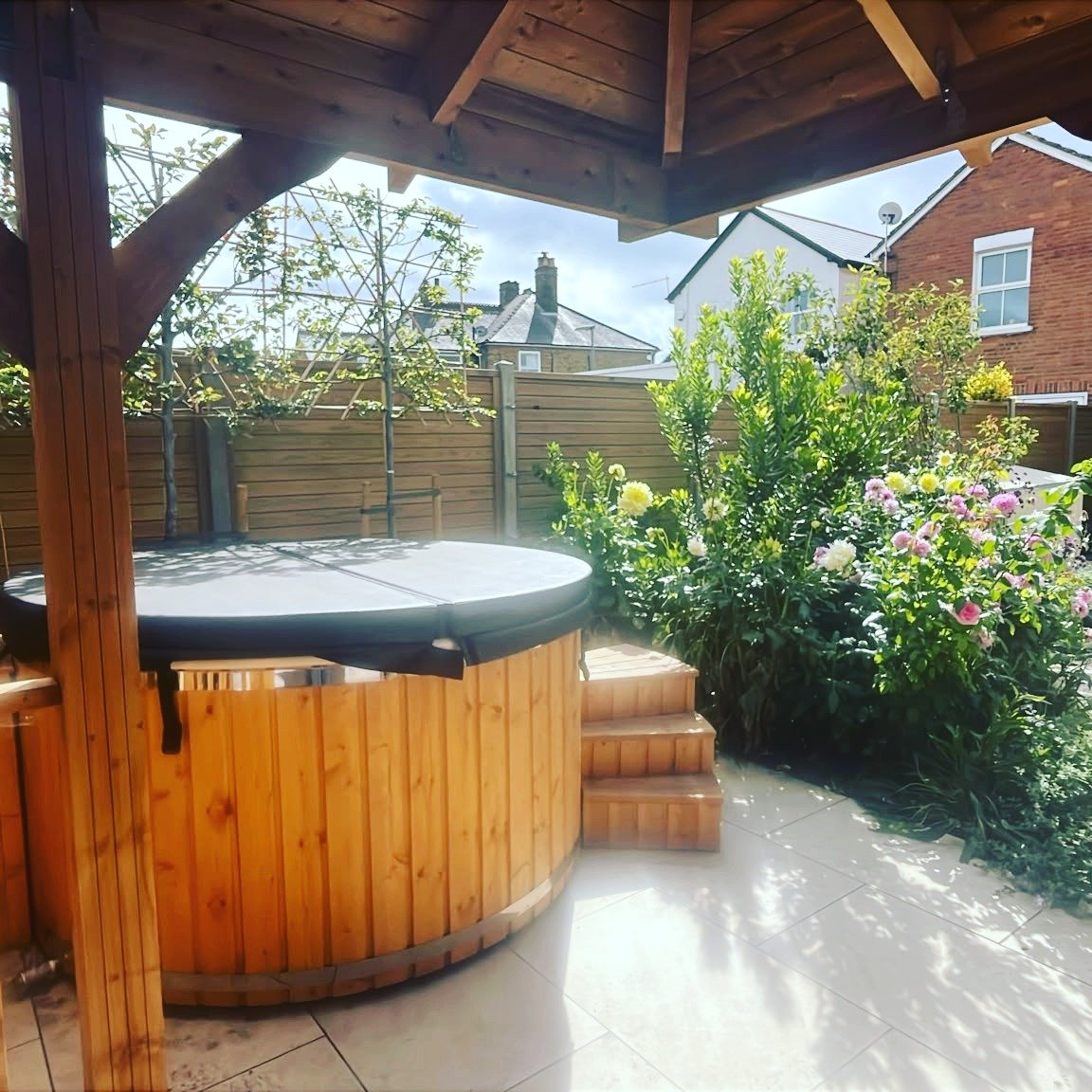
A 4 person hot tub is a practical middle size for couples, small families and households that occasionally invite guests. It provides more shared seating than a compact two-person model without the water volume, footprint and heating demand of a large group tub.
The phrase “four person” should be treated as an approximate capacity rather than a guarantee of equal comfort for every group. Internal diameter, bench shape, heater position, water depth and user size determine whether four adults can sit comfortably.
This guide compares wood-fired, electric, pellet and hybrid heating; round and square layouts; traditional wooden and liner-based construction; expected water volume; foundations; delivery; maintenance and the total installed cost.
Best buying principle: choose the model for the number of people who will use it most often—not the largest group that may visit occasionally.
4 person hot tubs at a glance
| Decision | Practical direction | Confirm before ordering |
|---|---|---|
| How many regular users? | Four-person capacity is often most spacious for two or three adults and suitable for four when dimensions allow. | Internal diameter, bench length and heater position. |
| Round or square? | Round tubs suit social seating; square tubs can align with terraces and dedicated seats. | External footprint and usable internal space. |
| Wood-fired or electric? | Wood-fired gives active manual heating; electric provides automatic control. | Heater output, electricity and preferred routine. |
| Traditional wood or smooth liner? | Traditional timber gives the most authentic material experience; liners are generally easier to clean. | Water-contact construction and maintenance. |
| How often will it be used? | Frequent and occasional use favour different heating and water-management strategies. | Filtration, cover and expected preparation time. |
| Small garden? | A compact tub can fit many gardens, but the operating footprint is larger than the shell. | Steps, heater, chimney, cover movement and service space. |
Why choose a 4 person hot tub?
The main advantage is balance. A four-person model can serve a couple comfortably, accommodate a small family, and still remain manageable in terms of water volume, foundation size and heating demand.
| Potential advantage | Why it matters | Qualification |
|---|---|---|
| Moderate footprint | Fits more gardens than large group tubs. | Allow space for steps, heater, cover and servicing. |
| Lower water volume than larger tubs | Usually requires less energy per full heat-up. | Actual litres vary significantly between models. |
| Flexible occupancy | Works for daily couple use and occasional guests. | Four adults may have less personal space. |
| Simpler delivery | Smaller units may need less lifting reach. | Gate and vehicle access must still be measured. |
| Broad heater choice | Can suit wood-fired, electric, pellet or hybrid systems. | The site infrastructure determines what is practical. |
A smaller tub is not automatically cheaper to own. Heater efficiency, insulation, cover quality, water care and frequency of use still determine real cost.
How big is a 4 person hot tub?
Many round models marketed for approximately four users fall within a compact family-size range, but there is no universal diameter. Square and oval designs also use space differently.
| Dimension | What it tells you | What it does not tell you |
|---|---|---|
| External diameter or width | Required foundation and garden footprint. | Actual seating and legroom. |
| Internal diameter | Usable bathing width. | Comfort around heater guards and steps. |
| Water depth | Immersion level and total volume. | Ease of entry for shorter users. |
| Bench width | Seating support and posture. | Shoulder room for multiple adults. |
| Water volume | Heating, water-care and filled-weight demand. | How well the seating is arranged. |
Request the internal drawing and water volume for the exact configuration. Exterior dimensions alone can be misleading because insulation, shell thickness and integrated equipment use space.
Can four adults sit comfortably?
Four adults may fit the capacity rating while experiencing different levels of comfort. A model may be ideal for two adults who want generous space, comfortable for three, and socially close for four.
| Typical use | Useful interpretation |
|---|---|
| Couple | Generous space and easier movement. |
| Two adults and one child | Often a comfortable family arrangement, subject to safe temperature and supervision. |
| Three adults | Good social capacity in many compact family models. |
| Four adults | Check shoulder room, leg overlap and heater position. |
| Two adults with occasional guests | A four-person model often avoids oversizing for rare use. |
Round versus square four-person tubs
| Shape | Advantages | Trade-offs |
|---|---|---|
| Round | Traditional Nordic appearance and natural social seating. | Furniture and decking may need to follow a curved footprint. |
| Square | Fits modern terraces and can provide defined seating sides. | Corner construction and technical layout may increase external size. |
| Oval | Can suit narrow spaces or two primary seating positions. | May feel less spacious for four equally sized adults. |
| Compact deep tub | Smaller footprint with good immersion. | Entry and legroom need careful checking. |
Compare the round hot-tub guide and square hot-tub guide before choosing the final layout.
Wood-fired, electric, pellet or hybrid?
| Heating system | Best suited to | Main considerations |
|---|---|---|
| Wood-fired | Traditional sessions, active fire management and suitable off-grid locations. | Fuel, chimney, supervision and variable heat-up. |
| Electric | Frequent use and automatic temperature control. | Electrical capacity, gradual heat-up and standing losses. |
| Pellet | Buyers wanting automated wood-fuel feeding. | Electricity, dry pellet storage and burner maintenance. |
| Hybrid | Wood-fired preparation with electric support or backup. | More components, controls and service access. |
Wood-fired does not automatically mean completely off-grid. Pumps, filters, lights, jets and pellet controls require electricity.
Compare wood-fired hot tubs, electric wooden hot tubs and pellet-fired hot tubs.
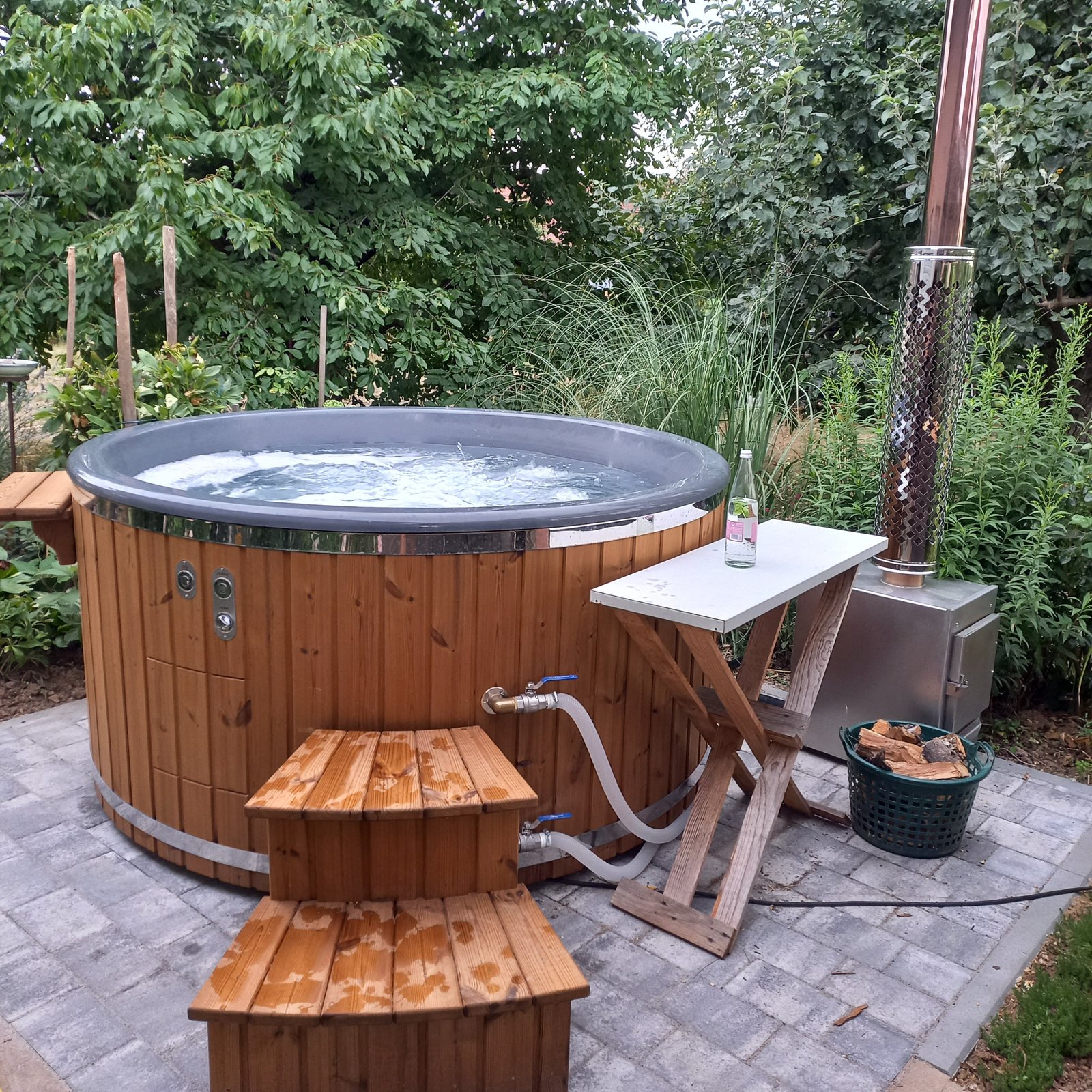
Internal, integrated or external wood-fired heater?
| Heater position | Advantage | Trade-off |
|---|---|---|
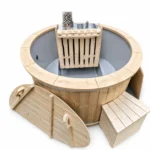
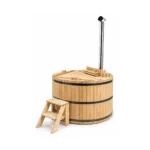
| Internal or snorkel heater | Compact total footprint and direct heat transfer. | Uses bathing space and requires a guard. |
| Integrated heater | Clean visual form and compact installation. | Ventilation and service access must remain clear. |
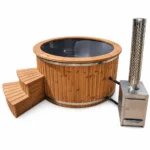
| External heater | Preserves more seating space inside. | Needs additional ground area and connecting pipework. |
An external heater may make a compact tub feel more comfortable for four users because the firebox does not occupy internal seating space.
Realistic heating-time calculation
A universal claim of 1.5–2.5 hours is too precise without knowing the water volume, starting temperature and heater output. Use the following theoretical calculation:
Litres of water × temperature rise in °C × 0.001163 = kWh of heat added to the water.
Heating 1,000 litres from 10°C to 38°C requires approximately 32.6 kWh in the water before allowing for losses. A larger 1,200-litre tub requires approximately 39.1 kWh for the same temperature rise.
| Factor | Effect on heating | Practical response |
|---|---|---|
| Water volume | More litres need more energy. | Confirm actual fill volume. |
| Starting temperature | Cold winter water increases the temperature rise. | Allow additional preparation time. |
| Heater output | Higher useful output can reduce heat-up time. | Match the heater to the tub and circulation system. |
| Fuel moisture | Wet wood reduces useful combustion heat. | Use dry, untreated fuel. |
| Wind | Increases water-surface and wall losses. | Choose a sheltered but safely ventilated position. |
| Thermal cover | Reduces surface heat loss during preparation. | Use the model-approved cover correctly. |
How much wood does a four-person tub use?
There is no reliable universal quantity. Fuel use depends on water volume, temperature rise, heater design, combustion quality, wood species, moisture, cover, weather and operator technique.
| Fuel-use driver | Why it matters |
|---|---|
| Dryness | Energy in wet wood is spent evaporating moisture. |
| Log size | Affects lighting, burn rate and air movement. |
| Heater cleanliness | Deposits can reduce heat transfer. |
| Starting temperature | Cold water needs more energy. |
| Target temperature | Every additional degree requires more heat. |
| Cover and insulation | Determine how much heat escapes during preparation. |
Compare sessions using the same fill temperature and weather rather than relying on a fixed basket or kilogram claim.
Traditional wooden tub or smooth liner?
| Feature | Traditional all-wood tub | Liner with timber exterior |
|---|---|---|
| Water contact | Water is contained by timber staves. | Water is contained by polypropylene, fibreglass or another shell. |
| Initial filling | Dry timber may need time to swell. | Shell is normally immediately watertight. |
| Cleaning | Needs timber-compatible methods. | Smooth surface is generally easier to wipe. |
| Dry storage | Timber may shrink during long empty periods. | Exterior timber can dry without opening the water vessel. |
| Jets and filtration | Possible only on compatible designs. | Usually easier to integrate. |
| Experience | Most traditional material feel. | Natural exterior with modern interior. |
Read the wooden hot-tub guide for a deeper construction comparison.
Spruce, larch and thermowood
| Timber | Appearance | Ownership considerations |
|---|---|---|
| Spruce | Light and traditionally Nordic. | Protect from persistent dampness and expect natural knots and checking. |
| Larch | Warmer tone and pronounced grain. | Naturally resinous but still weathers and greys. |
| Thermowood | Darker heat-treated appearance. | Improved dimensional stability, although exterior care may still be required. |
| Timber cladding | Natural finish around a liner tub. | Requires airflow and protection from standing water. |
Insulation and thermal cover
| Area | What to compare | Why it matters |
|---|---|---|
| Walls | Construction and insulation continuity. | Controls side heat loss. |
| Base | Insulation compatible with structural support. | Reduces heat transfer into the ground. |
| Pipework | Insulation and drainage. | Reduces loss and frost risk. |
| Technical compartment | Dryness, ventilation and access. | Protects pumps and controls. |
| Cover | Fit, insulation value and water resistance. | The water surface is a major heat-loss area. |
Smaller water volume does not compensate for a poor cover. Surface heat loss remains significant during heating and between sessions.
Water care and filtration
A simple wood-fired soaking tub may be filled for a session and drained more frequently. A tub used regularly with retained water benefits from filtration and a compatible treatment routine.
| Use pattern | Likely water-management direction |
|---|---|
| Occasional private session | Manual cleaning and more frequent water replacement. |
| Regular household use | Filtration and consistent testing. |
| Jets or bubbles | More pipework requiring circulation and cleaning. |
| Holiday rental | Documented testing, treatment and turnover procedures. |
| Traditional all-wood tub | Water-care products must suit timber and metal components. |
- Shower before bathing.
- Keep the cover closed when the tub is unused.
- Test water rather than dosing by guesswork.
- Do not mix chemicals.
- Use products compatible with the shell, timber, seals and heater.
- Replace water when quality cannot be maintained safely.
Jets, bubbles and optional equipment
| Option | Benefit | Trade-off |
|---|---|---|
| Hydro massage jets | Targeted water movement. | Pump, electricity, pipework and winter drainage. |
| Air bubbles | Gentle whole-tub bubbling. | Blower noise and faster water cooling. |
| LED lighting | Improves atmosphere and visibility. | Electrical controls and maintenance. |
| Filtration | Supports retained-water management. | Pump operation and filter cleaning. |
| Digital control | Convenient management on compatible systems. | Requires electricity and suitable equipment. |
See the hot tubs with jets guide before adding massage systems.
Foundation and filled weight
One litre of water weighs approximately one kilogram. A compact four-person tub may therefore place well over a tonne on the foundation once the tub, heater, cover and users are included.
| Base option | Potential use | Important checks |
|---|---|---|
| Concrete slab | Permanent installations. | Level, size, drainage and cable or pipe routes. |
| Engineered paving base | Freestanding garden projects. | Compaction and uniform support. |
| Ground screws and platform | Selected sloping or low-excavation sites. | Professional design and accurate support points. |
| Engineered timber deck | Raised terraces. | Full wet load, deflection, ventilation and moisture. |
| Compacted gravel system | Only where the specific frame allows it. | Level, edge stability and drainage. |
Operating footprint in a small garden
The external shell is only part of the required space. Add the heater, chimney, cover movement, steps, fuel area and service access.
| Space element | Why it matters |
|---|---|
| Steps | Safe entry requires a stable approach. |
| Cover storage | The cover must open or be removed without blocking access. |
| External heater | Needs a non-combustible working area and pipe access. |
| Chimney clearance | Protects nearby structures and planting. |
| Service panels | Pumps, filters and controls must remain reachable. |
| Drain route | Full-volume emptying must not flood the garden. |
Freestanding, decked-in or sunken
| Installation | Advantage | Main caution |
|---|---|---|
| Freestanding | Best inspection and maintenance access. | Higher entry point. |
| Deck surround | Integrated garden appearance. | Do not block ventilation or technical access. |
| Partially sunken | Lower entry and strong visual integration. | Requires drainage and removable access. |
| Fully in-ground | Minimal visible height. | Most complex for moisture, safety and future replacement. |
Use the sunken and in-ground guide before designing a recessed project.
Planning and location
A freestanding domestic hot tub may not always need planning permission, but this should not be stated as a universal rule. Raised decks, listed buildings, protected settings, commercial use, prominent structures or major landscaping can change the position.
- Check the actual property and local restrictions.
- Keep smoke and flues away from neighbours, windows and combustible structures.
- Use qualified professionals for electrical and structural work.
- Plan drainage so it does not create nuisance or erosion.
- For rentals or commercial use, confirm additional operating and insurance duties.
Delivery and installation
Hot-tub production is commonly approximately 3–4 weeks, with transport planned after production. Total UK delivery is often around 6–8 weeks depending on model, options, production schedule and route. These are estimates rather than guaranteed dates.
| Stage | What to prepare |
|---|---|
| Before ordering | Confirm model, dimensions, water volume, heater and access. |
| During production | Complete the foundation, drainage and electrical work. |
| Before transport | Confirm vehicle access and arrange lifting equipment. |
| At delivery | Inspect packaging and position the tub safely. |
| Before first use | Connect, fill, inspect, test circulation and follow heater instructions. |
A four-person tub is not automatically easy to position. Measure gates, turns, overhead obstacles and the final lifting distance before production.
Price and total installed cost
The current WooCommerce prices appear in the product section directly below the Trustpilot widget. Compare complete configurations rather than only the starting product price.
| Cost area | What to compare | Common omission |
|---|---|---|
| Tub construction | Timber or liner, size, seating and cladding. | Comparing different water volumes as equivalent. |
| Heater | Type, output, chimney and controls. | Ignoring flue or electrical work. |
| Insulation and cover | Walls, base, pipework and top cover. | Focusing only on heater power. |
| Water system | Filter, pump, treatment and drainage. | No plan for regular water care. |
| Foundation | Groundworks, deck or slab. | Treating the tub as lightweight furniture. |
| Delivery and lifting | Vehicle, crane or local equipment. | Assuming final placement is included. |
| Options | Jets, bubbles, lighting and controls. | Ignoring electricity and future maintenance. |
4 person versus 2, 6 and 8 person tubs
| Capacity category | Best suited to | Main trade-off |
|---|---|---|
| 2 person | Couples, compact gardens and lower water volume. | Limited guest capacity. |
| 4 person | Couples, small families and occasional guests. | Four adults may sit closely. |
| 6 person | Larger families and regular social use. | More water, space and heating demand. |
| 8 person | Large groups and commercial settings. | Highest foundation, heating and water-care requirements. |
Compare the 2-person, 6-person and 8-person guides.
Family and rental use
| Use case | Priority |
|---|---|
| Couple | Comfort, efficient heating and easy maintenance. |
| Small family | Safe entry, cover security and direct child supervision. |
| Occasional guests | Real seating capacity and clear user controls. |
| Holiday rental | Water hygiene, simple operation and service access. |
| Urban garden | Smoke direction, equipment noise and neighbour impact. |
A hot tub may improve guest appeal, but it does not guarantee higher occupancy, rates, revenue or property value.
Common mistakes
| Mistake | Likely consequence | Better approach |
|---|---|---|
| Assuming four adults always have generous space | The tub feels crowded. | Check internal dimensions and seating. |
| Relying on a fixed 1.5–2.5 hour heating claim | Preparation expectations are unrealistic. | Calculate from litres, temperature rise and heater output. |
| Assuming lower wood use without comparing volume | Running cost is misjudged. | Compare actual water volume and heat loss. |
| Choosing a heater that occupies needed seating | Reduced usable capacity. | Compare internal and external heater layouts. |
| Installing directly on an unsuitable patio or deck | Settlement or structural risk. | Design for the full wet load. |
| Building decking over service points | Maintenance requires demolition. | Use removable access panels. |
| Assuming no planning issues ever apply | Possible conflict or redesign. | Check the actual property and project. |
| Ignoring delivery access | The tub cannot reach the base. | Survey road, gates and lifting route. |
4 person hot-tub buying checklist
- Confirm the normal number and size of users.
- Check internal dimensions, not only external diameter.
- Confirm the actual water volume.
- Choose round, square, oval or compact deep seating.
- Compare internal, integrated and external wood heaters.
- Choose wood-fired, electric, pellet or hybrid heating.
- Calculate theoretical heating demand.
- Compare total insulation and the thermal cover.
- Confirm whether filtration, jets or bubbles are included.
- Choose water care for the exact shell or timber construction.
- Prepare a foundation for the complete wet load.
- Plan drainage for rain, splash and full emptying.
- Maintain access to heater, pumps, filters and fittings.
- Measure the complete operating footprint.
- Check planning, smoke, electrical and rental requirements.
- Survey delivery and lifting access.
- Compare complete installed cost rather than headline price.
- Treat 3–4 week production and 6–8 week UK delivery as estimates.
Frequently asked questions about 4 person hot tubs
How big is a 4 person hot tub?
There is no universal size. Compare the internal diameter or width, bench layout, water depth and actual litres for the selected model.
Can four adults sit comfortably?
Many models can seat four adults, but comfort depends on internal space and user size. A four-person tub is often particularly spacious for two or three adults.
How long does a wood-fired four-person hot tub take to heat?
Heating time depends on water volume, starting temperature, heater output, fuel, cover and weather. A fixed time cannot be guaranteed for every installation.
How much wood does a four-person tub use?
Fuel use varies with water volume, temperature rise, heater efficiency, wood moisture, insulation and weather. There is no universal quantity.
Is a four-person hot tub suitable for a small garden?
Often yes, but measure the complete operating footprint, including steps, heater, chimney, cover movement and service access.
Is round or square better?
Round tubs offer social seating and traditional appearance. Square tubs fit contemporary terraces and can provide more defined seating positions.
Is an internal or external heater better?
Internal heaters save external space but use bathing space. External heaters preserve internal seating but need more ground area and pipework.
Can a four-person tub be electric?
Yes. Electric heating provides automatic temperature control but requires a suitable permanent electrical supply.
Can it have massage jets?
Yes, on compatible models. Jets add pumps, pipework, electricity, cleaning and winterisation requirements.
What foundation is required?
The base must be level, stable, well drained and capable of supporting the complete filled weight, equipment and users.
Can it be installed on decking?
Yes, when the deck is professionally designed for the full wet load and does not block ventilation or service access.
Does a four-person hot tub need planning permission?
Requirements depend on the property and installation. Raised structures, listed settings, commercial use or major landscaping may need additional checks.
Is a four-person tub cheaper to run than a larger tub?
It often contains less water, but actual cost depends on heating system, insulation, cover, weather and usage pattern.
Is it suitable for a holiday rental?
It can be, provided the site has appropriate water management, simple controls, maintenance access, safety instructions and operating procedures.
What is the expected UK delivery time?
Production is commonly approximately 3–4 weeks, and total UK delivery is often around 6–8 weeks depending on model, options and route. These are estimates, not guaranteed dates.
Choose by regular use, not maximum capacity
Start with the people who will use the tub most often. Then compare internal seating, water volume, heater, insulation, maintenance and installation as one complete configuration.
4 person hot tubs as a strong mid-size option
This page supports capacity-led buying intent, while the strongest core category remains wood fired hot tub.
For related capacity comparisons, review 2 person hot tubs, six person hot tubs, small garden hot tubs and hot tubs for families.
For pricing intent, also review hot tub prices.
Featured 4 person hot tub models
- TimberIN Nordic Compact Snorkel hot tub is a relevant model to compare for this search intent.
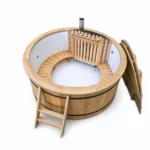
- 4 person wood fired hot tub is a relevant model to compare for this search intent.
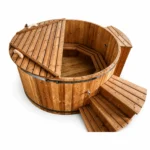
- affordable wooden hot tub is a relevant model to compare for this search intent.
Explore the full range of wood fired hot tubs, including traditional wood burning models, outdoor spa-style options, garden hot tubs, outdoor baths, best-buy comparisons and UK delivery pages.