

Choose mobility for the journeys you will actually make
A mobile hot tub makes sense when changing location is a regular part of its job. It may serve several properties, travel to private events or form part of an operated hire service. The purchase needs to cover two distinct situations: a secured empty system during transport and a supported bathing installation at the destination.
An ordinary garden tub can sometimes be relocated using an appropriate empty-handling method, but that does not make it a towable product. Its support frame, cladding and pipework have not thereby become a road chassis. A purpose-built trailer system needs a coordinated arrangement for carrying the vessel, securing equipment and preparing it for use after arrival.
Write down the expected journey frequency, typical access routes and available working time at each venue. If the tub will usually stay in one garden, compare the fixed alternatives below and the wider wood-fired hot-tub range. Designing the services once at a permanent site can be more practical than owning transport equipment that is rarely used.
The current Nordic Mobile configurations
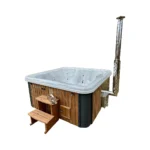
TimberIN Nordic Mobile is the current dedicated hot-tub trailer model. The live selector currently offers 1,600 mm or 1,800 mm inner diameter, each with an external or an internal snorkel wood-fired heater. Those four combinations are active in the configurator. Select the diameter and heater together before comparing optional equipment or requesting the completed trailer specification.
The product’s broader descriptive material and polypropylene family sheet also discuss larger shells and other heater arrangements. They do not establish those as currently selectable mobile combinations. For this purchase, use the live choices and obtain a written response if you need a different build. Do not assume that an option shown on a fixed tub can be transferred to the trailer.
| Current mobile size | Polypropylene family reference | What still needs confirmation |
|---|---|---|
| 1,600 mm interior | Approximately 1,800 litres; 4–6 bathers; 1,920 mm top outside diameter | Selected benches and heater, final operating capacity and complete trailer dimensions |
| 1,800 mm interior | Approximately 2,280 litres; 6–8 bathers; 2,120 mm top outside diameter | Selected benches and heater, final operating capacity and complete trailer dimensions |
The polypropylene technical sheet provides these shell comparisons. It also notes that closed polypropylene benches reduce water volume. Treat the figures as family guidance, not a trailer certificate or a promise of identical bathing space with every heater and bench arrangement. Confirm critical measurements before production.
Keep three different weights separate
The dry tub, the completed system ready for transport and the filled installation are different loads. A shell weight from a product sheet does not include every part of the trailer, heater, cover, steps, storage and optional equipment. Ask for the completed build’s documented masses and ratings, with a clear explanation of what is included.
For travel, account for everything carried on the trailer in its approved transport arrangement. Loose accessories, fuel, hoses and cleaning equipment still have weight. Their position affects how the load is distributed, so storage should be agreed as part of the build rather than improvised after the trailer has been handed over.
At the venue, the water load changes the support requirement substantially. About 1,800 litres represents about 1,800 kg of water alone, before the vessel, trailer, bathers and equipment are counted. That is an illustration of scale, not permission to fill a trailer supported in any convenient way. Use the manufacturer’s specified operating support and stabilisation arrangement.
Request a drawing that distinguishes transport configuration from parked operation. It should show what remains attached, what is removed or deployed and how the system is supported before filling. Keep the final documents with the unit so that each operator is working from the same configuration.
Check the finished trailer against the vehicle and driver
Match the final trailer documentation to the intended tow vehicle, coupling equipment, driver entitlement and insurance. This cannot be decided from a tub diameter or a generic statement that a model is mobile. Ask for the relevant ratings, completed dimensions and required documents before arranging collection or planning a route.
GOV.UK’s towing weight and size guidance explains that the vehicle’s towing and combined-weight limits matter. Use the actual vehicle and trailer information to check the combination. A vehicle having a towbar does not establish that it is suitable for every trailer build or load.
The DVSA pre-towing checks, for Great Britain, cover the coupling and connections, tyres, lights and secured load. Build the applicable checks into every journey and follow the supplied equipment instructions. Check the relevant requirements separately for Northern Ireland or travel outside Great Britain, and obtain appropriate towing training where needed.
Survey the route into the venue as carefully as the road journey. Gates, sharp turns, overhead branches, gradients and soft verges can prevent access even when the road route is suitable. Leave space to position the trailer and depart again without relying on moving a filled tub.
Prepare an empty, cool and secured system for travel
The mobile tub is transported empty. Plan the end of the bathing session around safe cooling, drainage and preparation for the road. Leaving a small amount of water in the vessel is not a shortcut to a documented transport arrangement, and no one should occupy the bathing area during movement.
Follow the supplied sequence for draining the tub and any fitted pumps, pipework or filter equipment. Water can remain outside the main vessel after the visible tub has emptied. Identify those locations at handover, together with components requiring protection from frost or movement between venues.
Let the wood heater cool fully and follow its instructions for dealing with ash and any removable flue parts. Do not drain the heater while a fire or embers remain or it is still hot. The ability to attach the trailer to a vehicle is not evidence that the bathing system is ready to move.
Secure covers, steps, equipment boxes and other accessories using the specified transport fittings and locations. Confirm whether a bathing cover is also suitable for travel, and how removable components are restrained. Ask the supplier to demonstrate the completed transport configuration rather than relying on a photograph of a parked display unit.
Agree the operating area before accepting a venue
Each destination needs suitable access and ground that can support the filled operating load. Assess the whole working area, including the trailer, deployed steps, heater access and space for people entering and leaving the water. A small parking space is not necessarily a usable bathing site.
Use the manufacturer’s procedure for positioning, securing, levelling and stabilising the system before filling. Confirm which supports are intended to carry the operating load and where they must bear. Do not assume that a jockey wheel, transport suspension or improvised blocks provide the required filled-use support.
Keep the approach firm and appropriate for wet feet. Route supply cables and hoses so people do not have to step over them. Consider lighting, privacy and access control, particularly where other guests can walk close to the heater or bathing area. Leave an unobstructed route for assistance and routine maintenance.
For a longer stay, revisit the site after heavy rain or changes in ground conditions. The garden hot-tub guide helps with wider placement and access decisions, but a mobile system still needs its own approved support arrangement. Wheels do not remove the need to assess the destination properly.
Confirm water, electricity and discharge at every stop
Establish the water source before arrival and check that it can provide the required fill within the available time. Ask the venue about access to the supply, hose route and any restrictions. A tap appearing on a site plan does not prove that it is suitable or available for filling on the booking day.
Optional filtration, massage or lighting may need electricity even when the water heater burns wood. Confirm the selected equipment’s actual supply requirements and have temporary connections assessed for the location. Keep electrical equipment and connections positioned and protected according to their instructions, away from the bathing and drainage routes.
Agree where used water will be discharged and how it will reach that point. The route must suit the site and the water-treatment routine. Do not assume that a field, roadside drain or nearby stream is an acceptable outlet. Establish permissions and responsibilities with the venue and relevant local bodies before filling.
Allow for draining time as part of the visit. An optional tap or hose adaptor controls the connection but does not guarantee rapid emptying or an adequate discharge route. Keep the route away from neighbouring property, access paths and ground that would become unsuitable for the departing trailer.
Choose the heater around the parked layout
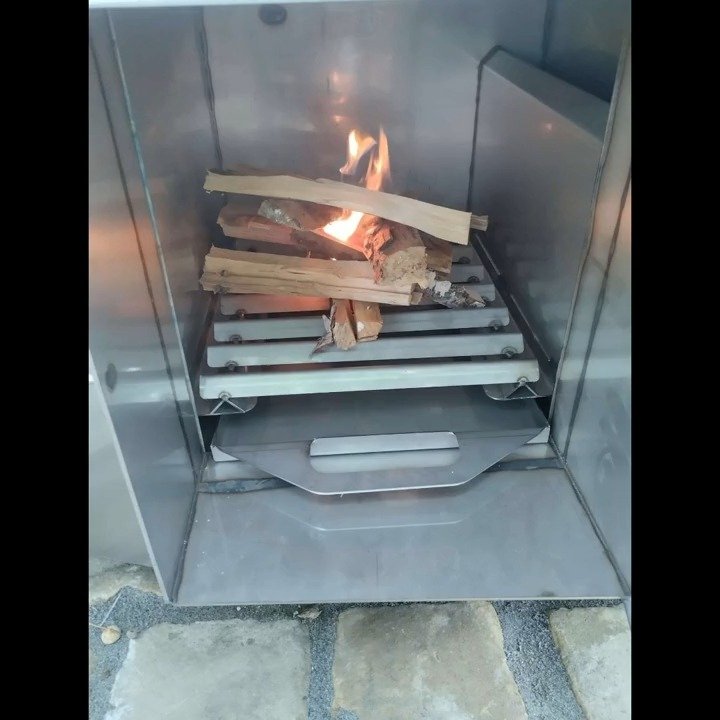
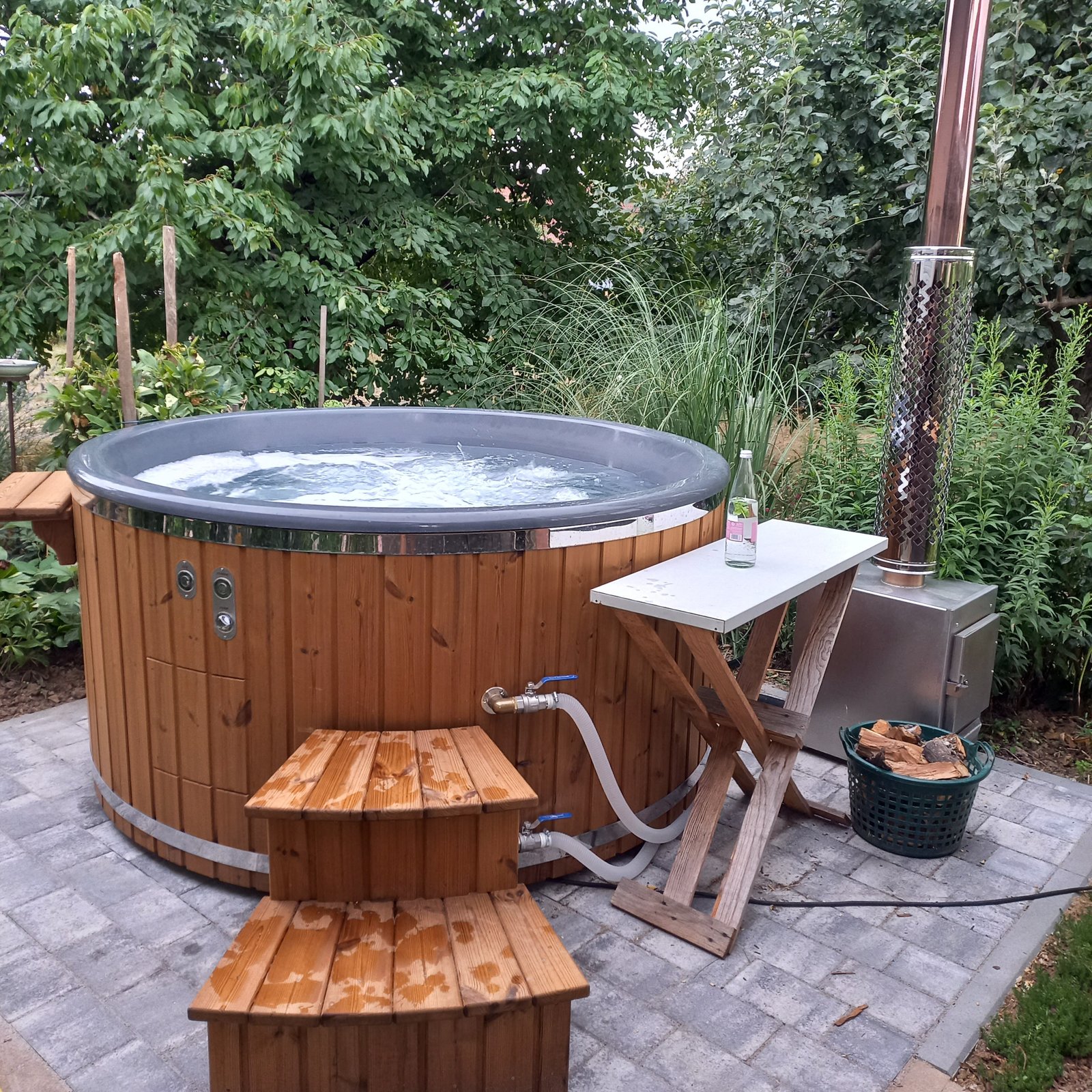
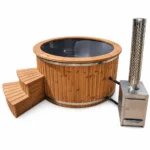
The external heater keeps the firebox outside the bathing vessel and requires a suitable operating position and connection arrangement. Preserve the specified circulation relationship and pipe route after setting up at each venue. Moving the stove or extending connections for convenience can change the installation and needs supplier approval.
An internal snorkel heater occupies part of the vessel and needs its specified guarding, operating water level and access for tending the fire. Consider how the chosen benches and heater affect usable seating and entry. The nominal number of bathers is not a substitute for understanding the actual layout.
At either size, the heating schedule depends on starting water temperature, weather, selected heater and operating practice. Leave time for commissioning and checking the bathing water before use. Record actual performance after handover so future bookings can be planned around your system and conditions rather than a generic heat-up promise.
Keep fuel storage, firebox access and the flue’s required clearances separate from the guest route and temporary structures. The optional chimney guard does not replace the heater’s installation requirements or supervision. A marquee, fence or overhanging tree can change whether a proposed location is workable.
Choose equipment that works between journeys
The current mobile product offers timber, bench and liner-colour choices alongside steps, insulation and spa equipment. Select these for the way the unit will be used and maintained. A larger equipment package can increase the work of setting up, draining, inspecting and securing the system between destinations.
Keep the cover and edge specification explicit in the quotation. The configurator offers different cover arrangements, and the selected combination should be recorded with any additional charge. Ask how the cover is handled at the venue, where it is stored during bathing and how it is secured for transport.
Access to pumps, filters, connectors and drain points is especially valuable on a travelling installation. Demonstrate that the relevant panels can open in the parked layout without removing permanent fittings or blocking the steps. Include spare consumables and maintenance items in an agreed storage plan, with their transport weight accounted for.
If the project also needs a sauna, compare mobile outdoor saunas and sauna and hot-tub combinations as separate systems. Their room allocation, heating and transport requirements differ; a combined installation should be assessed as its own complete build.
For hire use, price the full operating cycle
An operated hire service needs more than a trailer and a calendar. Allow for travel, positioning, filling, heating, guest handover, monitoring, cooling, draining, cleaning and the return journey. Include the staff time and service access needed to perform those tasks properly, including at venues you have not visited before.
HSE’s HSG282 guidance covers management of spa-pool systems, including domestic-type hot tubs used as part of a business activity. Have a competent person establish the appropriate water-quality, inspection and maintenance arrangements for the actual equipment and use. Mobility does not remove those responsibilities.
Keep records of the unit’s configuration, servicing, journey checks and site handovers. Agree who operates the heater, checks the water, manages access and responds to problems during a booking. This guide does not establish a commercial approval or treatment schedule for a particular trailer.
Questions about mobile hot tubs
Can the tub be towed while full of water?
No. Plan to transport the mobile system empty, with the heater cool and equipment prepared and secured according to the supplied instructions. Filling takes place only after the unit is correctly positioned, supported and stabilised at the destination.
Does the listed tub weight tell me which car can tow it?
No. Shell weight and completed transport weight are different. Use the final trailer documentation, actual carried load, vehicle ratings, driver entitlement and applicable rules to assess the combination.
Can I order a larger mobile diameter shown in the technical sheet?
The current mobile selector offers 1,600 mm and 1,800 mm interiors. The sheet describes a wider polypropylene family. Request written confirmation of any different mobile build and its complete trailer specification before assuming it can be supplied.
Request a complete mobile-system quotation
Send your intended venues, journey frequency, vehicle details, preferred diameter and heater, and required equipment. Ask for the finished transport specification, parked support arrangement, services, delivery responsibilities and operating handover to be included alongside the tub price.