
Wood-Fired Hot Tubs in Glasgow: Models, Delivery and Site Planning
A wood-fired hot tub can work well at a Glasgow or Greater Glasgow property when the heater, flue, access and drainage are planned as one installation. The tub itself is only part of the project: local smoke-control considerations, exposed weather, a filled-weight base and the final delivery route can decide whether a chosen configuration is practical.
TimberIN manufactures configurable tubs in Europe and arranges UK delivery subject to the selected model and a confirmed route. This page does not promise that every garden can accept every tub. It explains the evidence to collect before a quotation is finalised.
Use it to compare current models, heater positions, insulation, water systems and the responsibilities that remain with the property owner or project team.
Glasgow planning rule of thumb: verify fuel and flue acceptability first, then confirm access, foundation and drainage before choosing optional equipment.
What makes a Glasgow project different?
Glasgow projects range from compact urban gardens to larger properties outside the city boundary. A generic “delivery to Glasgow” statement therefore says very little about the final approach. Gate widths, shared access, parking restrictions, steep ground, walls and overhead cables must be checked for the specific address.
The region’s cool, wet and windy periods also reward a well-fitted cover, sensible insulation and a sheltered bathing position. Shelter must not obstruct the combustion air or ignore the heater manufacturer’s flue clearances. The final layout should protect bathers without trapping smoke around neighbouring windows or boundaries.
Current wood-fired hot-tub models
The products and prices below are loaded directly from WooCommerce. Open each product to check its selectable size, heater position, interior, cladding and equipment. Final availability and delivery are confirmed for the completed configuration and address.
-
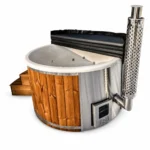
Product on saleSave up to 16% Wood Fired Hot Tub with Jets – TimberIN Nordic Rojal™ (4–8 Person)
From: £6,785From: £5,874 -
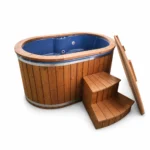
2-person model2 Person Wood Fired Hot Tub – TimberIN Nordic DuoFrom: £2,420
-
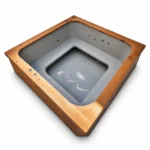
Square modelSquare Wood Fired Hot Tub – TimberIN Nordic Square™ (160–220 cm)From: £2,862
-
8-person modelLarge 8 Person Wood Fired Hot Tub – TimberIN Nordic Elite™ SquareFrom: £4,290
-
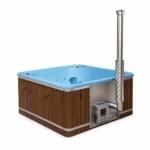
Acrylic luxuryTimberIN Nordic Square™ Acrylic Hot Tub – External or Integrated Wood Stove (Luxury Marble Edition)From: £6,787
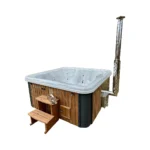
Choosing the tub before choosing the options
Write down regular occupancy and the maximum group you genuinely need to accommodate. Published capacities are model guidance; usable seating changes with shell thickness, bench layout and an internal or integrated stove. Ask for internal dimensions and water volume for the exact version.
A smaller tub requires less water to fill, heat and treat. A larger model can be right for a family, holiday property or group use, but only when the base, utilities and maintenance plan support it. Compare two-person and four-person hot tubs from normal occupancy rather than occasional ambition.
External, integrated or internal wood heater
An external stove preserves the most bathing space and gives direct maintenance access. It needs additional room beside the tub and correctly arranged connecting pipes. An integrated stove creates a compact outline, while an internal snorkel stove places the heater in the water and reduces usable seating.
Ask for the exact stove model, material, output, water-level requirement, included chimney sections and clearances. Position steps and the normal walking route away from hot surfaces. Never light the heater until the required water level and circulation conditions have been established.
Smoke-control, flue and neighbour checks
Glasgow contains smoke-control areas, and Scottish guidance restricts smoke from chimneys in those areas unless the fuel or appliance meets the relevant rules. An outdoor hot-tub heater should not simply be assumed to qualify as an exempt domestic stove. Before ordering, give the exact heater and proposed flue details to the relevant local authority environmental service and obtain advice for the installation address.
The Scottish Air Quality smoke-control guidance explains the general framework and directs householders to their council for the local boundary. Also consider prevailing wind, neighbouring windows, fuel quality and the possibility of smoke or odour nuisance even where a technical permission exists.
Burn only the fuel approved for the heater, keep it dry and never use treated timber, waste or accelerants. The operating manual and written local advice should take precedence over informal assumptions about what can be burned in a garden.
Planning permission and property constraints
Some garden work falls within Scottish householder permitted-development rights, but limits and exclusions apply. Conservation areas, listed buildings, flats, raised decks, shelters, new structures and flues can change the position. Check the current Scottish householder permitted-development guidance and ask the planning authority about the complete proposal.
A free-standing tub, a substantial platform and a roofed enclosure should not be treated as one invisible purchase. Show the base, deck, screen, shelter, heater and flue on the same sketch. Tenants, leaseholders and owners with title conditions should obtain the required private permissions as well as any public consent.
If the tub forms part of short-term-let or commercial accommodation, assess the wider use of the property rather than relying on domestic garden assumptions. Scotland has separate planning and licensing considerations for short-term lets. The operator should confirm occupancy controls, supervision, water records and guest access to the heater with the relevant authorities and insurer.
Heating performance in Glasgow weather
There is no fixed heat-up time for “a Glasgow hot tub”. Water volume, starting temperature, useful stove output, wind, cover quality, insulation and fire management all affect the result. Ask for the assumptions behind an estimate and compare them with the intended winter or shoulder-season use.
Keep the fitted cover in place during heat-up when the manufacturer’s instructions allow it. Store dry logs off the ground and under weather protection while preserving ventilation. If regular temperature maintenance matters more than the firing routine, compare electric or hybrid support rather than oversizing the wood stove.
Delivery access and unloading
Measure the complete route from the delivery vehicle to the prepared base. Record the narrowest opening, tightest turn, slope, steps, wall heights, branches and overhead cables. Photographs with a tape measure are more useful than describing access as “standard”.
Confirm where a vehicle can stop without blocking unsafe traffic movement and whether unloading equipment, a crane or temporary fence removal is required. Responsibility and cost for special handling must be written into the order. Where access crosses shared or neighbouring land, obtain agreement before dispatch.
The heater, steps and service connections also need a final orientation. Mark them on a site sketch so the delivered tub does not place the chimney against a boundary or the filter box where it cannot be opened.
Foundation, drainage and water disposal
The base must remain level and stable under the filled tub, bathers, heater and equipment. Confirm the filled weight and the foundation designer’s requirements. Provide drainage around the base so persistent rain does not leave timber or service components standing in water.
Plan a controlled drain route before the tub arrives. Do not discharge treated water into a surface drain, burn or watercourse without confirming that it is lawful. SEPA’s standing advice distinguishes a single domestic hot tub discharging to land or a soakaway from other pool and hot-tub discharges, so commercial, rental or unusual sites should obtain project-specific advice.
Water care, filtration and winter protection
Filtration supports repeated use but does not replace testing, cleaning or an appropriate treatment routine. Jets and air systems add pipework that must also be cleaned and drained. Ask where filters, pumps and valves are housed and preserve access for cartridge changes and repairs.
Freezing water can damage pipes, pumps, filters and heaters. Decide whether the installation will remain filled under a documented protection regime or be completely drained. “Empty” must include concealed equipment and low points, not just the visible shell.
Outdoor electrical components need the supply, protection and isolation specified for the equipment and site. Arrange this through a competent installer, keep control boxes out of drainage routes and record which circuits serve heating, pumps, filtration, jets and lighting. The owner should know how to isolate the system safely without disabling equipment needed for an agreed frost-protection mode.
Compare a complete Glasgow quotation
| Project area | Evidence to request |
|---|---|
| Configured tub | Size, water volume, interior, cladding, heater, cover and steps |
| Local compliance | Heater/flue details and planning or environmental advice |
| Site work | Foundation, drainage, electrical work and service clearance |
| Delivery | Vehicle access, unloading, lifting and final orientation |
| Ownership | Fuel, water care, cleaning, winterisation and servicing |
Use the price guide to compare proposals on the same basis. Final cost depends on configuration and address, so a low base price is not a substitute for a complete written scope.
Who is responsible at each stage?
| Stage | Questions to settle |
|---|---|
| Before order | Local checks, selected specification and measured access |
| Before delivery | Base, drainage, utilities and unloading equipment |
| Installation | Heater, flue, electrical and hydraulic connections |
| Handover | Manuals, commissioning, warranty and operator training |
Glasgow hot-tub project checklist
- Confirm the property’s local-authority area and smoke-control status.
- Check planning, conservation, listed-building and private-title constraints.
- Select the tub from regular occupancy and internal dimensions.
- Obtain the exact heater, flue, output and fuel requirements.
- Measure and photograph delivery and unloading access.
- Prepare a filled-weight base and lawful drainage route.
- Specify cover, insulation, filtration and freeze protection.
- Record installation, commissioning and maintenance responsibilities.
Frequently asked questions
Can a wood-fired hot tub be used in a Glasgow smoke-control area?
Do not assume that it can or cannot. Give the exact outdoor heater, fuel and flue details to the relevant local-authority environmental service and obtain address-specific advice before ordering.
Do I need planning permission for a hot tub in Glasgow?
Requirements depend on the property and the complete works, including decks, shelters and flues. Check Scottish permitted-development guidance and confirm the proposal with the planning authority.
Can TimberIN deliver to a Glasgow property with narrow access?
Delivery feasibility depends on measured access and unloading arrangements. Provide photographs and dimensions so special handling can be assessed before the order is confirmed.
Which heater is best for a small Glasgow garden?
An integrated or internal heater can reduce the external footprint, but it also affects seating and service access. Compare the complete measured layout rather than heater width alone.
How should a hot tub be protected in winter?
Use the equipment-specific freeze-protection or complete-drain procedure. Pumps, filters, pipes and heaters must be included; draining only the visible shell is not enough.
Prepare the Glasgow site before finalising the tub
Send the intended occupancy, heater preference, local-authority advice, delivery measurements and site photographs with your enquiry. TimberIN can then price a defined configuration and route instead of relying on assumptions.