
Wood-Fired Hot Tubs Manchester: Delivery and Site Guide
Buying a wood-fired hot tub for Manchester is less about finding a local product badge and more about solving access, foundation, drainage, smoke and delivery for the actual property. A wide suburban driveway, a Stockport slope and a narrow Manchester terrace require different plans even when the tub model is identical.
TimberIN supplies from its European manufacturing base and does not present this page as a Manchester showroom or installer directory. This guide explains how delivery to Greater Manchester can be assessed, how to choose the tub and heater, and which local trades or authorities may need to be involved before an order is confirmed.
Manchester project rule: send the postcode, street restrictions, gate measurements and photographs of every turn. “Access to the garden” is not precise enough for a large tub.
Greater Manchester coverage without a false local-presence claim
Delivery enquiries can be assessed for Manchester, Salford, Trafford, Stockport, Tameside, Oldham, Rochdale, Bury, Bolton, Wigan and nearby areas. Coverage is not a promise that every postcode, restricted street or final garden position can be served in the same way.
Final freight, vehicle size, unloading and lifting depend on the chosen model and route. Installation trades should be selected for the relevant work and location. Ask for responsibilities to be written into the quotation rather than assuming a national delivery price includes positioning and connection.
Wood-fired hot-tub models for Manchester projects
The current wood-fired category appears below. Open a model to compare its current sizes, heater choices, included equipment and optional systems. A wood-fired listing can still include powered filtration, jets, bubbles, lighting or electric support, so identify every utility in the final configuration.
-
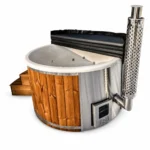
Product on saleSave up to 16% Wood Fired Hot Tub with Jets – TimberIN Nordic Rojal™ (4–8 Person)
From: £6,785From: £5,874 -
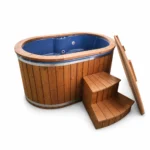
2-person model2 Person Wood Fired Hot Tub – TimberIN Nordic DuoFrom: £2,420
-
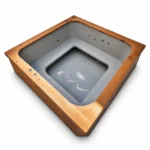
Square modelSquare Wood Fired Hot Tub – TimberIN Nordic Square™ (160–220 cm)From: £2,862
-
8-person modelLarge 8 Person Wood Fired Hot Tub – TimberIN Nordic Elite™ SquareFrom: £4,290
-
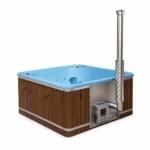
Acrylic luxuryTimberIN Nordic Square™ Acrylic Hot Tub – External or Integrated Wood Stove (Luxury Marble Edition)From: £6,787
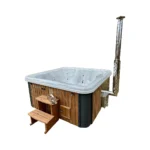
Choose the tub around normal use
Start with normal bathers, preferred interior and operating water volume. A compact two-person model can suit a small courtyard; a family may need wider benches or a square layout. Nominal capacity is not a comfort guarantee, so request internal dimensions and consider the stove position.
A moulded insert offers a smooth surface and defined seating. A traditional timber interior has a different water-retention and maintenance routine. Compare the complete ownership pattern rather than choosing only from exterior cladding photographs.
External, integrated or internal stove?
An external stove keeps the fire outside the bathing area and preserves seats, but increases the footprint and needs connected pipework and its own support. An integrated heater creates a compact outline. An internal or snorkel heater sits in the water, occupies space and requires its specified guard.
Draw the stove door, ash area, chimney and fuel route on the site plan. Keep them away from fences, sheds, planting and the path used by wet bathers. Use only the approved arrangement for the selected tub and follow its water-level and circulation instructions before lighting.
Heating time is not a Manchester postcode figure
Water volume, starting temperature, useful stove output, dry fuel, wind, cover and operator technique determine heat-up. A sheltered Salford courtyard and an exposed edge-of-Pennines garden can behave differently. Any estimate should state its assumptions and exact model.
Use suitable temperature monitoring, mix or circulate water as instructed and supervise the fire. Do not light a dry heater, obstruct circulation or drain the tub while the stove remains hot. A fixed “ready in” promise is weaker than a clear operating method.
Plan dry firewood in a wet climate
Store suitable dry logs off the ground with weather protection and ventilation. Keep only the session supply near the heater and leave the stove, door and chimney accessible. A plastic sheet directly over wet wood is not a useful long-term fuel store.
Estimate storage from expected use, not from one demonstration firing. Poor fuel can increase smoke and make heating less predictable. Ash should cool in an appropriate non-combustible container away from the tub and combustible waste.
Smoke control and neighbours need an early check
Urban and suburban sites put chimneys close to windows, extensions and boundaries. Use the official DEFRA smoke-control service and ask the relevant local authority about the address. Requirements depend on appliance, fuel and location; a wood-fired hot tub should not be assumed exempt.
Position the chimney with competent advice and consider prevailing conditions and neighbour impact. Never shorten or redirect it simply to hide it below a fence. Good fuel and operation matter, but they do not replace applicable legal or manufacturer requirements.
Audit Manchester access from road to base
| Access point | What to record | Typical decision |
|---|---|---|
| Street and unloading | Parking controls, width, traffic, permit or timed access | Vehicle type and unloading window |
| Gate or alley | Clear width and height after hinges, pipes and bins | Assembled, tilted, module or crane delivery |
| Corners and steps | Diagonal clearance, slope, handrails and surface | Manual route, temporary removal or lifting |
| Overhead space | Eaves, cables, branches and conservatory roofs | Safe lifting or alternative route |
| Ground route | Soft lawn, paving strength and wet-weather condition | Ground protection and handling equipment |
| Final position | Base, stove support, service and cover clearance | Orientation before the tub arrives |
Terraced and semi-detached gardens need realistic lifting plans
A side passage may be narrower than the tub even when the garden is large. An assembled tub might need mechanical lifting, delivery in another form or a different model. Never plan to pass a tub through the house without a surveyed route, protection and safe handling method.
For a crane or lifting vehicle, confirm setup space, outreach, ground bearing, overhead hazards and permissions with a competent contractor. Photograph the road and property from both directions. The supplier and lifting contractor need the packed dimensions and weight, not just a catalogue diameter.
Foundation and drainage should be designed together
A filled tub, bathers, stove, steps and accessories create a significant load. Obtain the final support requirements, empty weight and operating water volume before specifying a slab, pads or another base. Existing paving is not confirmed simply because it is level.
Plan full drain-down and routine splash water so neither undermines the base, floods a neighbour or crosses the path. Greater Manchester includes multiple councils and drainage circumstances; check the relevant local requirements and treatment-product instructions for the property.
Water care depends on use, not location
A private fill-and-drain tub and a retained-water filtered tub have different routines. Establish the source, treatment, testing, cleaning and change schedule for the chosen model and bathing load. Clear-looking warm water is not proof that it is hygienic.
Holiday-let and commercial use require a formal risk-based water-management process, records and trained responsibility. Do not copy a household routine into guest accommodation. Keep filters, pumps and valves accessible despite screening or decking.
Jets, filtration and lights affect the electrical plan
Wood can heat the bathing water while pumps, filters, jets, bubbles and lights still require electricity. List each component and its rated supply. A competent electrician should assess the property, cable route, isolation, earthing and outdoor protection.
Run the electrical design before landscaping closes the route. If genuinely low-power or zero-electricity operation matters, use the off-grid hot-tub guide and remove incompatible accessories from the written configuration.
Check planning and property restrictions
A hot tub, base, deck, enclosure and chimney may raise separate planning or building questions. Manchester and Greater Manchester are not one planning authority, so use the council responsible for the address. Listed buildings, conservation areas, flats, leases and title restrictions need particular care.
Describe any holiday or commercial use accurately. Keep authority responses, drawings and certificates with the project. Permission for one element does not automatically approve the whole installation.
Budget for the delivered Manchester project
| Cost area | Include | Manchester-site question |
|---|---|---|
| Configured tub | Size, interior, cladding, stove, cover and selected features | What is included in the starting price? |
| Freight and access | Delivery, restrictions, unloading, lifting and protection | Can the packed product reach the base? |
| Site works | Survey, foundation, drainage, path and screening | Who designs for the full operating load? |
| Utilities and fire | Electrical work, chimney, fuel store and clearances | Which competent trades are needed locally? |
| Commissioning | Assembly, connections, filling, testing and handover | Where does each party’s responsibility end? |
| Ownership | Fuel, water care, electricity, cleaning and replacement parts | Does the routine suit actual frequency of use? |
Manchester enquiry checklist
- Send the full postcode and street-access constraints.
- Photograph every gate, turn, step and overhead hazard.
- Choose normal capacity, interior and stove arrangement.
- Confirm packed dimensions, weight and unloading method.
- Design foundation and full drain-down before delivery.
- Check smoke control, chimney position and neighbour impact.
- List every powered accessory for the electrician.
- Check the correct council and property restrictions.
- Compare written responsibilities and whole-project cost.
Frequently asked questions
Do you deliver wood-fired hot tubs to Manchester?
Manchester and Greater Manchester enquiries can be assessed, but final coverage, freight, vehicle, unloading and lifting depend on postcode, model and access. Provide measurements and photographs for confirmation.
Is there a TimberIN showroom in Manchester?
This page does not claim a Manchester showroom. TimberIN supplies from its European manufacturing base; ask about current viewing options and delivery arrangements rather than assuming local stock.
Can a hot tub be delivered over a terraced house?
Potentially, using a competent lifting plan, but access, setup, outreach, weight, overhead hazards and permissions must be surveyed. The packed product data is required.
Can I use a wood-fired hot tub in a smoke-control area?
Do not assume so. Check the address, appliance, fuel and current requirements using official smoke-control information and the relevant local authority before choosing the heater.
How long will a wood-fired hot tub take to heat in Manchester?
There is no postcode-based time. Water volume, starting temperature, stove output, fuel, cover, wind and operation matter. Request an estimate for the chosen model under stated conditions.
Turn the postcode into a delivery plan
Share the postcode, model shortlist, access measurements, proposed base, users and heater preference. TimberIN can then assess product and delivery information without pretending every Manchester garden is the same.