
Wood-Burning Outdoor Saunas: Complete UK Stove, Chimney and Garden Installation Guide
A wood-burning outdoor sauna uses a solid-fuel sauna stove to heat the sauna stones, the room air and the internal timber surfaces. For many UK buyers, the appeal is the traditional routine of lighting the fire, preparing dry logs and managing the heat manually.
The stove is only one part of the project. A safe and comfortable wood-burning garden sauna also depends on the heated room volume, bench layout, chimney, clearances, ventilation, foundation, weather protection, access route and maintenance plan.
This guide compares wood-burning sauna options for private gardens, rural properties, holiday lets, cabins, retreats and commercial wellness projects. It explains barrel, pod, square-barrel, cabin, mobile and 2-in-1 sauna designs, realistic warm-up factors, smoke planning, UK installation issues and complete project costs.
Best buying principle: treat the sauna room, stove, stones, chimney, ventilation and foundation as one matched system rather than choosing the stove separately from the cabin.
-
 Pod DesignTimberIN Nordic Pod™ CustomFrom: £4,327
 -
 Barrel DesignTimberIN Nordic Barrel™ ClassicFrom: £4,106
 -
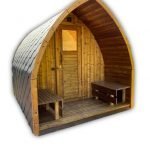 Best Seller! 15 % OFFTimberIN Nordic Pod™ Porch
From: £5,957From: £5,006 -
 Square designTimberIN Nordic Square Barrel™From: £6,056
 -
 Vertical DesignTimberIN Nordic Vertical™From: £4,127
 -
 2 Person ModelTimberIN Nordic Terrace™ 160 ElectricFrom: £5,192
 -
 Hobbit StyleTimberIN Nordic Hobbiton™ GlassFrom: £7,348
 -
 NEW!TimberIN Nordic Oval™ TerraceFrom: £7,590
Wood-burning outdoor saunas at a glance
| Decision | Practical direction | Confirm before ordering |
|---|---|---|
| Sauna shape | Choose from internal room and stove placement, not appearance alone. | Bench layout, heater guard and chimney route. |
| Stove output | Size from effective heated volume. | Room volume, glass, construction and stove range. |
| Chimney | Use a compatible complete flue system. | Sections, clearances, roof penetration and support. |
| Fuel routine | Plan dry untreated log storage. | Moisture, loading route and safe storage location. |
| Urban or rural site | Smoke and neighbour impact matter more in tight locations. | Boundaries, windows, wind direction and local restrictions. |
| Delivery form | Assembled models need access; modular or flat-pack can solve narrow routes. | Road, gates, turns, lifting and final base. |
Modern wood-burning sauna models
Modern outdoor sauna cabins can be configured with clean lines, panoramic glazing and wood-burning stove options where the room and chimney route are suitable. Large glass areas and modern shapes should be assessed carefully because they can change effective heating demand and privacy.
-
 Modern StyleTimberIN Nordic Vista™From: £6,808
 -
 Module Design 2in1 ComboTimberIN Nordic Modular Spa™From: £4,620
 -
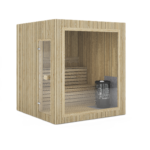 Modern CubeTimberIN Nordic Cube™From: £6,050
 -
 NEW!TimberIN Nordic Horizon™£9,350
 -
 NEW!TimberIN Nordic Oculus™£11,990
Mobile wood-burning sauna models
Mobile sauna trailers are often paired with wood-burning stoves because they can operate at events, retreats or remote locations without relying on a fixed electric heater. The complete trailer, towing, flue safety, setup procedure and commercial responsibilities must be planned together.
-
 Barrel DesignTimberIN Nordic Nomad™ Mobile Barrel SaunaFrom: £4,106
 -
 Square designTimberIN Nordic Square Mobile Sauna™From: £6,056
 -
 Pod DesignTimberIN Nordic Mobile Sauna Pod™From: £4,327
 -
 Barrel Design 2in1 ComboTimberIN Nordic Mobile Barrel Sauna & Hot Tub Combo™£15,510
 -
 Pod Design 2in1 ComboTimberIN Nordic Mobile Sauna Pod & Hot Tub Combo™£15,510
2-in-1 sauna and hot-tub models
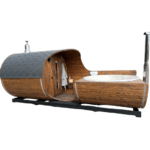
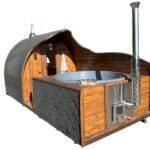
Combined sauna-and-hot-tub models create a larger outdoor wellness project. Wood-fired elements may suit the traditional atmosphere, but weight, water, drainage, chimney route, heating systems and maintenance all need careful planning.

What is a wood-burning outdoor sauna?
A wood-burning outdoor sauna is an exterior sauna building heated by a purpose-designed sauna stove that burns dry logs. The stove heats a basket or chamber of sauna stones, and water can be added to suitably heated stones to create short bursts of steam.
| System element | Function | What to verify |
|---|---|---|
| Sauna room | Contains the heated air, users, benches and stove. | Internal volume, bench geometry and safe movement. |
| Wood-burning stove | Converts dry fuel into heat for stones and room. | Supported room range, stone capacity and operating instructions. |
| Sauna stones | Store heat and create steam when water is added. | Approved stone type, quantity and arrangement. |
| Chimney | Removes combustion gases and supports draw. | Compatible sections, clearances, support and termination. |
| Ventilation | Supports combustion, comfort and drying. | Inlet and outlet arrangement for the exact model. |
| Hearth and guards | Protect surfaces and reduce contact risk. | Non-combustible protection and clearances. |
The stove should not be treated as a general-purpose garden-room heater. It must be matched to the sauna and installed according to the stove, chimney and sauna instructions.
Wood-burning, wood-fired and traditional sauna terminology
| Term | What it normally means | Important distinction |
|---|---|---|
| Wood-burning sauna | Sauna heated by a log-burning stove. | Usually requires chimney, hearth, clearances and fuel storage. |
| Wood-fired sauna | Common alternative term for the same type. | Use the exact stove specification rather than the label. |
| Traditional sauna | High-temperature sauna with heated stones. | Can be wood-burning or electric. |
| Finnish sauna | Traditional sauna associated with Finnish sauna culture. | May use water on suitable hot stones. |
| Off-grid sauna | Often used for non-electric heating. | Lighting or other accessories may still need power. |
For a wider heating comparison, see the wood-fired outdoor sauna guide and the electric outdoor sauna guide.
Wood-burning sauna designs compared
| Design | Why it can suit wood-burning heat | Trade-offs |
|---|---|---|
| Barrel sauna | Compact room and traditional appearance. | Curved walls reduce side headroom and affect stove position. |
| Pod or igloo sauna | Distinctive Nordic form with useful lower wall shape. | Porch and glazing change volume and access. |
| Square-barrel sauna | More usable bench and wall geometry. | Larger footprint than some barrels. |
| Cube or modern cabin | Straight walls and architectural glazing. | Glass can increase effective stove demand. |
| Traditional cabin | Flexible benches and possible changing room. | More volume, site work and roof detailing. |
| Vertical sauna | Compact footprint for one or two users. | Limited reclining and stove-placement options. |
| Mobile sauna | Can use wood heat away from fixed services. | Trailer, towing, flue setup and commercial rules. |
| 2-in-1 model | Combines heat routines with bathing. | More weight, water, drainage and maintenance. |
Detailed design guides are available for barrel saunas, pod saunas, cube saunas, garden saunas and mobile saunas.
Stove sizing from effective heated volume
A wood-burning sauna stove should be selected from the internal heated volume and the manufacturer’s supported room range. The number of users is not an adequate sizing method because two saunas with the same seating capacity can have very different volumes and glass areas.
| Sizing input | Why it matters |
|---|---|
| Internal length, width and height | Defines the basic cubic volume. |
| Panoramic glass | Usually increases heat loss. |
| Wall and roof construction | Changes how the room retains heat. |
| Floor and door details | Affect heat loss and comfort. |
| Stone mass | Takes time and energy to heat but stores warmth. |
| Ventilation | Required for combustion and users, but carries heat out. |
| Outdoor exposure | Wind and cold change real performance. |
Do not oversize the stove just to chase faster warm-up. Excessive output can make control harder and can create unsuitable clearances or uncomfortable surfaces.
Warm-up time and real performance
A fixed warm-up time should not be promised for every wood-burning sauna. The stove must heat air, stones, benches, walls, floor and glazing while the building is losing heat outdoors.
| Warm-up factor | Effect |
|---|---|
| Room volume | Larger rooms require more energy. |
| Stone quantity | Higher mass takes longer to heat but stores more heat. |
| Glass area | Increases heat loss compared with insulated wall sections. |
| Cold, rain and wind | Increase envelope losses. |
| Fuel moisture | Wet logs reduce useful heat and increase smoke. |
| Chimney draw | Affects combustion and stove performance. |
| Door opening | Releases hot air and lengthens recovery. |
| Operator technique | Lighting, airflow and loading routine change results. |
Use model-specific guidance as an estimate and establish a normal preparation routine for the actual sauna, site and fuel.
Wood-burning versus electric sauna heating
| Topic | Wood-burning stove | Electric heater |
|---|---|---|
| Preparation | Manual fire lighting and fuel loading. | Controller-based preparation. |
| Infrastructure | Chimney, hearth, guards, clearances and log storage. | Dedicated electrical supply and protection. |
| Control | Managed through fuel, airflow and timing. | More repeatable thermostat-based control. |
| Smoke | Requires flue planning and neighbour awareness. | No combustion smoke. |
| Routine | Traditional and hands-on. | Convenient for frequent use. |
| Maintenance | Ash, stove, stones and chimney. | Stones, elements, sensor and controls. |
| Best fit | Suitable sites where the fire ritual is valued. | Convenience-focused residential or commercial use. |
Wood-burning heat is not automatically cheaper, faster or better than electric heating. Compare the actual stove, local firewood cost, electricity tariff, sauna volume and usage pattern.
Chimney and flue planning
| Chimney element | What to confirm |
|---|---|
| Stove connection | Correct diameter and compatible connector. |
| Internal section | Clear route from stove to roof or wall exit. |
| Insulated flue | Appropriate for passing near combustible construction. |
| Roof penetration | Weatherproofing, support and heat protection. |
| Termination height | Suitable for draw and smoke dispersal. |
| Chimney support | The flue should not twist or overload the stove. |
| Cleaning access | Inspection and sweeping must be possible. |
Do not mix unrelated chimney parts or improvise roof penetrations. Use a complete compatible flue system and follow the stove and chimney instructions.
Hearth, heat shields and clearances
| Safety area | Purpose |
|---|---|
| Non-combustible hearth | Protects floor areas beneath and in front of the stove. |
| Wall protection | Reduces heat exposure where specified. |
| Stove guard | Helps separate users from hot surfaces. |
| Bench clearance | Keeps seating and movement away from the stove. |
| Fuel-loading space | Allows the door to open and logs to be loaded safely. |
| Door route | Keeps the exit path clear during operation. |
| Roof and flue clearances | Protects combustible roof and wall details. |
Clearances are model-specific. Generic distances should not replace the exact stove documentation.
Combustion air and sauna ventilation
A wood-burning sauna needs ventilation for users and for combustion. Poorly planned air supply can lead to weak stove performance, uncomfortable air, smoky lighting or slow drying after use.
- Follow the stove and sauna manufacturer’s ventilation arrangement.
- Keep combustion-air routes unobstructed.
- Do not block vents to retain heat.
- Coordinate air inlets with the heater position.
- Allow the room to dry after use.
- Keep external vents clear of planting, snow, leaves and stored items.
- Inspect persistent condensation around glazing and lower walls.
Firewood selection and storage
| Fuel practice | Why it matters |
|---|---|
| Use dry untreated logs | Supports more predictable combustion and reduces smoke. |
| Avoid painted, glued or treated timber | Prevents hazardous fumes and deposits. |
| Use practical log size | Improves loading and airflow inside the stove. |
| Store logs ventilated and raised | Reduces moisture uptake. |
| Keep day fuel convenient | Improves routine without overloading the sauna area. |
| Keep bulk storage away from sparks | Reduces fire risk. |
| Follow stove fuel guidance | Protects the stove and flue system. |
There is no universal rule that one wood species is always best. Use dry, untreated fuel permitted by the stove manufacturer and available responsibly in the local area.
Smoke, neighbours and urban gardens
A wood-burning sauna produces combustion emissions, especially during lighting and refuelling. Good fuel, correct draw and proper operation can reduce smoke, but no wood-burning sauna should be described as smoke-free.
- Consider neighbouring windows, gardens and boundaries.
- Review prevailing wind and chimney termination.
- Keep the flue away from unsuitable roofs, pergolas and planting.
- Use dry fuel and correct air control.
- Do not smoulder the fire deliberately.
- Maintain the stove and chimney.
- Check local smoke-control or property-specific restrictions where relevant.
Off-grid use and powered accessories
A wood-burning stove can heat the hot room without an electric heater. That does not automatically make the complete sauna fully off-grid because lighting, controls, security, ventilation equipment or nearby facilities may still require power.
| Feature | Can be non-electric? | Qualification |
|---|---|---|
| Wood-burning stove | Yes | Requires a suitable stove, fuel and chimney. |
| Natural ventilation | Potentially | Must follow the sauna and stove guidance. |
| Lighting | Optional | Battery or solar options have limitations. |
| Changing-room heating | Not automatically | May need a separate system. |
| Commercial monitoring | Usually powered | Depends on the operating setup. |
| Nearby shower or plunge | Not automatically | Water systems may require services. |
Capacity and bench layout
Wood-burning sauna capacity should be assessed from usable bench length, movement space and stove clearance. The stove and guard can reduce flexible interior space compared with some electric layouts.
| Use case | Practical direction | Check carefully |
|---|---|---|
| One or two users | Compact barrel, vertical, pod or small cabin. | Heater guard, door swing and upper bench position. |
| Two to four users | Medium sauna with clear stove separation. | Shoulder room and safe circulation. |
| Four to six users | Family pod, barrel, square-barrel or cabin. | Stove output, ventilation and bench layout. |
| Reclining | Prioritise bench length over headline capacity. | Clear usable bench after guard and backrests. |
| Commercial groups | Design around normal operating capacity. | Cleaning, supervision and safe procedures. |
Compare four-person saunas and family outdoor saunas where capacity is the main decision.
Walls, roof, floor and glazing
| Component | Wood-burning sauna check |
|---|---|
| Walls | Material, thickness, joints and heat exposure near the stove. |
| Roof | Weatherproof covering and chimney penetration details. |
| Floor | Support, cleaning, hearth and moisture management. |
| Door | Safe movement and clear exit route. |
| Glazing | Heat loss, privacy and proximity to stove. |
| Porch | Fuel and entry convenience without blocking ventilation. |
| Lower exterior edge | Protection from standing water and splashback. |
Large panoramic glass can be attractive but may increase effective heating demand and create privacy or cleaning considerations. It should be included in stove sizing.
Foundation and outdoor position
| Base option | Potential use | Critical checks |
|---|---|---|
| Concrete slab | Permanent and heavier installations. | Level, dimensions, drainage and support points. |
| Engineered paving | Many domestic gardens. | Compacted sub-base and uniform support. |
| Ground screws and platform | Selected sloping or sensitive sites. | Professional design and exact support points. |
| Engineered deck | Raised terraces. | Complete load, deflection, fire and moisture. |
| Existing patio | May reduce groundwork. | Condition, level and compatibility. |
Position the sauna so the chimney can be serviced, the roof can be inspected, firewood can be stored safely and rainwater moves away from the structure.
UK weather exposure and winter use
Wood-burning saunas are often used in colder seasons, but year-round performance depends on the building, stove, roof, ventilation, fuel quality and access route. Outdoor use should not be described as guaranteed without considering the exact configuration and site.
| Exposure issue | Practical response |
|---|---|
| Driving rain | Maintain roof covering, seals and lower-wall protection. |
| Wind | Review door orientation, chimney draw and roof detailing. |
| Frost | Keep access routes stable and non-slip. |
| Standing water | Control drainage around the base. |
| Leaves and debris | Keep vents and roof edges clear. |
| Coastal exposure | Inspect fixings and exterior finish more often. |
| Stored fuel | Keep firewood dry and ventilated. |
Planning, smoke-control and property checks
A garden sauna may sometimes be treated as an outbuilding, but a wood-burning stove adds chimney, smoke and fire-planning considerations. The answer depends on the exact property, size, position and use.
- Check external height, boundary position and total footprint.
- Include porch, terrace, canopy and chimney details.
- Consider listed status, conservation areas and designated land.
- Review neighbouring windows and smoke direction.
- Check lease, covenant, estate or shared-access restrictions.
- Confirm commercial or holiday-let responsibilities separately.
- Use competent professionals for structural, stove and flue work.
- Review current Planning Portal outbuilding guidance where appropriate.
Delivery, unloading and installation
| Supply form | Advantages | Trade-offs |
|---|---|---|
| Factory assembled | Controlled factory build and less site work. | Needs wide access and suitable lifting equipment. |
| Large modules | Balances factory quality and restricted access. | Requires lifting and final joining. |
| Flat pack | Can pass through narrow garden routes. | More skilled local assembly and weather protection. |
| Custom site assembly | Can solve unusual access. | More planning, labour and programme complexity. |
Measure the full route from vehicle stopping point to final base: road width, parking, gates, passages, corners, slopes, steps, overhead cables, branches and lifting distance. Transport, unloading and final positioning should be confirmed separately.
Production and transport timing
Outdoor sauna production is commonly approximately 4–6 weeks depending on model, timber, stove, glazing, chimney and selected options. Transport timing is scheduled separately according to the model, assembly form, destination, access and unloading method. These timings are estimates, not guaranteed dates.
Complete project cost
| Cost area | What to compare | Common omission |
|---|---|---|
| Sauna body | Shape, size, timber, walls, roof, glazing and benches. | Comparing different heated volumes. |
| Stove package | Stove, stones, guard, hearth and chimney. | Assuming every flue component is included. |
| Foundation | Slab, paving, screws or engineered deck. | Using an unsuitable existing base. |
| Delivery | Vehicle, crane, telehandler or modular transport. | Assuming final placement is included. |
| Installation | Assembly, flue, roof penetration and commissioning. | Comparing kit and installed prices directly. |
| External works | Path, steps, fuel store, drainage and cooling area. | Pricing only the sauna. |
| Maintenance | Fuel, ash, stones, chimney, timber and roof care. | Assuming low-effort ownership. |
See the outdoor sauna price guide for broader budget planning.
Maintenance schedule
| Frequency | Typical task |
|---|---|
| Before use | Check stove, stones, guard, hearth, chimney and ventilation. |
| During heating | Supervise the fire and operate airflow as instructed. |
| After cooling | Remove ash as required and allow the room to dry. |
| Regularly | Inspect door, air controls, chimney joints and heat shields. |
| Seasonally | Clean or inspect the flue and check roof penetration. |
| As needed | Rearrange or replace deteriorated stones. |
| After storms | Inspect roof, base, vents and exterior timber. |
Maintenance is manageable but not minimal or maintenance-free. Frequency depends on use, fuel, exposure and the exact stove and chimney system.
Commercial, rental and hospitality use
Wood-burning saunas can suit glamping sites, cabins, retreats, holiday cottages and event businesses where the fire routine is part of the experience. Commercial use needs clear procedures and should not be promoted with guaranteed rental-return claims.
| Operating area | Plan before purchase |
|---|---|
| Supervision | Decide who lights, tends and extinguishes the fire. |
| Guest access | Control contact with stove, guard, chimney and fuel. |
| Cleaning | Create ash, floor, bench and ventilation routines. |
| Inspection | Record stove, chimney, stones and structure checks. |
| Insurance | Confirm the exact installation and use are covered. |
| Instructions | Provide simple operating and emergency guidance. |
| Cooling and changing | Provide safe paths, lighting and non-slip areas. |
Health and environmental claim safety
A sauna can be described as a relaxation or personal wellness product, but pages should not promise detoxification, disease treatment, cardiovascular improvement, rapid recovery, sleep improvement or other medical outcomes.
Wood is renewable only when responsibly sourced, and wood burning is not automatically carbon neutral or environmentally harmless. Fuel sourcing, moisture, stove operation, chimney maintenance and local air quality all matter.
Common buying mistakes
| Mistake | Likely consequence | Better approach |
|---|---|---|
| Choosing stove size from user count | Poor heater match. | Use effective heated room volume. |
| Promising a fixed warm-up time | Real site conditions differ. | Use estimates and actual operating routine. |
| Ignoring glass | Slow heating or unrealistic expectations. | Include glazing in sizing. |
| Improvising the chimney | Poor draw or safety risk. | Use a compatible complete flue system. |
| Forgetting combustion air | Weak fire and poor comfort. | Plan ventilation with the stove. |
| Using wet or treated wood | Smoke, deposits or hazardous fumes. | Use dry untreated logs. |
| Ignoring neighbours | Smoke complaints or poor positioning. | Review wind, boundaries and windows. |
| Installing on an unchecked base | Movement or damp risk. | Prepare a level drained foundation. |
| Assuming off-grid means no power at all | Lighting or accessories still need services. | List every powered component. |
| Pricing only the sauna | Budget is incomplete. | Include stove, chimney, base, delivery and installation. |
Wood-burning outdoor sauna buying checklist
- Confirm the normal number and size of users.
- Check internal dimensions and heated room volume.
- Account for glazing and less-insulated surfaces.
- Select a stove within the supported room range.
- Confirm approved sauna stones and quantity.
- Plan the complete compatible chimney system.
- Check hearth, heat shields, guards and clearances.
- Design combustion air and room ventilation together.
- Choose barrel, pod, square-barrel, cube, cabin, mobile or 2-in-1 design.
- Plan dry untreated firewood storage.
- Review smoke direction, neighbours and boundaries.
- Prepare a level foundation with controlled drainage.
- Measure road, parking, gates, passages, turns and lifting route.
- Choose assembled, modular or flat-pack supply.
- Confirm unloading and final positioning responsibilities.
- Check planning, smoke-control and property-specific requirements.
- Budget stove, stones, chimney, hearth, base, delivery and assembly.
- Create stove, chimney, stone, timber and roof maintenance schedules.
- Treat 4–6 week production as an estimate.
Frequently asked questions about wood-burning outdoor saunas
What is a wood-burning outdoor sauna?
It is an outdoor sauna heated by a purpose-designed log-burning sauna stove, sauna stones and a compatible chimney system.
Is wood-burning the same as wood-fired?
In sauna buying language, the terms are usually used for the same general type: a sauna heated by a stove burning logs.
Is a wood-burning sauna better than an electric sauna?
Neither is universally better. Wood-burning heating offers a traditional manual routine, while electric heating offers easier control.
How long does a wood-burning sauna take to heat?
Warm-up depends on room volume, stove output, stone mass, glazing, construction, fuel, chimney draw and outdoor weather.
What size stove do I need?
Select the stove from the effective heated room volume and the stove manufacturer’s supported range, not from user count alone.
Can a wood-burning sauna be off-grid?
The stove can heat without an electric heater, but lighting, controls or other accessories may still require power.
Do wood-burning saunas produce smoke?
Yes. Dry fuel, good chimney draw and correct operation can reduce smoke, but combustion emissions cannot be eliminated.
What firewood should I use?
Use dry untreated logs approved for the stove. Do not burn painted, glued or pressure-treated timber.
Does the chimney need special planning?
Yes. The chimney must be compatible with the stove, supported correctly and installed with suitable clearances and weatherproofing.
Can a wood-burning sauna be used in a small garden?
It may be possible, but smoke, clearances, chimney position, boundaries and access need careful checking.
Does a wood-burning sauna need planning permission?
Requirements depend on dimensions, position, chimney, property status and use. Check the actual project locally.
What foundation is required?
A level, stable and drained base is required. Options can include concrete, engineered paving, ground screws or a suitable deck.
Can a wood-burning sauna be delivered through narrow access?
Factory-assembled saunas need wide access. Modular, flat-pack or site-assembled options may suit restricted routes.
How much maintenance is required?
Maintenance includes ash removal, stove and chimney inspection, stone checks, ventilation, roof care, timber care and base drainage.
How long does production take?
Outdoor sauna production is commonly approximately 4–6 weeks depending on model and options. Transport is scheduled separately, and timings are estimates.
Choose the sauna room before the fire
Start with users, benches, effective room volume and stove range. Then plan chimney, clearances, ventilation, fuel storage, foundation, delivery and maintenance around the actual garden.
Wood burning outdoor saunas and log burner search intent
This page supports a specific sauna search intent, while the central commercial category remains garden saunas.
Helpful related pages include wood fired saunas, traditional outdoor saunas, Nordic outdoor saunas, barrel sauna cabins and outdoor sauna prices.
Explore the full range of outdoor saunas, including barrel, pod, cube, traditional, wood fired, electric, family, cold plunge combo and planning permission guides.